Perhaps only British readers will be interested in this one. Let’s see. We’re going to visit Masham, our neighbouring market town: population – just over 1000. Main employers: two breweries – Black Sheep and Theakstons. It’s an attractive place, much loved as a stopping off place and watering-hole by visitors to the Yorkshire Dales. But it’s nobody’s idea of the beating heart of the country, or even the county.
What I’ve only just found out is this. Boris Johnson, one of our (several) recent Prime Ministers (2019-2022), and Jeremy Corbyn, leader of the Labour Party from 2015 – 2020 both had antecedents in Masham. No love was lost between the two politicians as they faced each other across the despatch box. Yet once upon a time – about 170 years ago, when Queen Victoria was on the throne – their ancestors were neighbours up here in Yorkshire.
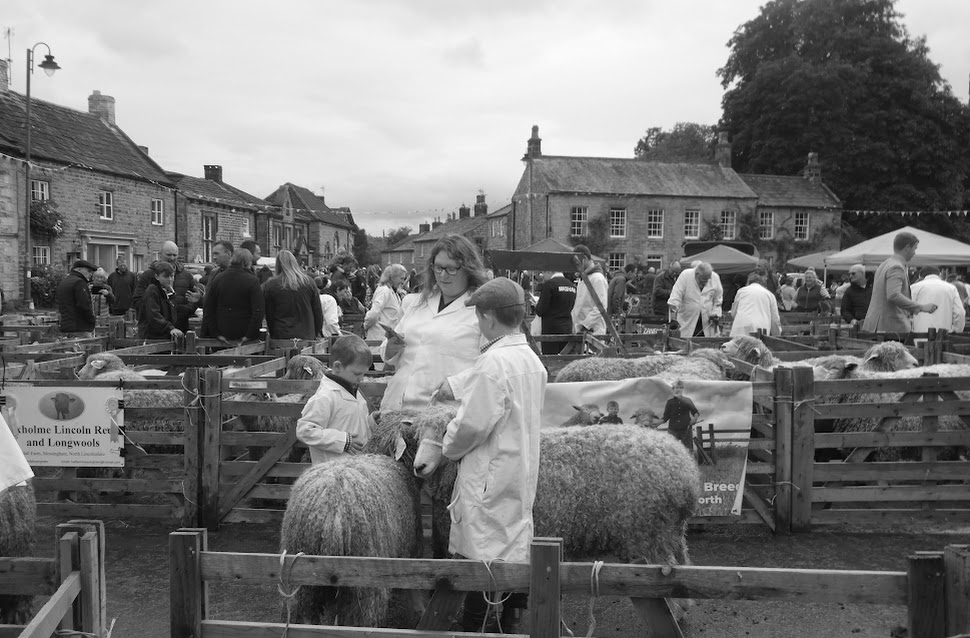
This is the Market Square on the best weekend of the year. The annual Sheep Fair.
A saddler called Mr. Stott lived in the Market Square. He was twice married and fathered 7 children, so you might think this makes him Boris Johnson’s forbear. No, he’s Jeremy Corbyn’s ancestor. His neighbour was a confectioner, a widow, a Mrs. Raper. And her sister-in-law was Miss Raper, who married the Prime Minister’s great-great-great grandfather Thomas John Johnson.
The smallest house on the Market Square. And it’s not the family seat of either the Johnson or the Corbyn family.
Both families had probably lived here for generations. Mr. Stott and Mrs Raper were certainly neighbours from before the census of 1851, and still lived next to each other when Mr Stott’s second wife Sarah died in 1871.
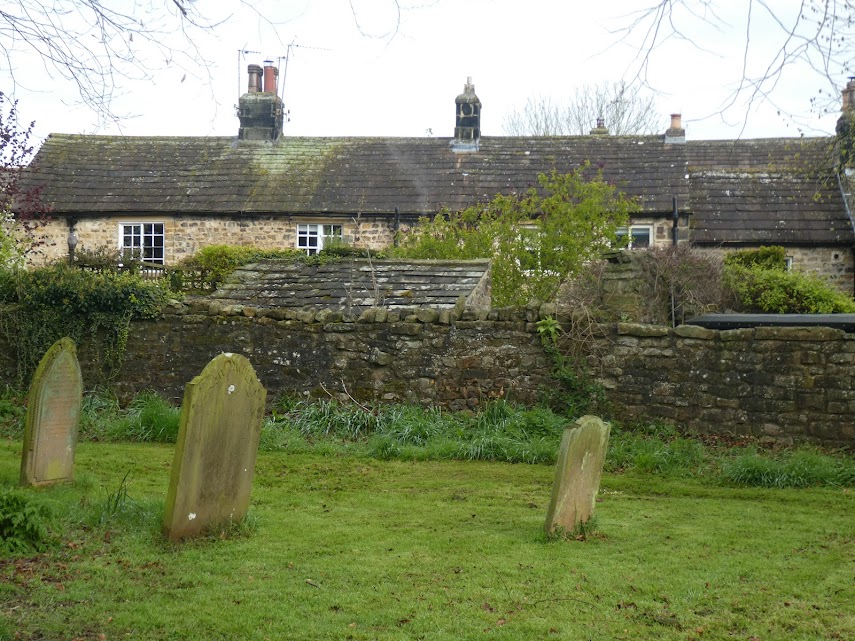
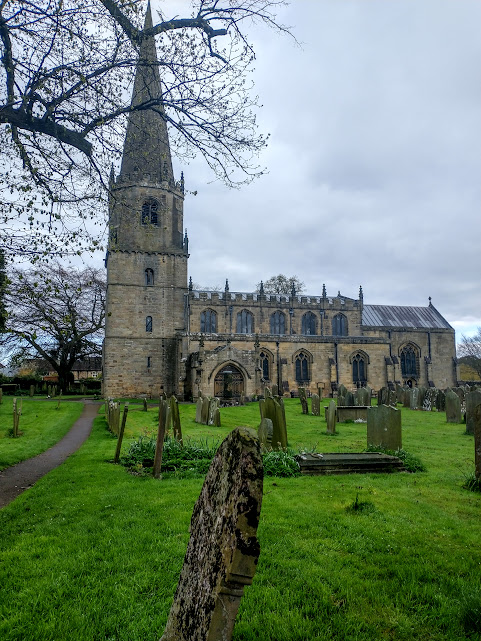
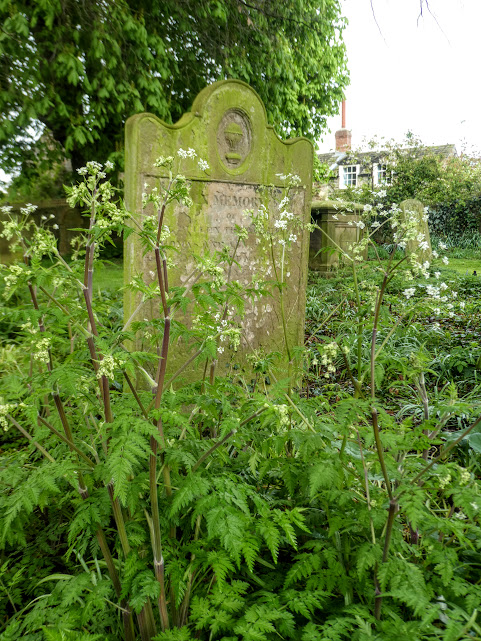
And both were buried in Masham Churchyard, though I haven’t yet spotted their graves.
*This is a reference to the BBC documentary series Who Do You Think You Are? which traces the family history of people in the public eye.
It was just five years ago this week that my whole family revealed the outcome of a Cunning Plot, months in the planning. Every single one of my chidren (three) and their partners and children conspired to get themselves to a holiday house in Catalonia, and then get me (and Malcolm of course) there too, without my suspecting a thing, to celebrate – extremely belatedly – my 70th birthday.
We had a whole weekend of catching up, of playtimes, of long lazy meals and silliness on the beach …
… and the memories will last me for the rest of my life.
For Becky’s #SquaresRenew Challenge, she’s inviting us to post square – only square – photos on the themes of Burgeoning; Moving Forward; Reconstruction; or Renewal.
Some of you know that I – theoretically – have another blog besides this one, called Notes on a Family. I say ‘theoretically’, because I haven’t posted for ages, and I should. It details parts of my family’s history, as well as vignettes about growing up as one of the immediate post-war generation, This post, from December 2016 seems particularly apposite at a time when it’s rarely been more necessary to avoid rampant consumerism.
Notes on a Family
‘Make do and mend’
The excesses of Christmas have got me thinking about my childhood, as part of the post war ‘make do and mend’ generation.
Even without rationing being a day-to-day part of my early years, we’d have been a thrifty family. My mother was a clergyman’s daughter, and priests were notoriously underpaid until quite recently. They also tended to live in large vicarages which were fine buildings, but hard to maintain and harder to heat. ‘Making do and mending’ was a core part of her life from her earliest days.
My father was a notoriously poor provider and I can’t remember a time when my parents got on well. My mother did the housekeeping and bill-paying on her income alone. She was a teacher, but until 1961, female teachers were paid less than their male counterparts. Admittedly, there was almost no job available to her that would have paid her on the same scale as a male colleague, but the assumption was that it was men who brought home the bacon. (As a little aside, my mother once failed to get a teaching post, because she referred to it during her interview as ‘a job’. Her interviewer regarded her frostily. ‘Miss Barton, teaching is not a job. It is a profession, a calling’.)
I was brought up with the following skills:
Darning:. I’m still not good at sewing, but I’m a dab hand at darning gaping holes in socks. Though actually I don’t do it any more. Even stockings got darned in those days (tights still didn’t exist).
Here are some of the contents of my sewing box. I rarely use any of these things (stocking darning thread, anyone?) but I couldn’t get rid of any of it.
Turning sheets ‘sides to middle’: when sheets wear thin in the middle, they’re split in half and rejoined with the edges towards the centre. I used to help with the cutting and tacking.
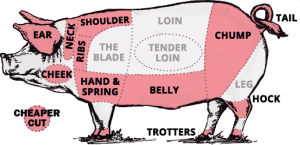
Preparing cheap cuts of meat: the meats we bought during my childhood were tougher, often bony cuts requiring long slow cooking – breast of lamb; oxtail; pigs’ heads to be transformed into brawn; skirt of beef – all helped to go further by the addition of lots of root vegetables to the pot.
Cheap cuts of pork (image from Farms not Factories)
Hand-making clothes: my mother made most of my clothes, though she wasn’t a natural. I used to help her, but I was even less gifted, and preferred choosing the cloth, and Butterick or Simplicity patterns, and pinning the pattern pieces to the cloth. I lost interest after that.
Some of the instructions from a Butterick’s pattern. I remember the occasional despair in interpreting these.
Taking shoes to be mended: shoes had to last. As there was a tiny cobbler’s shop near our house, I was usually the one that would take our shoes to be soled and heeled. With growing feet, I was the only one to get new footwear fairly regularly. And it was taken for granted that shoes would be polished every single day. I still do clean and shine my shoes – fairly often.
Baking: it was inconceivable that we would ever buy biscuits or cakes, though that was more to do with our preference for good food. Shop cakes and biscuits were pretty dire in those days. Some of my earliest memories involve cake mixing – always by hand, never with a fork or spoon – with the delicious pay-back at the end of ‘licking the bowl out’. Why do we ever cook cakes? That raw mixture clinging to the sides of the bowl is so much more appetising.
Saving anything that might have a future use:
That includes string – to be carefully unknotted, wound tightly and stored.
Gift wrapping paper: presents had to be carefully unwrapped, and the paper it came in smoothed out and ironed later. I still do this. It drives my daughter mad. (Update: September 2022: I read the other day that the late Queen also did this. If it was good enough for her …)
Saving tiny portions of food left over from a meal. I still do this too. My son-in-law used to say that it was so I could have a clear out a few days later and throw the stuff out then. He might sometimes have had a point.
The soup pot: usually those left overs formed the basis of a soup. Now, as then, there’s usually soup on the go in this house. Usually it’s based on those vegetables lurking in the crisper that really need to be used up, or something else that’s too small to make a meal in its own right. Normally known as ‘old boot soup’.
Soap: this was bought a few months ahead of its being needed, so that it could be stored in the airing cupboard, where it would dry out, and therefore last longer. I still do this.
Though I’m no longer as thrifty as my upbringing demanded, ‘make do and mend’ is a core part of me still. As I think it should be.
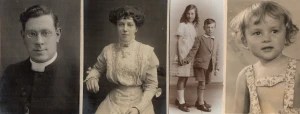
The feature photo shows my grandfather; my grandmother; my mother and her younger brother; and me, and is the banner image for Notes from a Family.
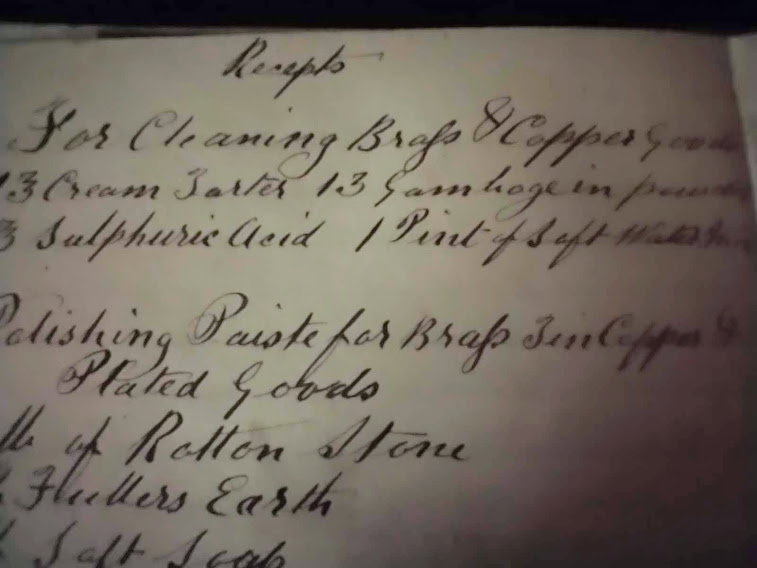
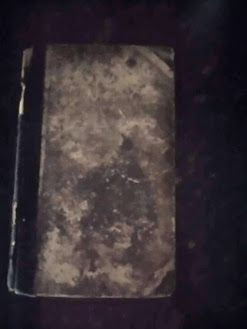
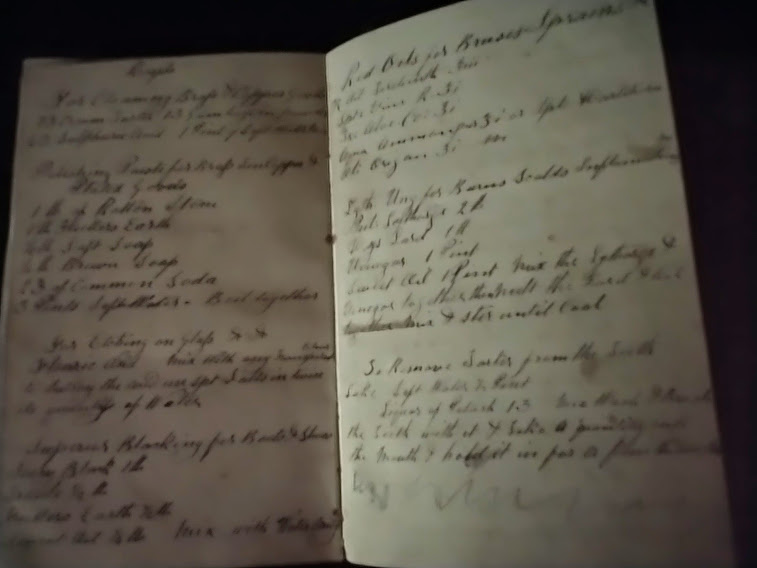
I have a very old hand-written recipe book. Not your usual sort of collection of well-loved family puddings, cakes and stews. This book, handed down from the Yorkshire/Lancashire branch of the family contains not one edible item. Instead, it’s full of tips on how to clean brass, make ink, and cure cholera. It must be very old indeed. Often the letter s is expressed as an f. I think it must date from the days before census entries from the 19th century indicate that many of my family members were involved in trade, or in reasonably supervisory positions in the textile mills. They tended to live in respectable but simple terraces houses in the likes of Batley and Colne.
Oddly, the first few and the last few pages of my little book are blank, but here’s a list of the contents:
Naptha Polish
Crimson Colour for (?) Show Bottles
Deep red
Cure for the Cholera
For Cleaning Brass and Copper Goods
Polishing Paiste(sic)for Brass, Tin, Copper and Plated Goods
For Etching on Glass etc. etc.
Superior Blacking for Boots and Shoes
Red Oils for Bruses (sic)Sprains etc.
Lyth Ung for Burns Scalds Inflammations
To remove Tarter (sic) from the Teeth
Blacking
Witworth Red Bottle
An Efficacious Receipt for the Rheumatism
The Original Family Receipt for a good Stomach Pill
A comprehensive guide for the householder, I think you’ll agree? I’ll publish a few of the recipes over the next few weeks. Now, which ones do you need?
By the way, I took these photos rather quickly, with my phone. I’ll do them the honour of much better attempts for any further posts.





 From Pyrenees to Pennines
You must be logged in to post a comment.