The I Spy Book Challenge

I  opened a new post from Bookish Beck‘s book-based blog.  She’d taken up a challenge, which she’d read about  here.  I’m hoping at least one of you may pick it up too and give it a go (I’m looking at you, Sandra...)

The idea is to take the list of twenty themes and find a book on your bookshelves that contains (either on the cover or in the title) an example in each category. You must have a separate book for all 20, be as creative as you want and do it within five minutes (or maybe a bit longer if you have too many books on too many overcrowded shelves, and you photograph them on the way).  The original challenge also contains the initials TBR, and it only later occurred to me that of course this means To Be Read.  So I’ve failed at the first hurdle, as I’ve read thirteen of my list.  Tough.

Food: Like Water for Chocolate: Laura Esquivel.  I still haven’t read this.  Put it on the TBR pile.
Transport: Stranger on a Train: Jenny Diski.  Am I going to read this?  You tell me.
Weapon: Where Poppies Blow: John Lewis Stempel  Not a weapon in the title or on the cover.  I think we can agree there were weapons involved in WWI.  This is a wonderful book putting the Great War in an entirely new context.

Animal: A Tiger in the Sand: Mark Cocker.  I love this man’s writing.  So I’ve enjoyed these essays.

Number: A Year in the Life of William Shakespeare: James Shapiro. Scholarly, readable social history.
Something you read. The Seabird’s Cry: Adam Nicolson.  There’s a reason for choosing this.  My friend Penny gave me this.  My friend Penny introduced me to Becky’s blog.  Perfect. This is a wonderful book: nature writing at its best.
Body of water: Caught by the river.  A good anthology for dipping into.

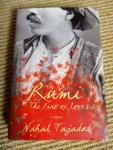
Product of fire: Rumi, the fire of love: Natal Tajerdod.  TBR.  
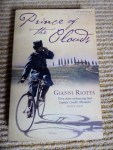
Royalty: Prince of the Clouds: Gianni Riolta.  I can’t remember if I’ve read this.  So I guess I haven’t.
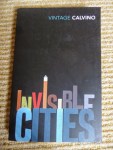
Architecture: Invisible Cities: Italo Calvino.  This wasn’t an easy read.  But it was short and stimulating.
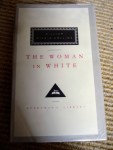
An item of clothing: Woman in White: Wilkie Collins.  It’s not an item of clothing.  But it is clothing.  And in my case, another TBR classic.
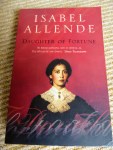
Family member: Daughter of Fortune: Isabel Allende.  How come I haven’t read this yet?
Time of day: How to stop time: Matt Haig.  A weird (in a good way!) and original time-travelling yarn.

Music: Music and Silence: Rose Tremain. I haven’t read this for years.  I know I enjoyed it.

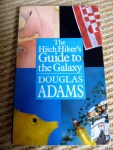
Paranormal being: Hitchhiker’s Guide to the Galaxy: Douglas Adams.  What would I have come up with if I hadn’t found this book that Tom must have left behind, all those years ago?  We used to listen on the radio together.
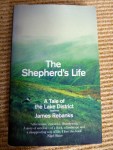
Occupation: The Shepherd’s Life: James Rebanks. A shepherd from a family whose occupation it’s been for generations.  This shepherd has been to Oxford.  He works for UNESCO. A realistic and illuminating  look at the realities of rural life in Cumbria.
Season: Hawthorn Time: Melissa Harrison.  A good story, with believable characters, with the countryside coming in at top spot.

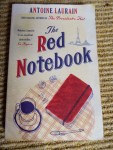
Colour: The Red Notebook: Antoine Laurain.  A vairy Frainch little mystery.
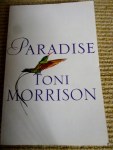
Celestial body: Paradise: Toni Morrison.  An eloquent, poetic though quite difficult book, read a long time ago now.
Something that grows: The Tulip: Anna Pavord.  Though not a tulip fan, I like Anna Pavord’s writing.  Fascinating stuff.
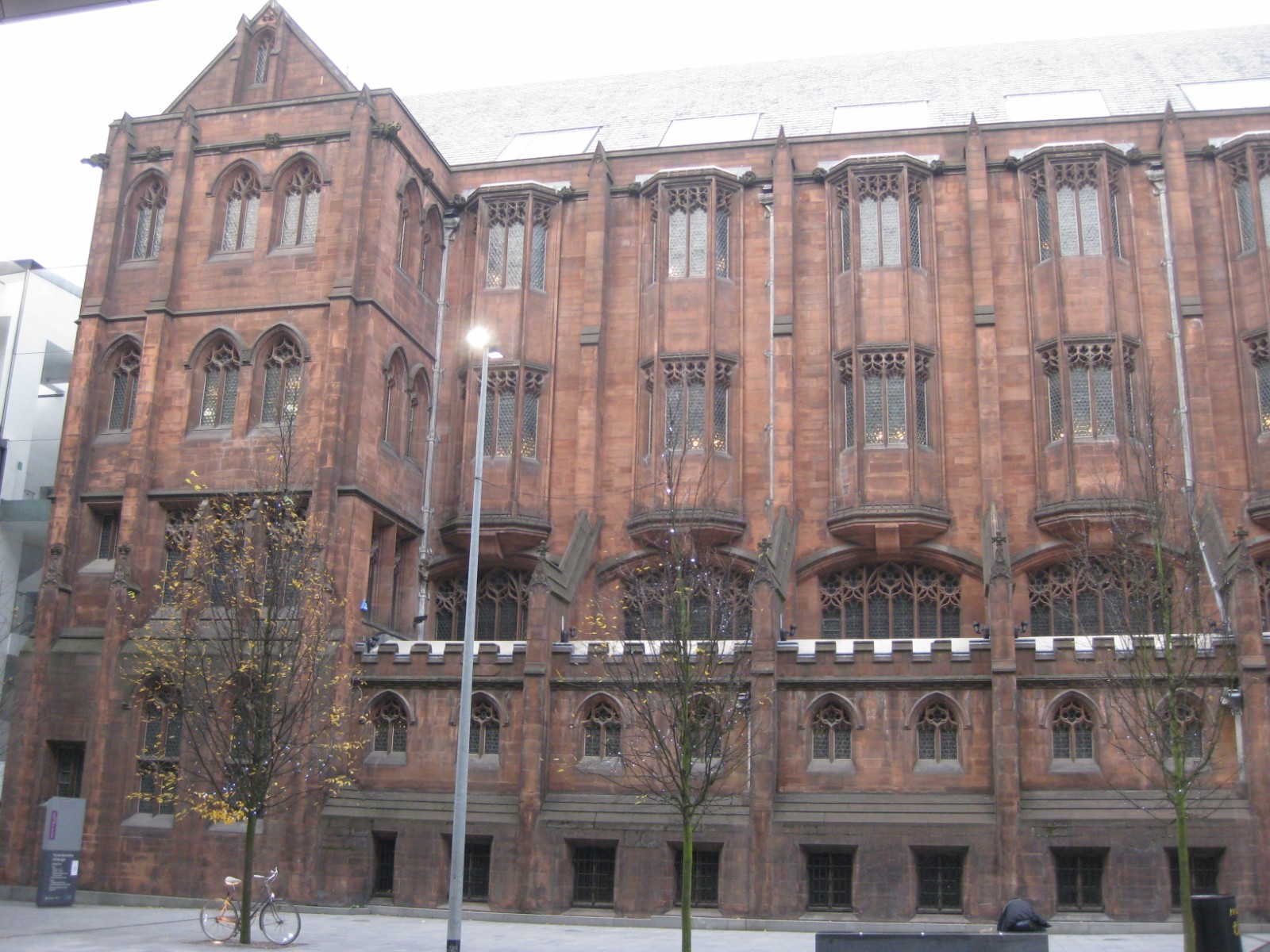
 

Our day out with John Rylands

Before we came back to France at the weekend, I wanted a day in Manchester, where I was at University more than 40 years ago.  It was a city people at that time seemed to love or hate.  I loved it then, and I still do.  It’s buzzy and busy, with galleries, music, shops, and a bravura display of civic Victorian architecture down every city centre street.

Outside John Rylands library

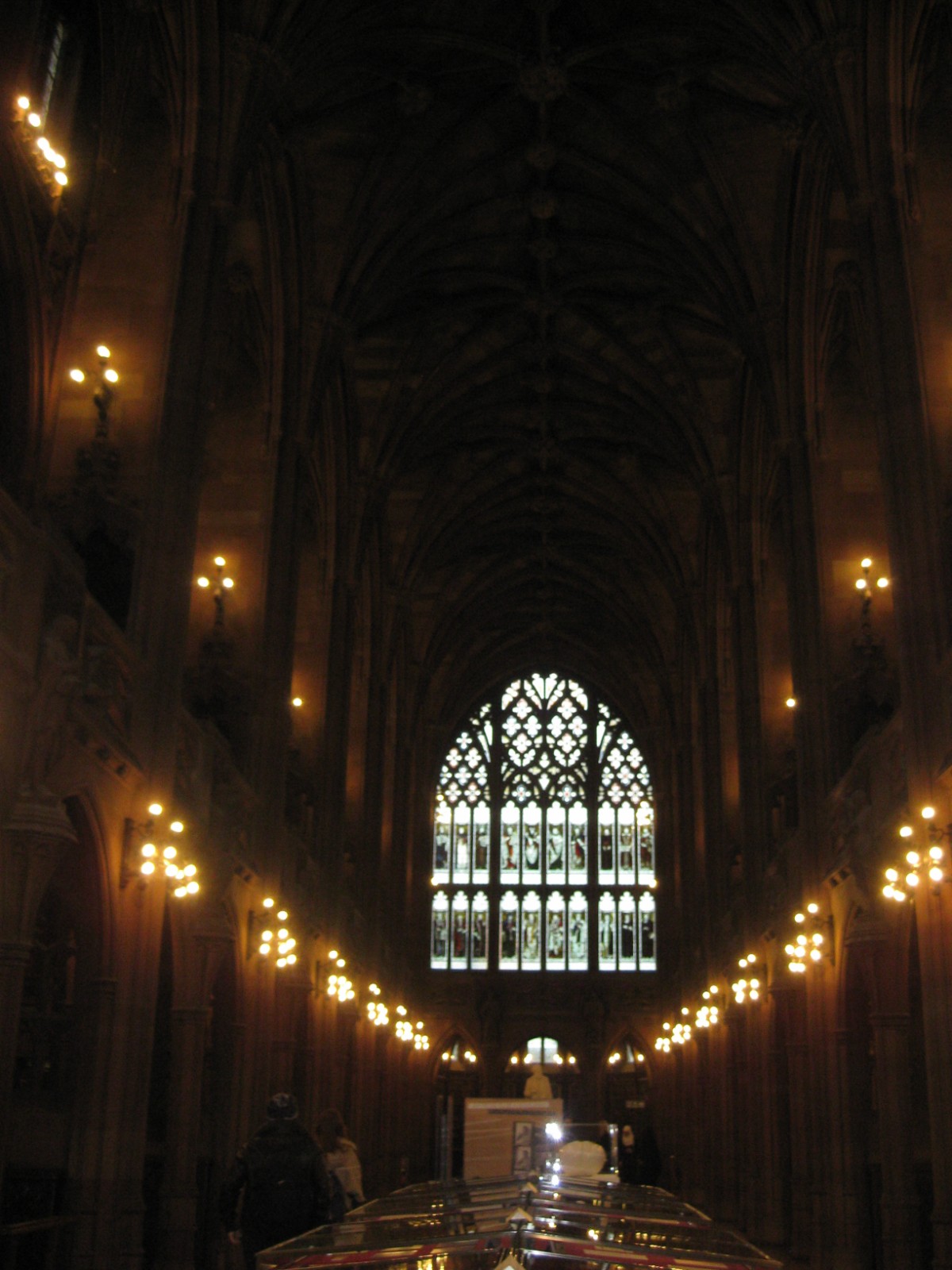
I had a particular memory I wanted to share with Malcolm.  The John Rylands Library.  I used to go there to write an essay or prepare for a seminar on those days when I wanted to pretend to some kind of scholarship that in truth was never part of my make-up.  The building was a celebration of Victorian Gothic architecture at its finest, with wonderful plaster tracery on the walls, splendid fan-vaulted ceilings, and shelf after shelf of ancient leather-bound books.  Seated in some darkened alcove, surrounded by the particular smell of the place – beeswax polish mixed with dusty books, I would work away for an hour or two, convincing myself, if nobody else, that I was getting down to the serious matter of studying in an industrious and creative manner.  Few other people would be there: there were no distractions other than the quiet beauty of the building itself.  The place was built for scholarship.

The reading room where I pretended to write essays.

It was built in the 1890’s by Enriqueta Rylands in memory of her husband John.  Although his origins were humble, he became Manchester’s first multi-millionaire, making his fortune in the textile industry as a cotton manufacturer.  At first, the library collection was modest, but over the years, has come to hold works of world-class importance: everything from the earliest known New Testament text, on papyrus, to medieval illustrated manuscripts, a Gutenberg bible, and the personal papers of the likes of Elizabeth Gaskell.

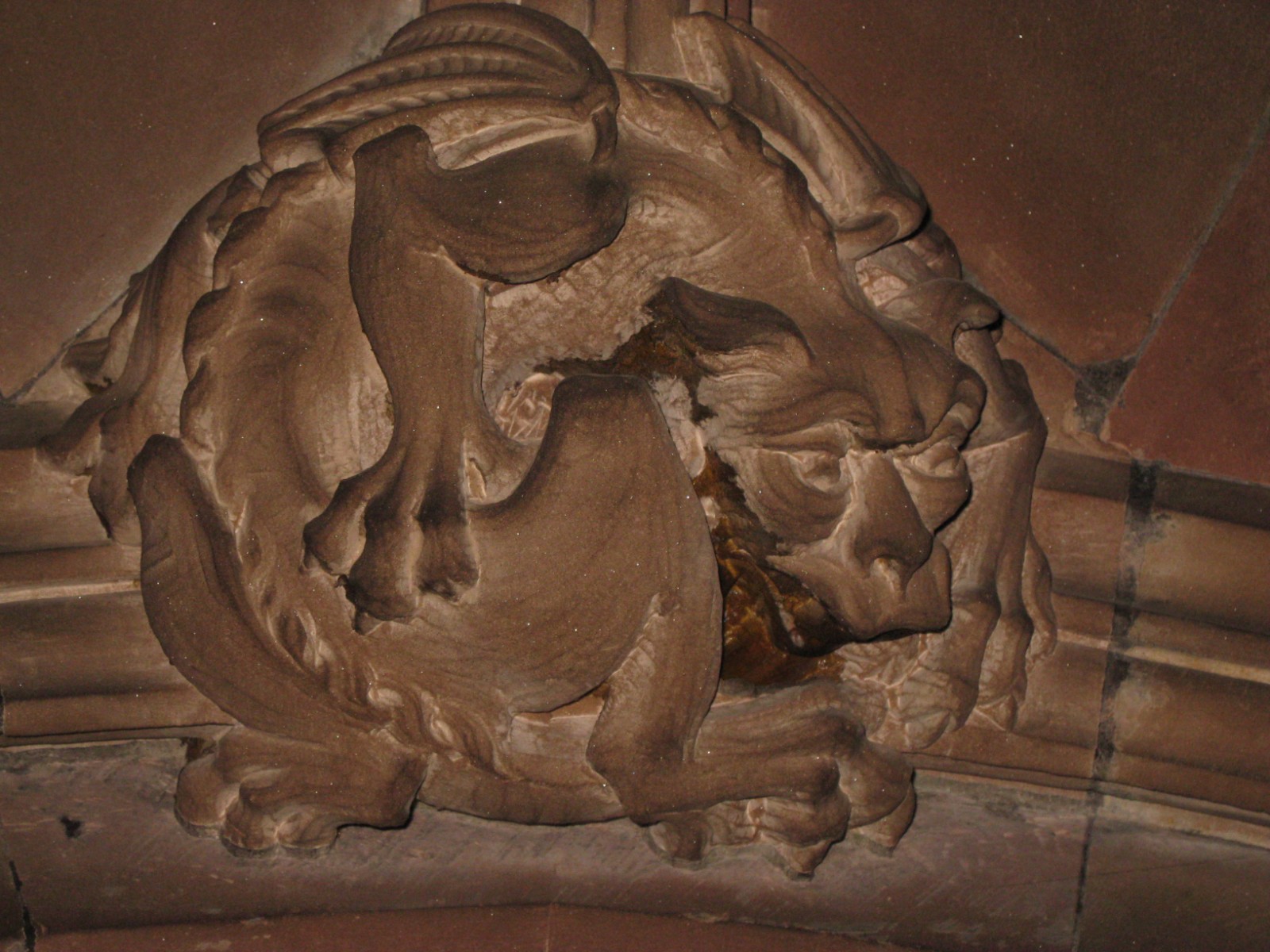
One of dozens of different fantastical creatures forming the roof bosses

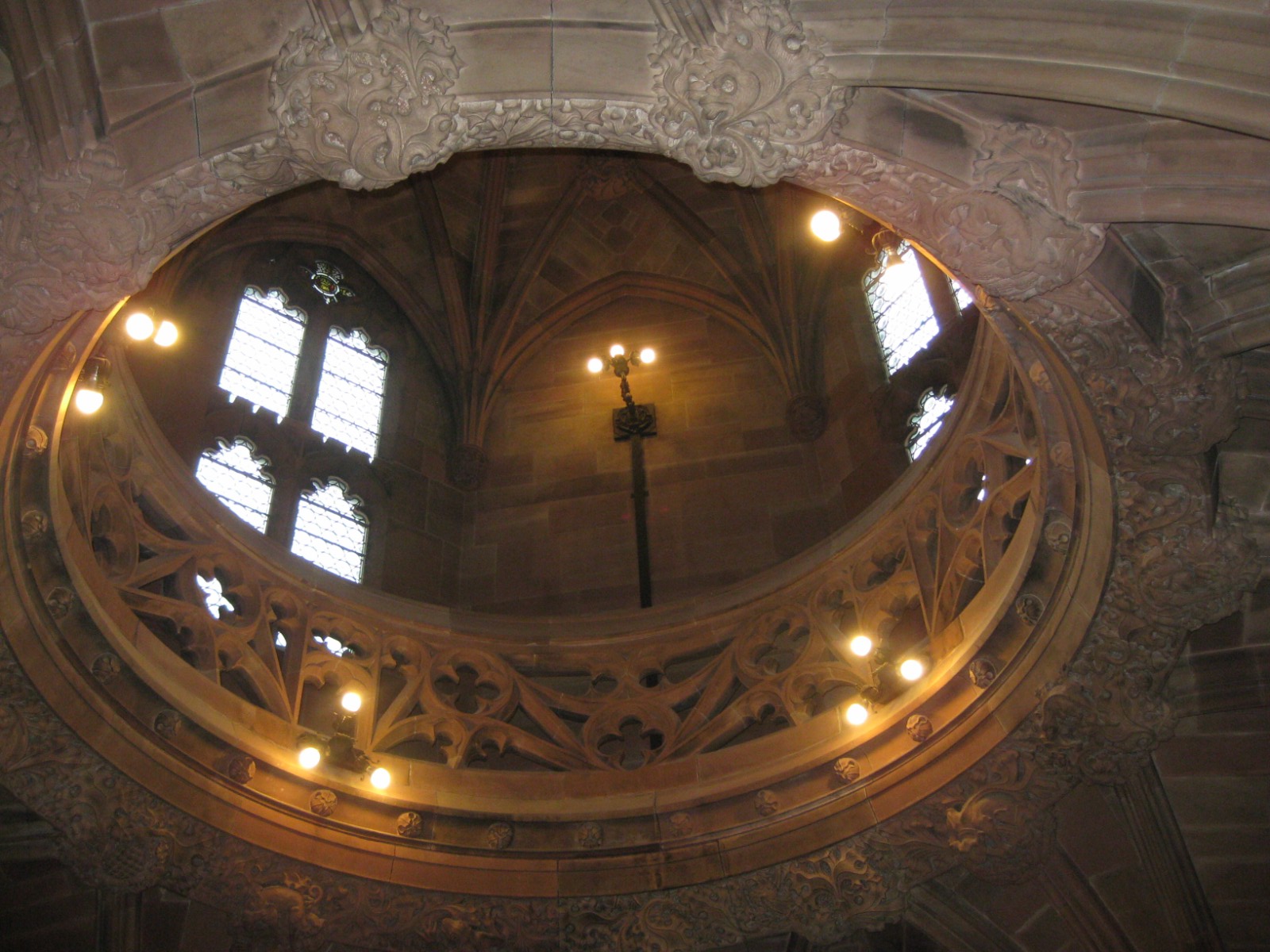
I’m not qualified to comment on the early air conditioning systems, or the electricity originally generated on site.  I simply enjoy the richly patterned stained glass, the sumptuous woodwork, the dragons encircling ceiling bosses, and the sandstones in which the building is constructed, which range from soft pink to a rich dull red.

An upward glance whilst on a staircase

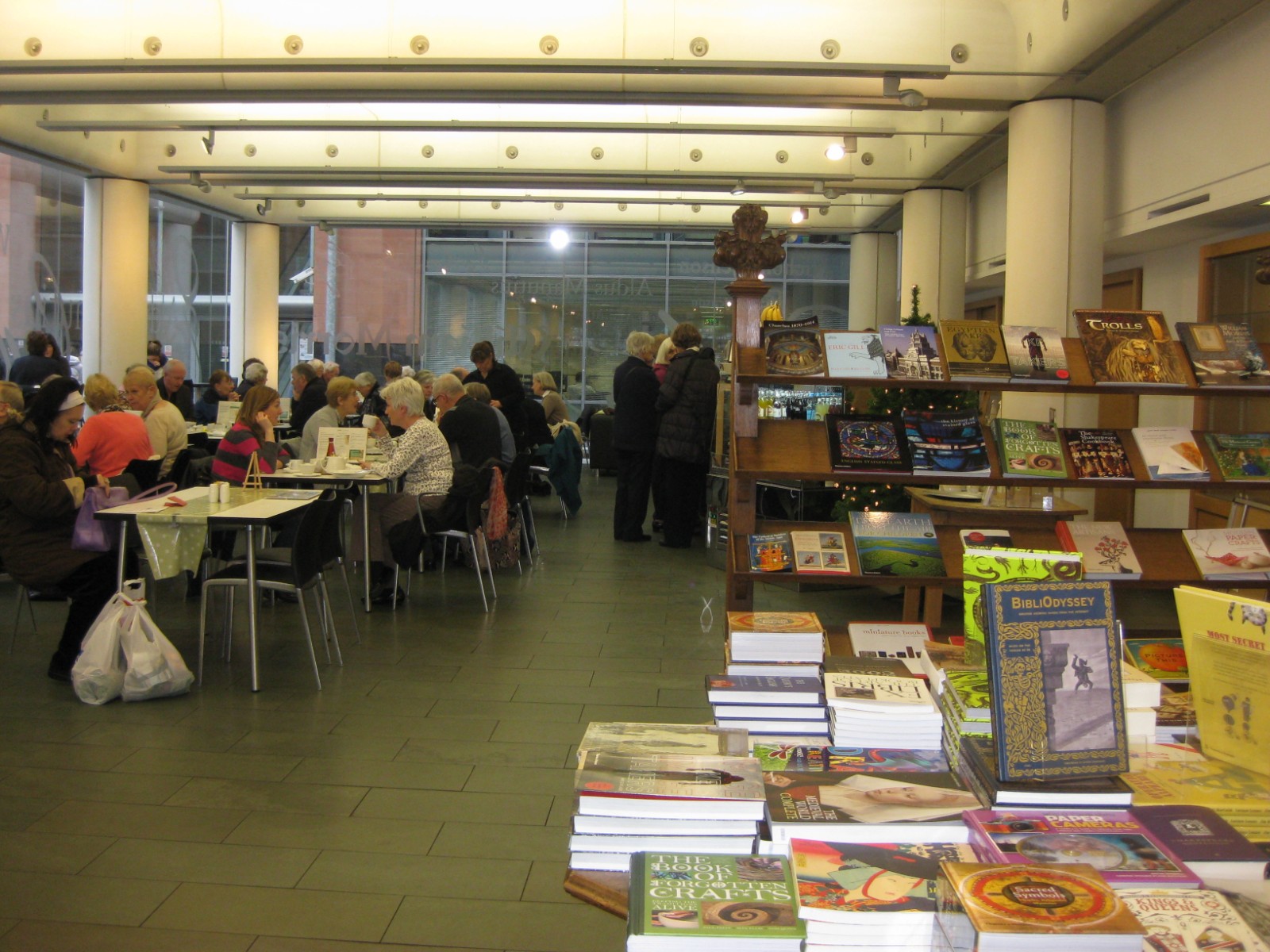
Back in the ‘60’s, I’d work till I got hungry, thirsty, or both.  Last week, we discovered that these days I’d have no excuse to leave, because there’s a modern extension sensitively joined to the side of the building.  This houses Café Rylands, where we had our lunch, made from locally sourced produce; a bookshop which, though small, presented us with fascinating choices, from architecture and design books to children’s stories; and an almost irresistible gift-shop.  It has an energetic and exciting programme of educational events, and I wished we could have signed up for some of them.

Café Rylands and the book shop

When I was a student in Manchester, the library was little known outside academic circles.  Now it’s a different story.  John Rylands Library has been made  Manchester’s ‘Large Visitor Attraction of the Year’ at the city’s annual tourism awards.  You could spend happy hours here, exploring the building itself, the exhibits, and making frequent sorties to the coffee shop for a relaxing break and browse through the papers.  And apart from your spending money, it’s all free.

Drop a coin or two into the donation box, and the automaton will go through its paces