When I showed you all the fun to be had at Masham Sheep Fair in Monday’s post, I included a couple of shots of dancers. Dancers who really didn’t give of their best in black and white. These are the 400 Roses.
They’re a group of women dancers from West Yorkshire. They’re folk dancers. But it’s not as simple as that. They combine Morris dancing with – yes – belly dancing, with a nod perhaps to steampunk. Their gloriously extravagant red, black and white costumes feature – among other things – red and white roses to celebrate their Yorkshire and Lancashire origins . Those of you who are not from these parts may not know that the red rose is the symbol for Lancashire, the white rose, that of Yorkshire. The Red Roses are accompanied by their energetically engaging band t’Thorns. Come and have a look.
And a close-up of the skirts of their dresses, every one different.
I couldn’t resist two black and white portraits though: one of a dancer, one of a bandsman.
And even one of the cheerful bags that accompanied them to where they were dancing.
Thank you, 400 Roses. We’ll come and watch you now whenever we can. I think you enjoyed yourselves as much as we your audience did.
Just over a week ago, I showed you an image of Masham gearing up for its annual Sheep Fair. It’s a weekend when the town itself is on display, and sheep in their hundreds turn up to be examined by judges who come from all over the kingdom and beyond to this special event. We go without fail. Our first visit had us astounded at the sheer variety of types of sheep on display. At other times we’ve focused on watching sheep dogs doing what they do best … herding … ducks.
So I have photos by the score. This year, then, I thought I’d limit myself to black and white. I’d look for sheep on display, the humans who handle them, some as young as five years old. I’d look at dancing displays, at those sheep dogs, and at humans also worth a second glance. And show them to Ann-Christine, and to you, for this week’s Lens-Artists Challenge: On Display.
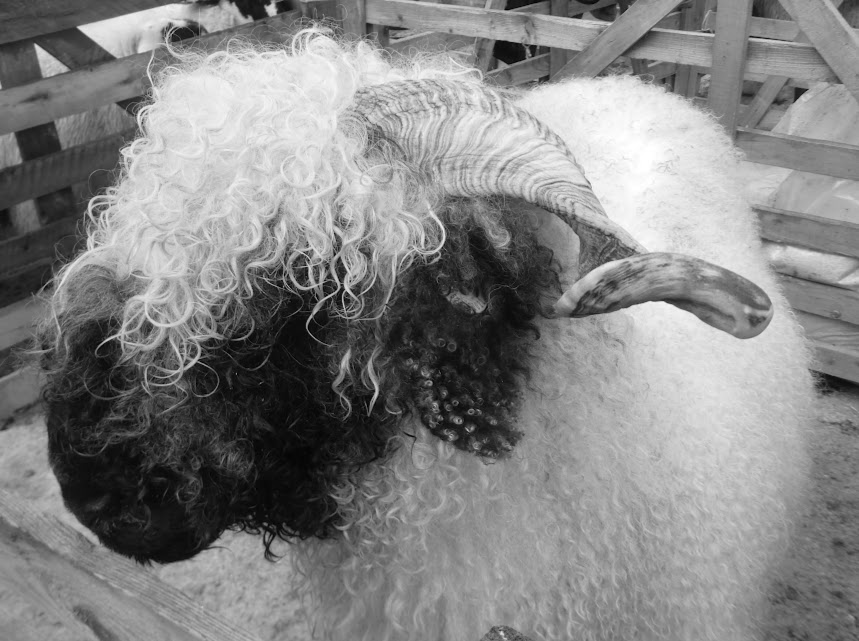
Sheep first then, of course…
… then their handlers…
… then there were dancers. You can see they’re not happy putting up with black and white photos. We’ll revisit them another day in glorious technicolor.
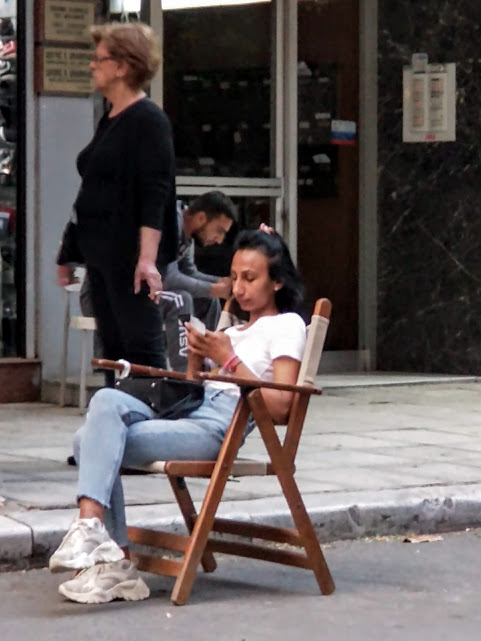
There were the passers by…
… and not forgetting the duck-dog.
And after that the walk back through the town, through fields of sheep who’d somehow dodged presenting themselves in town to the car, parked in the Nature Reserve car park.
I’m offering this to Jo as a Monday Walk too. Of course the WI had tasty soup and home-baked cakes on offer. We scoffed everything down without thinking even once of the photo-opportunity they represented.
On the first Saturday of every month, a book is chosen as a starting point and linked to six other books to form a chain. Readers and bloggers are invited to join in by creating their own ‘chain’ leading from the selected book.
Somehow, I didn’t read I Capture the Castle by Dodie Smith when I was younger. And I’ve only just managed to source a copy, so I haven’t read it in time for Six Degrees. This is how it’s introduced in Goodreads. ‘Through six turbulent months of 1934, 17-year-old Cassandra Mortmain keeps a journal, filling three notebooks with sharply funny yet poignant entries about her home, a ruined Suffolk castle, and her eccentric and penniless family. By the time the last diary shuts, there have been great changes in the Mortmain household, not the least of which is that Cassandra is deeply, hopelessly, in love’.
That seemed to chime with a book I’ve just finished, Natasha Solomon’s Fair Rosaline. This is a re-interpretation of the Romeo and Juliet story from the stand-point of bit- character Rosaline. To be fair, the story of bereavement, infatuation, love and bereavement again zipped along, but even as a page-turner, the narrative quickly became increasingly unbelievable. The characters were something of a caricature and the language veered unconvincingly between the Shakespearean and more modern idiom. If you want a reasonably page-turning beach read, this could be for you. I made the link to our starter book because Rosaline could well have lived in a castle (though she didn’t). And she falls hopelessly in love.
One thing you’ll notice if you read Fair Rosaline is that a fair few characters die. So my next book is A Tomb with a View, by Peter Ross. This is an evocative, delightful and thought-provoking book. Yes, it’s about death and burial. But the variety of cemeteries, ways of remembering the dead and rituals Ross explores is astonishing. He’s clearly a sympathetic man to have around, and historians of ancient cemeteries, gravediggers, Muslim celebrants, natural burial enthusiasts, proponents of The Queerly Departed all willingly open up to him and bring their own special Final Resting Place to life. He visits graveyards, charnel chapels, cemeteries and so much more, animating them in a delightful tribute to these sites and those who work there and care for them. A book to read with – yes – enjoyment.
From death, to near death, in Maggie O’Farrell‘s I Am, I Am, I Am. This is not an autobiography, but a non-chronological exploration of the author’s 17 (seventeen!) brushes with death, each episode named for a different part of the body. Attacks at machete-point, nearly-road-accidents, a dreadful experience of childbirth: all these and more are graphically and tenderly brought to life. Most affecting is the last quarter of the book, where she describes her own debilitating and long-running experience of the after-effects of a virus: and then her daughter’s even worse experiences. It’s compelling, sometimes angry, often visceral. She’s graphic at describing pain, fear, despair. Impossible not to experience at least some empathy for O’Farrell and her experiences. And yet she’s still here, bringing her experience to bear on her other work, in which she brings fictional characters and their dramas to life, informed no doubt by her own experiences.
And now from one non-chronological memoir to another: Sandi Toksvig’s Between the Stops. Marvellous. I was suspicious of a book written by something of a National Treasure. It would play to the gallery, surely? I was wrong. This is part memoir, part political polemic from someone whose views I’m happy to share, part social commentary and part Interesting Facts About London and the many places she’s called home. She uses the device of a journey on her most familiar bus route, the Number 12 from Dulwich to central London to gaze out of the window and use the memory triggers she finds as she observes the scene there, or among her fellow passengers to introduce the story of her life in America, Denmark and England. She’s witty, compassionate, angry and introspective by turn, and always amusing, often laugh-out-loud funny. I loved this book.
My next choice also uses London as a starting point. The End We Start From by Megan Hunter is a powerfully unsettling novella. Here is a world descending into chaos and uncertainty just after the ‘author’ has given birth, in London. This is the story of a fleeing into the unknown from a city that’s no longer functioning following an unspecified apocalyptic disaster. Sparingly and beautifully written this is a short, eloquent and potent account of one woman’s fall-out from a not too unlikely future catastrophe. But one which does not finish on a note of despair, but of love.
Lastly, let’s go back to the 14th century: a time when England, like much of Europe, was turned upside-down socially by the predations of the Black Death, as well as by war, and it must have felt like the end of the world. Barry Unsworth’s Morality Play. Nicholas Barber, a young cleric who has abandoned his post and fallen in with a band of itinerant players tells his story. What brings this story its power is its power to immerse the reader in the life he’s – at least for the time being – chosen. This band of players live from hand to mouth, often cold, always dirty, always on the move and wondering where the next meal and billet is coming from. But they devise the idea of re-enacting a shocking murder that has just taken place in the community in which they find themselves, and discover that all is not as it seems. And add fear of the more powerful to their list of worries. An immersive tale, bringing the sights, smells, sounds, and mores of the 14th century to life.
Well. We have wandered about a bit. Each book links, if tenuously, with the next: but there is no common thread running through these choices.
And next month, Kate invites us to read as our starter book Western Lane by Chetna Maroo. Are you going to join in the fun?
Britain is one of the most nature-depleted countries on earth, according to the fourth State of Nature (SON) Report, the product of a collaboration of environmental NGOs, academic institutions and government agencies, including Natural England. Depressingly, England, Wales, Scotland and Northern Ireland are on the edge, as far as much of the natural world is concerned.
Look at the featured photo for instance, taken on one of those in-glorious-technicolor days of high summer, with an impossibly blue sky, and fields of golden wheat just waiting for harvest. It really shouldn’t be like that. There should be poppies, cornflowers, wild flowers in general poking their heads above the crop. There should be generous field margins and hedges, offering home, food and shelter to whole varieties of insects, small mammals and birds. Where can all this wildlife call home these days? Many of them are on the very edge of sustainability. Here’s another field, even nearer to home, equally mono-cultured.
Part of the Sanctuary Way path skirting the edges of Ripon.
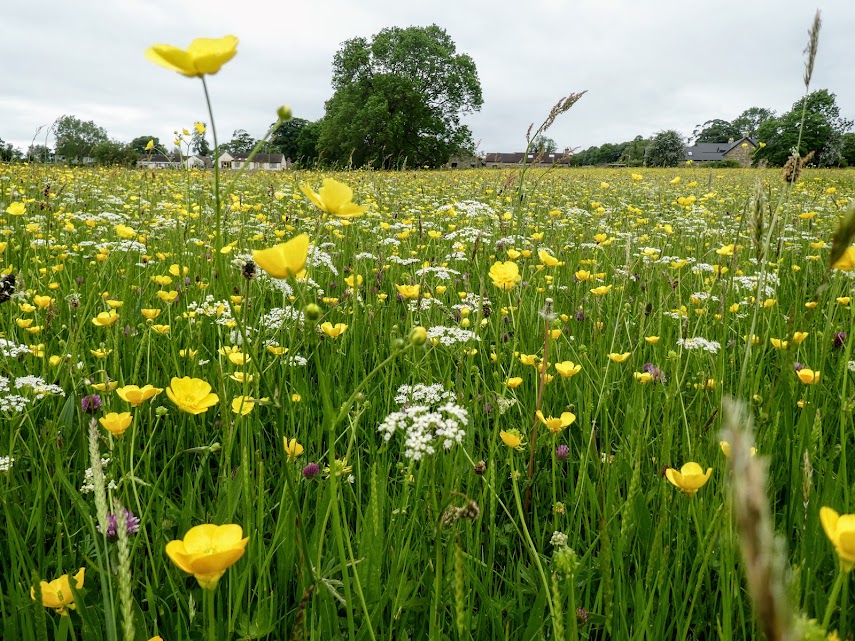
These days grass grown for hay-making as winter feed is just that. Grass. Meadowland used to be so different, crammed with wildflowers that made much richer, more interesting fare for the cattle that rely on it as winter feed. And a mecca for insects : all-important bees among others – during its growing season. These days, it’s so rare that it’s not just meadowland, but a Site of Special Scientific Interest.
Rock House Farm, Lower Wensleydale, and one of its SSSI meadows.
The farms nearer to our house have chosen to make do with narrow jumbles of poppies squeezed into narrow field margins, or at the edge of paths.
Poppies find a quiet corner along a field in West Tanfield.
See these? These are swallows on a telegraph wire in mid-September one year recently, assembling prior to their big autumn migration. It didn’t happen this year. Swifts and swallows are on the edge of viability here, from habitat loss.
Waiting to depart on that journey to Africa
Let me show you something all-too common though, both in town and country. Litter. These images are hauls from litter-picks we’ve done not just in town centres, but down country lanes. Everything from a carelessly-tossed can to rather toxic rubble and waste illegally dumped in a hedge margin. Not just an eyesore, but habitat-damaging and a danger to the many small species that call such areas home.
This is meant to be a photo challenge, not a diatribe, so I’ll leave it there. There’s a lot more I could say, but I don’t have the images to support the argument. It’s for Patti’s Lens-Artists Challenge #269: On the edge. And it was inspired by Susan Rushton’s post for the same challenge. If you pop over and read it, you’ll see why.
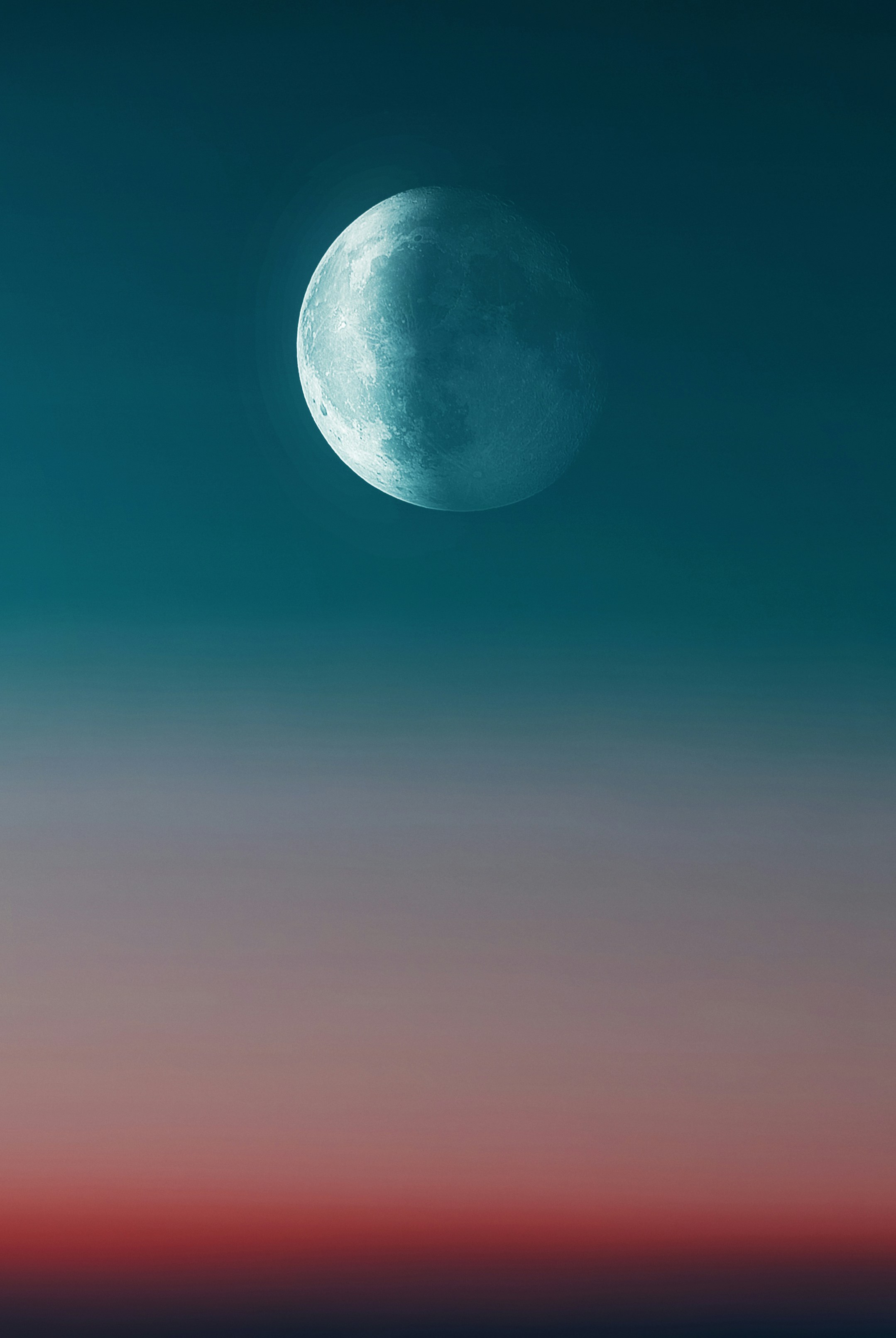
This week, for Denzil’s Nature Photo Challenge, we don’t have to worry where we live. The moon shines upon us whichever hemisphere we live in – whether we’re townies or country mice. So here are my moon shots, mainly from England and Wales… some of them may resemble yours, even if you’ve never visited the UK.
March in SleningfordMay in Alnmouth NorthumberlandOctober in Sleningford.
And here’s a selection of waxing moons, waning moons, all over the place.
I popped into Masham on Friday afternoon, and found they were already pretty much prepared for this weekend’s annual Sheep Fair. More of this soon, when I’ve downloaded yesterday’s camera photos from this Must-Visit event. Friday’s phone photo offers a preview.
The other day, when I posted some of my favourite photos for Tina’s Lens Artists Challenge, I included a view from my room in the quiet French quarter of Pondicherry of builders with their bullock cart full of bricks . Here’s another snapshot from that same room. It would win no prizes in any exhibition, but it’s special to me.
Sleep eluded me in India. One night, I was watching, as I often did, the street cleaners – all of them women – sweeping the streets with the kind of brooms we expect witches to fly around on, exchanging light-hearted chatter. At about two o’clock, they sat themselves in a convivial circle in the middle of the street, produced their snacks, gossiped, laughed and generally gave the appearance of contentment and good cheer.
Doubtless they could never have afforded my simple hotel room: nor could they have dreamt of travelling half way round the world on holiday. Yet they seemed at ease and content. I hope so.
This week, for the Lens Artists Challenge, Tina invites us to show off ten of our all-time favourite photos. Not only must we explain why we like them, but they have to be technically top-hole too. I can’t do it. When an image is freighted with memories, whether happy or exciting or astonishing, unpicking these from technical considerations is something this snap-shot-ist can’t do. I shall be disqualified. I can live with that.
I first ‘needed’ a camera when I had the chance to spend a month travelling in India in 2007. I was even more point-and-shoot than I am now. Here’s just one memory, taken from my hotel window in the French quarter of Pondicherry (as it was then called), Builders, both men and women, unstacking their consignment of bricks to begin their day’s work at 6.00 a.m. Some of my best memories come from staring out of that window: such as the women who cleaned the streets at night, sitting right in the middle of the road at 2.00 a.m. cheerfully chattering during their break.
Delivery from the Builder’s Yard
By then, we were already living in France. How to pick just a few shots from that period? Let’s have a go. I’ll choose pale and delicate wild daffodils in the mountains just outside Foix, in such profusion it was almost impossible to avoid treading on them. I’ll choose pristine snow, many feet deep, just waiting for a Sunday snow-shoeing outing. The only sound was the snow itself, squeaking softly as we trod it down with our raquettes. I’ll choose a dramatic , never-repeated sunset which glowered over our small town one spring evening.
And sea-voyages. We’ve had a lot of those – back and forth to France when we lived there and came back here often to see family. Nowadays it’s because we need to get to Spain where my daughter and her family live. There’s often a dramatic skyscape.
Sunset near Santander
And now North Yorkshire’s home, with its stone-walled Dales, its meadows and hills, its autumn fogs.
And then there’s Fountains Abbey, where I spend so much time volunteering. Can’t leave that out. We’re just coming into autumn, which may be my favourite season there. So the Abbey in Autumn in my featured photo.
So these are my choices today. Yesterday I might have chosen differently. Tomorrow I’d choose other shots.
PS. Can anybody tell me why WP is no longer always allowing me to centre my photos?Or – now that WP have made it impossible to comment directly onto a post, how to comment on a post that’s more than a couple of days old, such as Tina’s one about this challenge, and which is no longer reachable on the Reader?
Denzil, in this week’s Nature Photo Challenge, asks us to hunt for spiders and their webs – something that it’s easy to do at this time of year in Britain. Only yesterday, a huge specimen was standing guard over the shoe-rack. But by the time I’d got my camera, he’d vanished. These then, are all archive photos, and unidentified. Helpful suggestions welcomed.
The first one is from India. Perhaps I J Khanewala can help? And the second is also not from England, but from La Rioja in Spain.
The third is from Masham Parish Church, and it’s dead. Is it even a spider?
For the rest, I offer a gallery of webs, mainly taken on misty moisty mornings, or in fog, lending them a mysterious and often ethereal quality.
These were taken in Dumfries and Galloway, in Cairnsmore of Fleet National Nature Reserve. As is the header photo.
The next group come from just down the road, near Sleningford Hall.
And lastly, we return to India, where a tunnel spider has made his complex lure.
You must be logged in to post a comment.