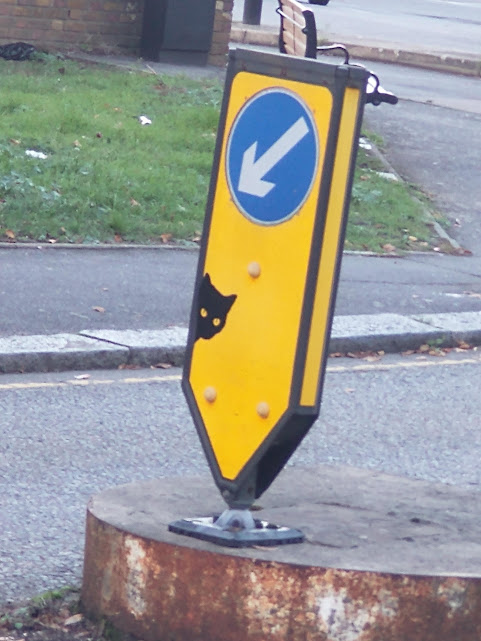
For Debbie’s One Word Sunday. And for once, I have no words. Unless you count the post title.
Author: margaret21
I'm retired and live in North Yorkshire, where I walk , write, volunteer and travel as often as I can.
Statuary for Small People to Enjoy
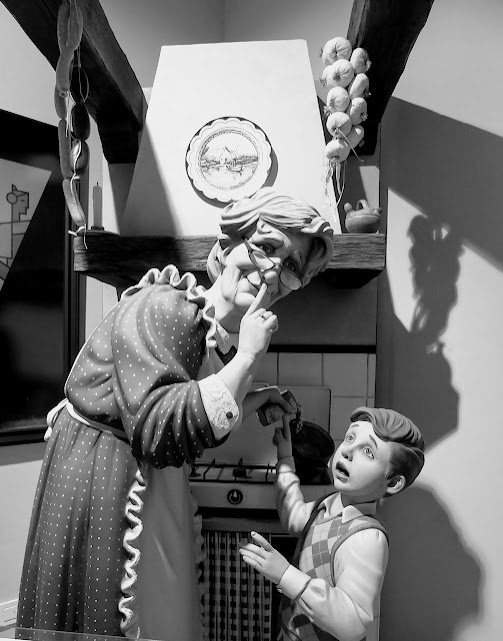
Monochrome Madness this week asks us to feature statues. I could show you Michelangelo’s David. I could feature statues of The Great and The Good, as featured in all big cities everywhere. Or Nymphs and Greek Gods from set-piece fountains everywhere. But I’ve decided to go low-brow and show you pieces destined to appeal to children, or adults in search of their inner child.
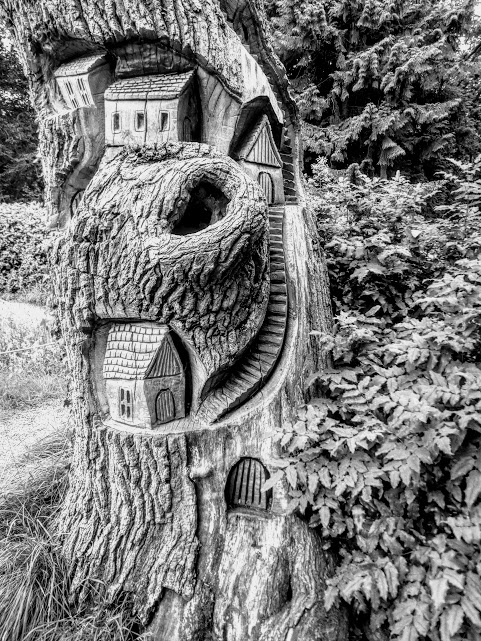
Let’s begin at the Arboretum at Thorp Perrow.
Then we’ll stay local and inspect the Alice in Wonderland characters you’ll find in Ripon Spa Gardens. Lewis Carroll spent part of his childhood in Ripon, because his father was a canon at the cathedral here.
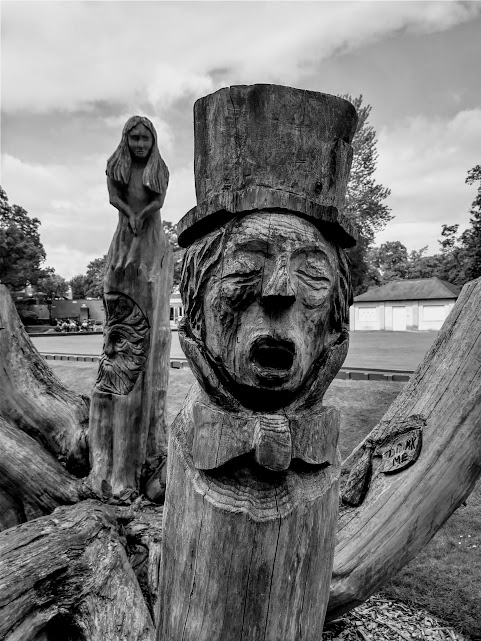
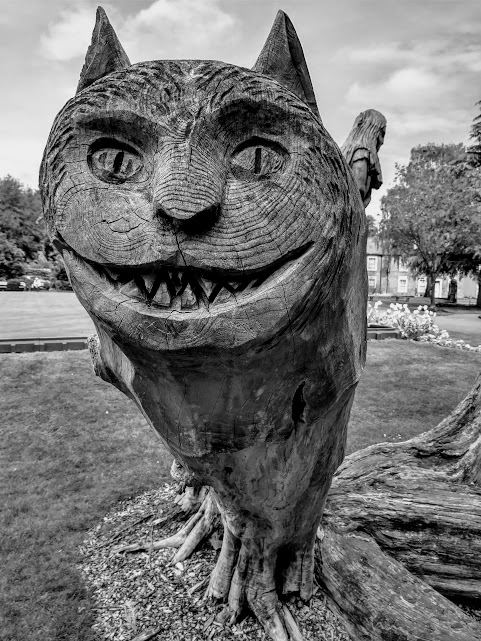
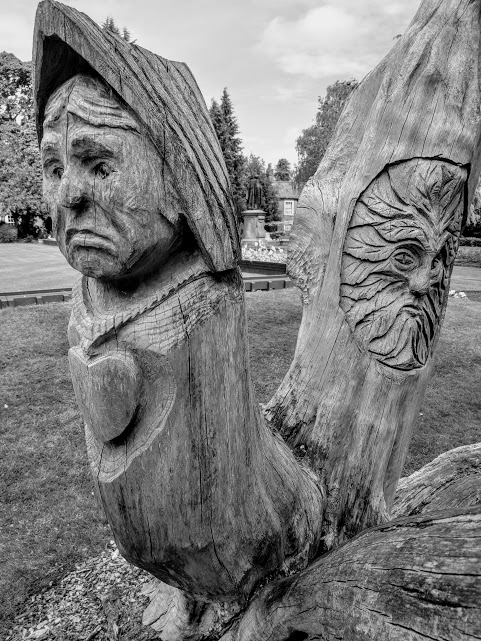
I hope you recognise the Mad Hatter, the Cheshire Cat and the Queen of Hearts.
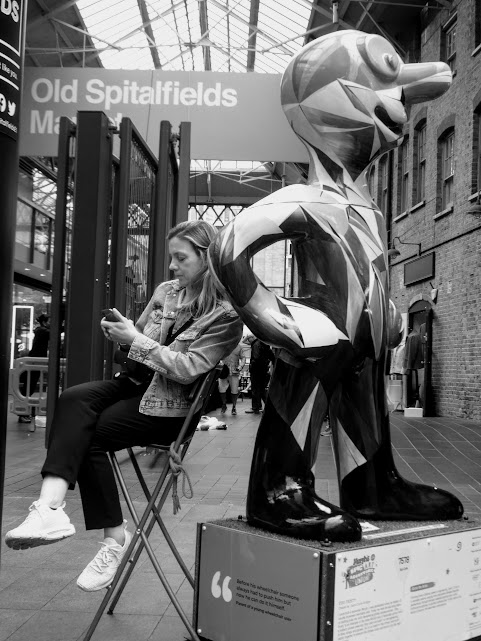
Then there’s this fellow, part of a sculpture trail promoted recently in London by the children’s charity Whizz Kidz.
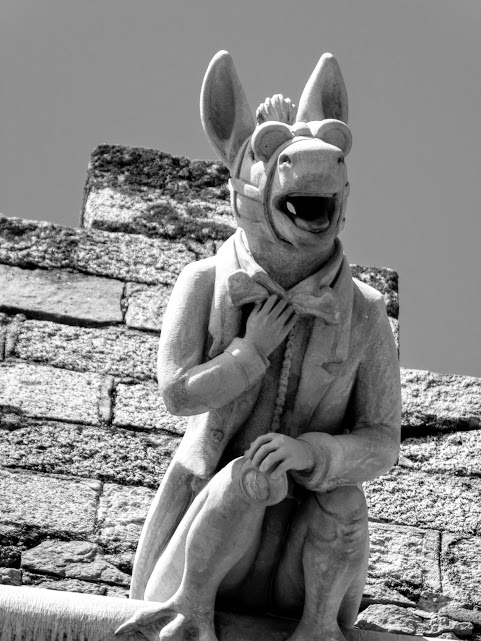
Here are some gargoyles, not necessarily designed for children, but certainly appealing to them: from the Hospital de Sant Pau, Barcelona, and the Església de Sant Julià in Argentona.
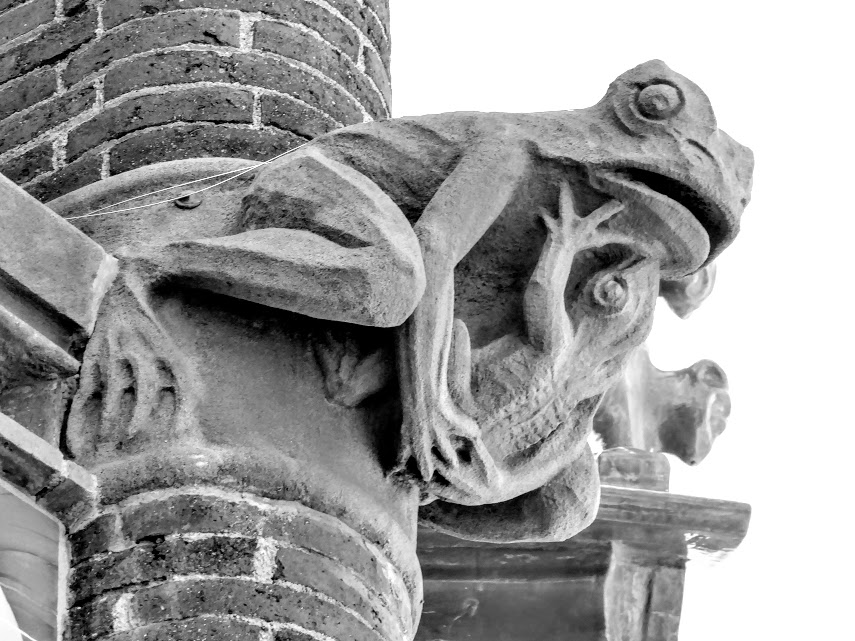
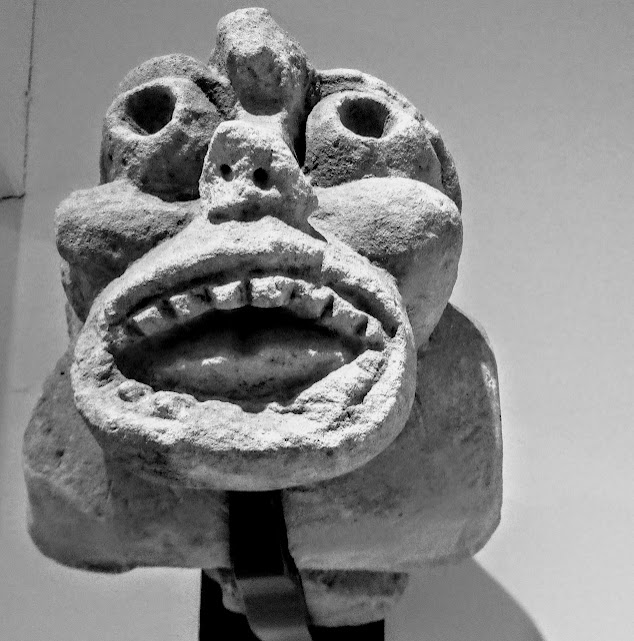
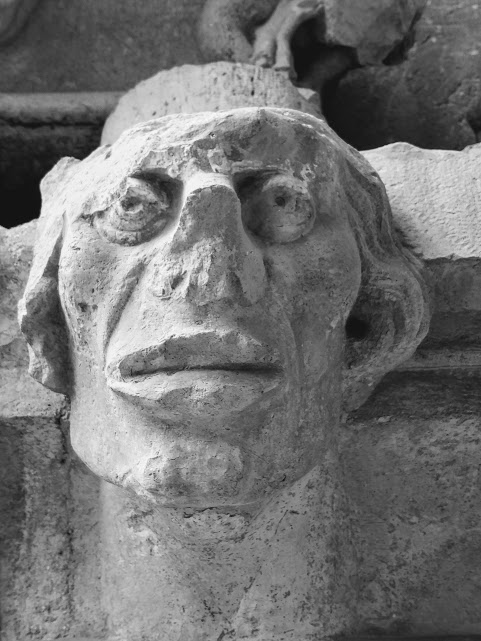
Monks and the Christian faithful – or certainly the masons working for them – generally weren’t above fashioning satisfyingly scary pieces. Here are two battered relics: one from Rievaulx Abbey, and the other from Rheims Cathedral.
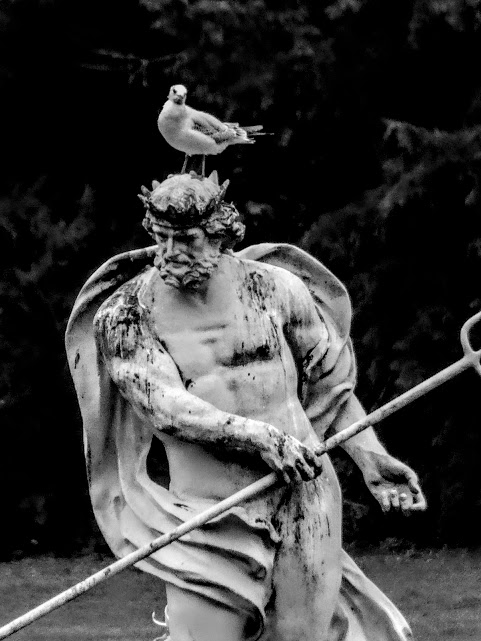
My last image isn’t of a statue designed to be amusing. But Neptune at Studley Royal always makes me and any children I happen to be with laugh when the poor fellow is sporting a seagull headpiece.
And my feature photo? Are they even statues? Well, I don’t know what else to call these two. They’re from Valencia’s annual Fallas Festival, where humorous figures, originally made of wood, are toted round town in March each year to celebrate the arrival of spring.
For Leanne’s Monochrome Madness, hosted this week by PR, of Flights of the Soul.
And Debbie’s Six Word Saturday.
And Natalie’s Photographing Public Art Challenge (PPAC).
Getting in Touch with Our Inner Child
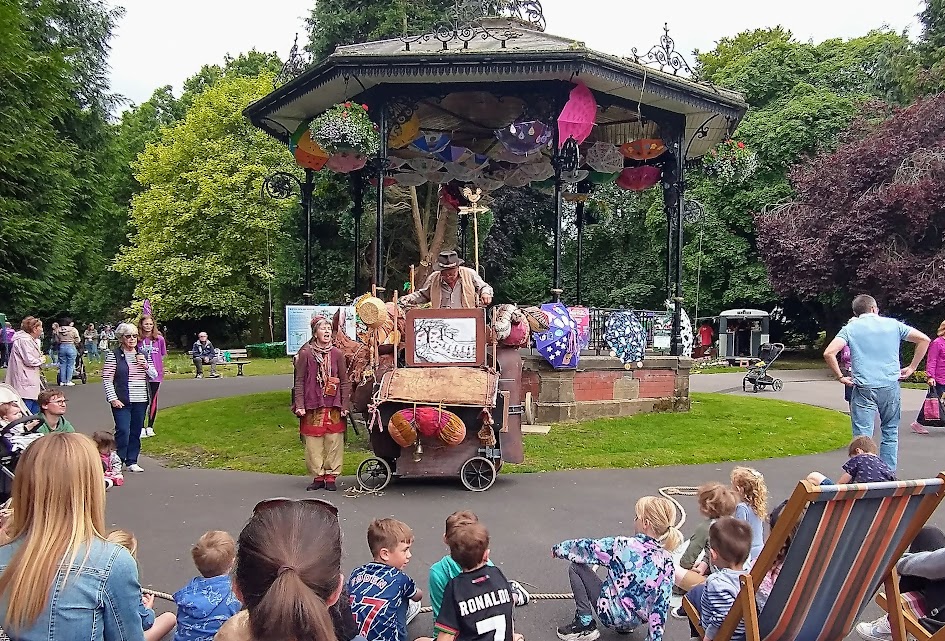
It was Ripon’s third Theatre Festival last week, and the weekend was to be given over to the streets and the park for theatre-in-the-street. The first two festivals had been sunny, warm, and everything good the weather could offer. Last weekend’s forecast was unremittingly vile. Rain, wind, thunder … everything you don’t want. Ripon’s luck had run out.
Except it hadn’t. Apart from one short sharp shower in the middle of Sunday, the weather was – sunny, warm enough, and everything anyone could have wished for.
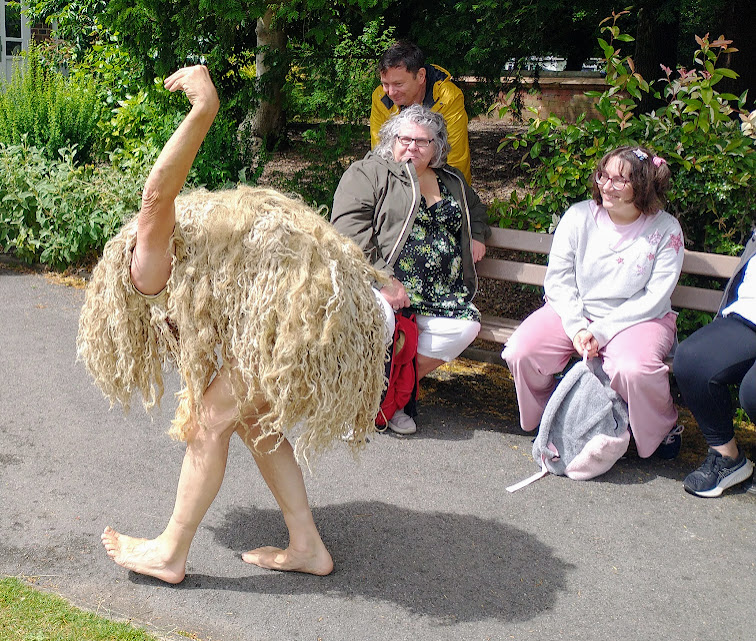
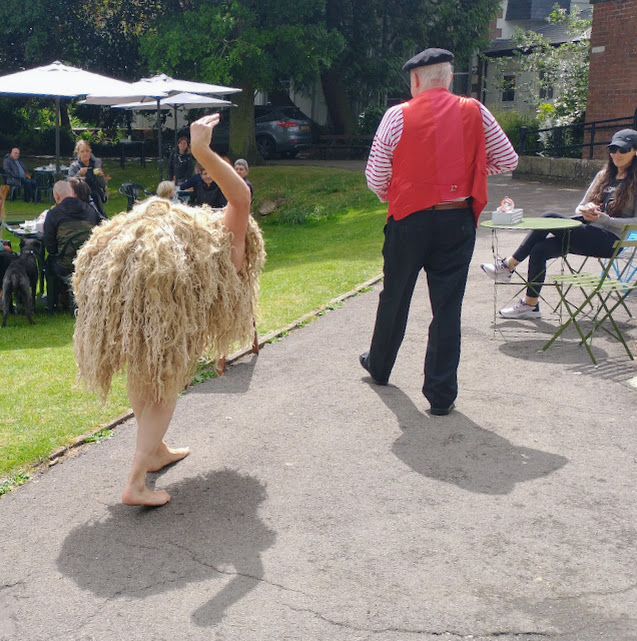
Come and have a stroll. We could join Struzzo the ostrich and Maxim as they wander round the park.
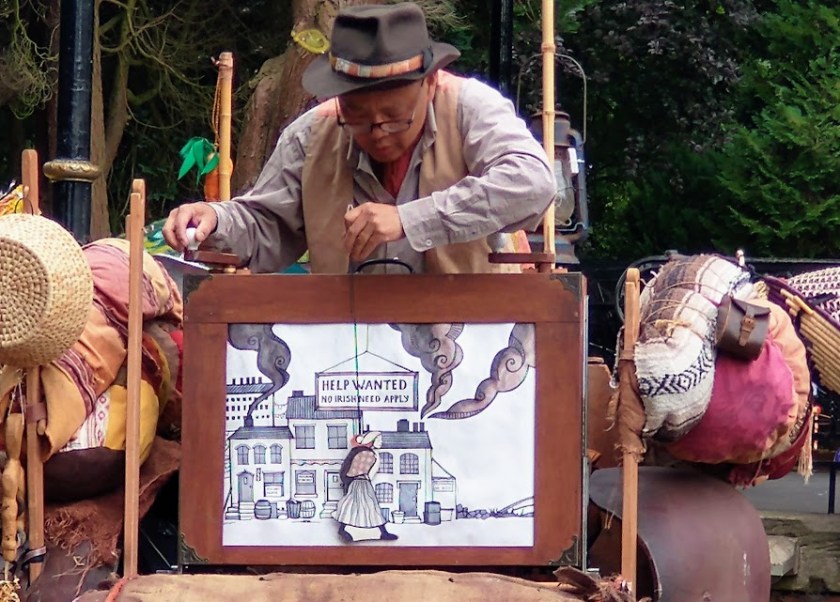
Kit and Caboodle told a good yarn from their laden mule- cart. It was nicely illustrated by a moving picture show, transcribed onto an apparently unending scroll of paper unfurling before our eyes. And with added paper puppets.
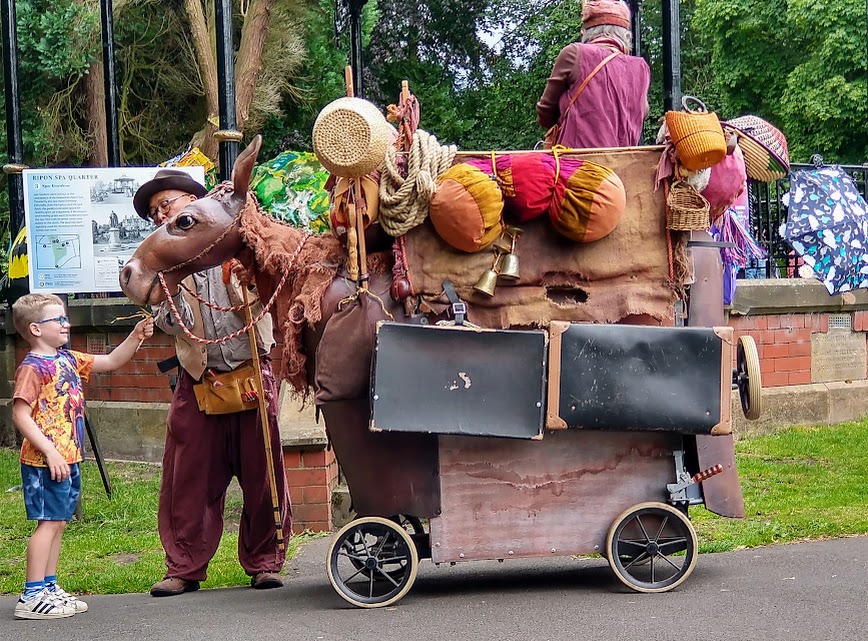
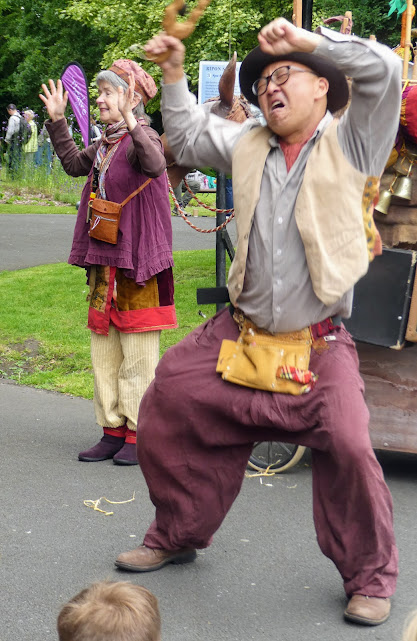
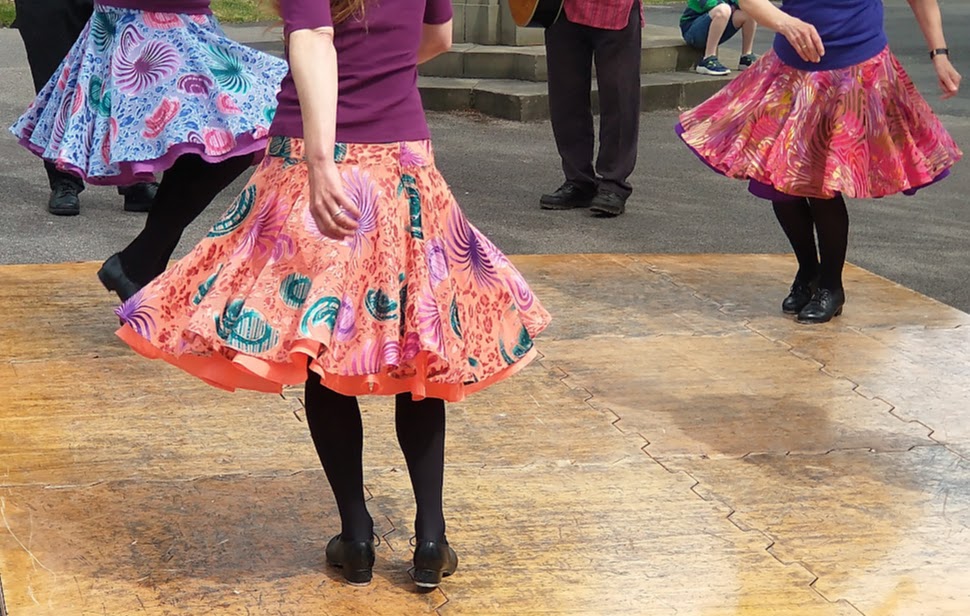
We could watch the swirling-skirted clog-dancers rhythmically and musically clickety clacking their clogs.
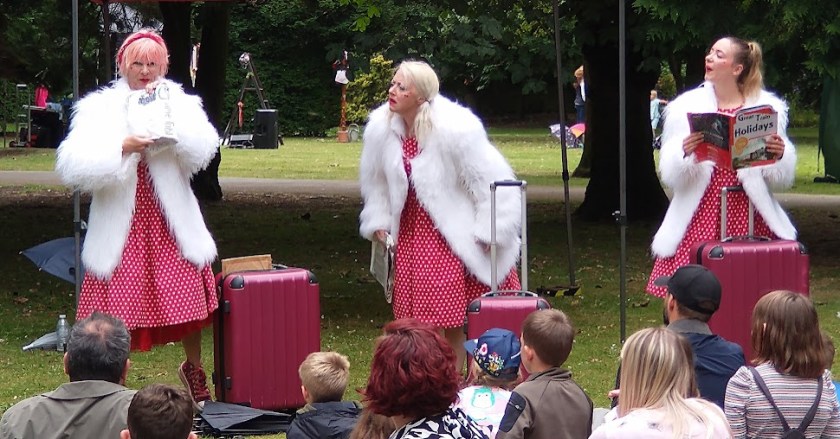
Or we could wait for a train with the Rhubarb Theatre and their Three Suitcases as they try to set off on holiday. We’d have a long wait. Ripon doesn’t have a station.
Oh, hang on! There’s plenty going on near the Market Square too…. such as Fireman Dave …
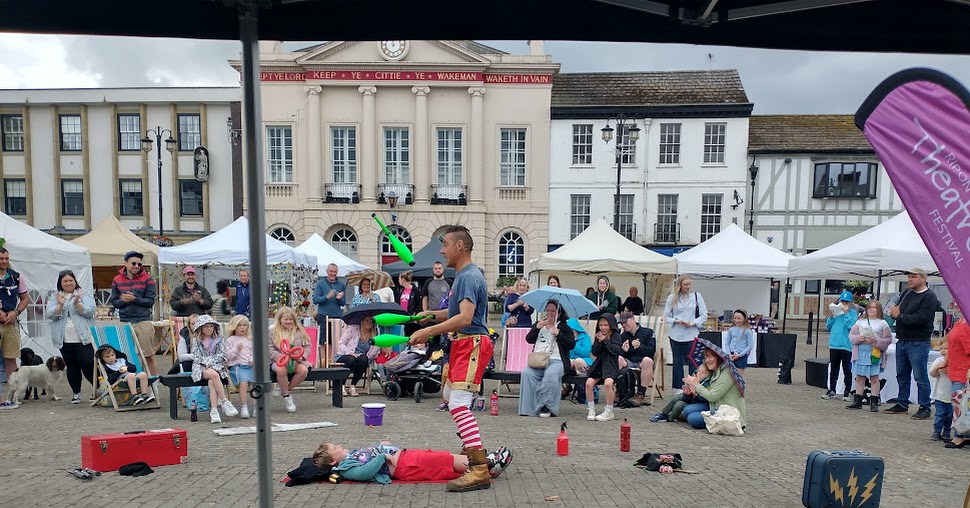
… I want to catch the Bachelors of Paradise …
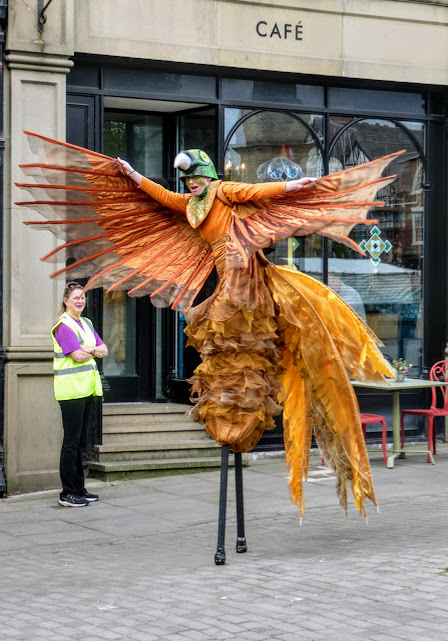
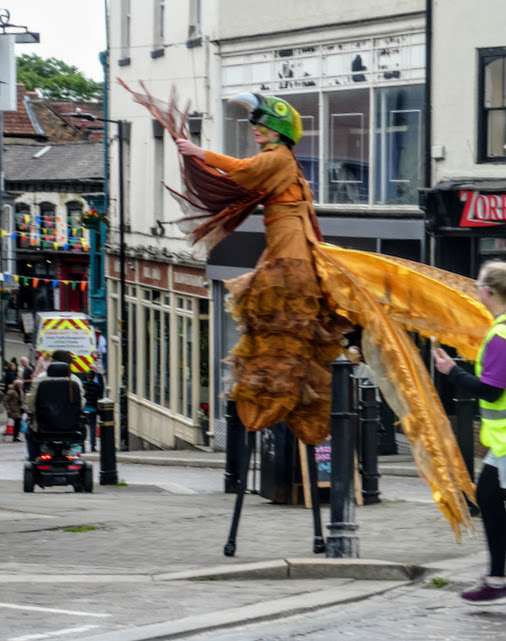
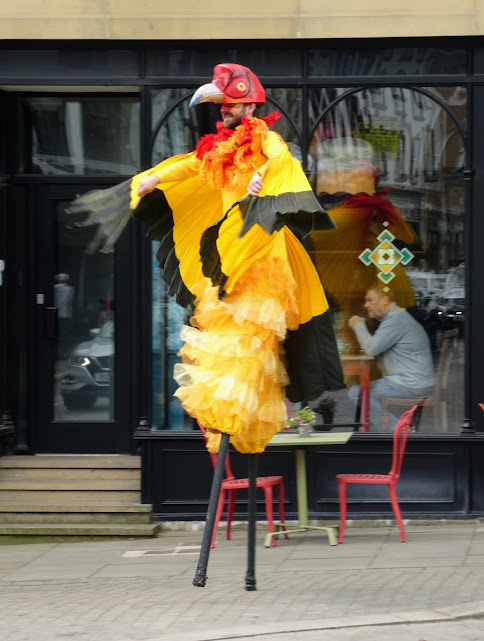
… and Logy on Fire, who does astonishing feats of acrobatics and balance with batches of discarded cigar boxes …
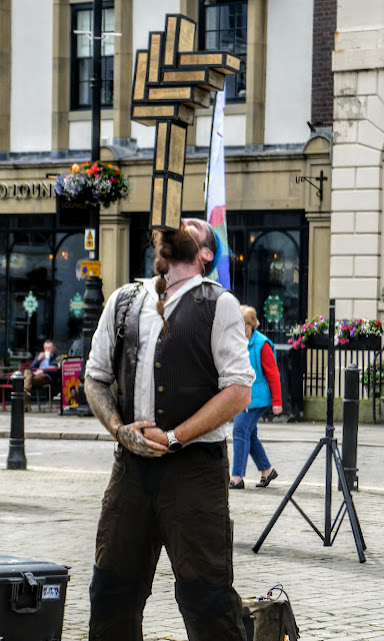
And there’s so much more. I only managed to see Four Hundred Roses, whom I photographed here, as they wandered up Kirkgate between performances.
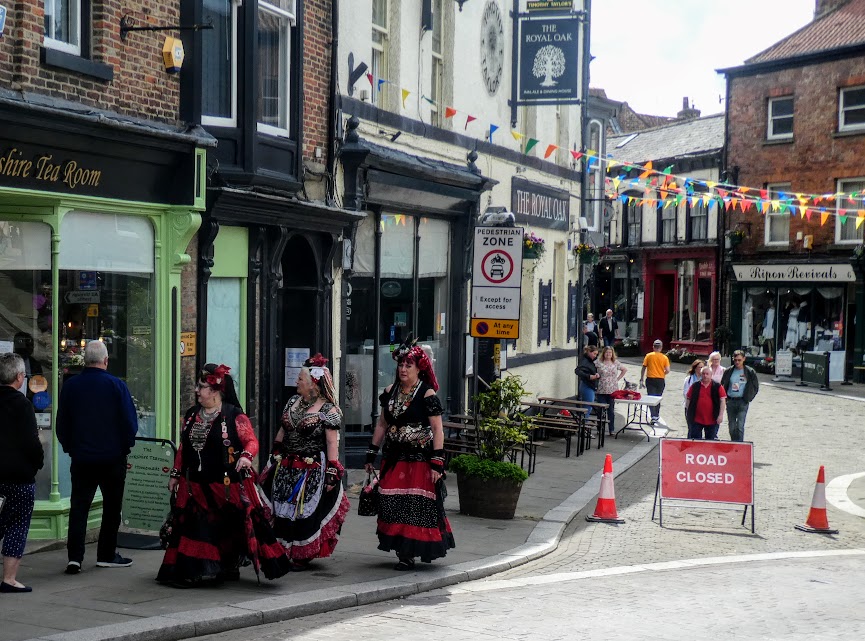
I wish you could have been actually – rather than virtually – there too. Maybe next year?
Dressing Up for an English Summer Barbecue

We went to a barbecue last week. It was already July, remember? Mid-summer. I wore, on top of my underclothes:
- a vest
- a polo-necked jumper
- a winter-weight cosy jumper
- thick socks
- and to top it all off, this ...

I was – just about – warm enough.
The header image comes courtesy of Andrik Langfield: Unsplash.
Six Degrees of Separation: from Kairos to The Little Man from Archangel
On the first Saturday of every month, a book is chosen as a starting point and linked to six other books to form a chain. Readers and bloggers are invited to join in by creating their own ‘chain’ leading from the selected book.
Kate W: Books are my Favourite and Best
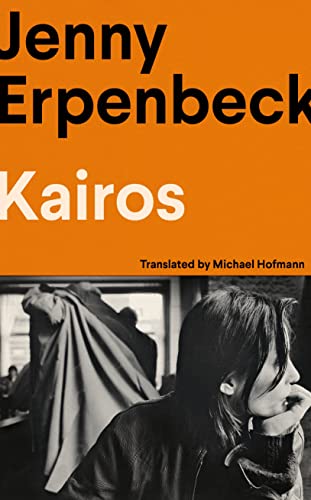
This month’s chain began with Jenny Erpenbeck‘s Kairos, translated by Michael Hoffman, which as it happens I reviewed in my post in May. It gave me the idea though that I would make works in translation this month’s focus.

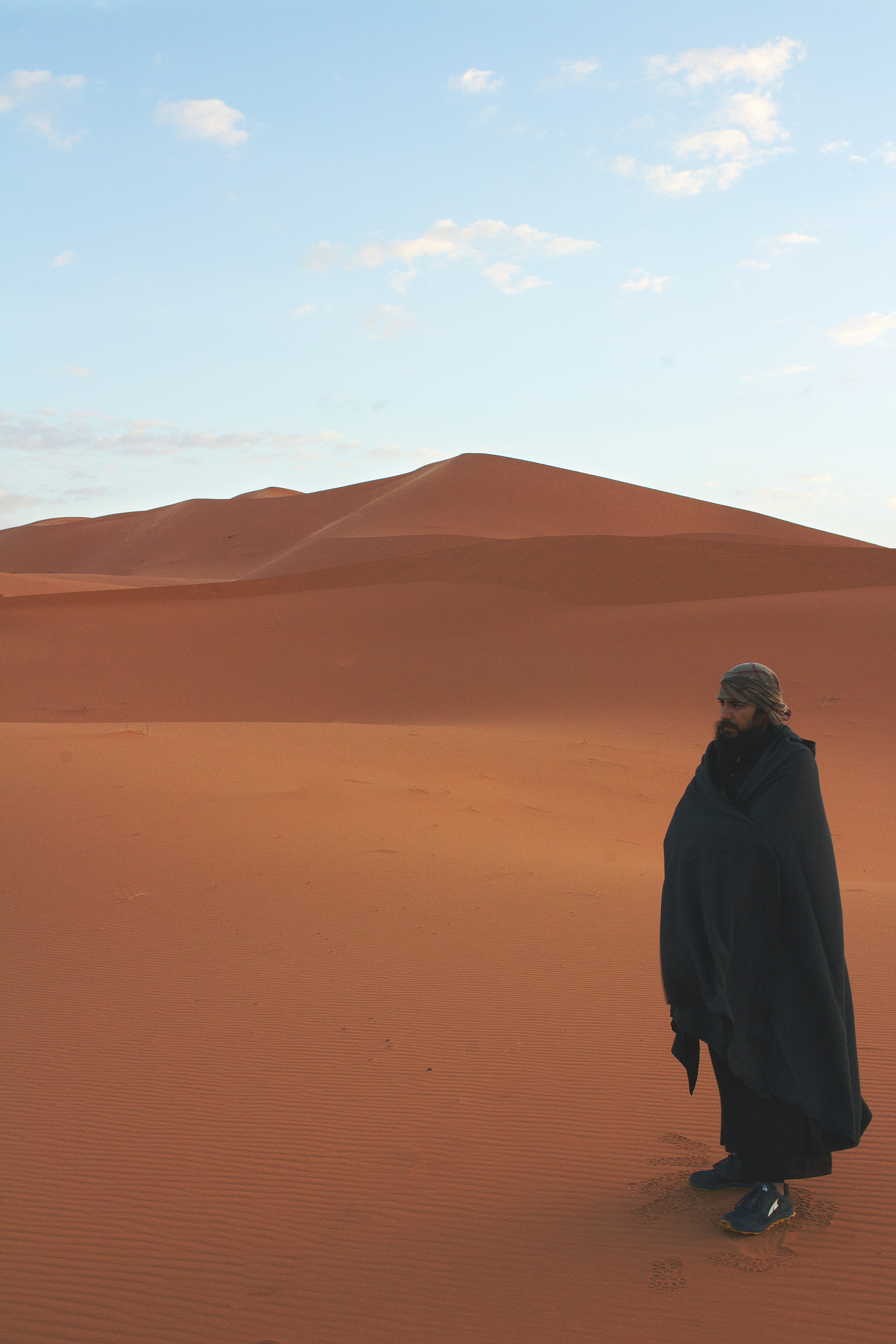
My first choice is Adania Shibley‘s Minor Detail, translated by Elisabeth Jaquette: another story about living with the consequences of war. The first part of this book is set in 1949, in Israeli- Egyptian border country, and a platoon of Israeli soldiers are seeking unsuccessfully for hidden weapons. They kill a group of Bedouin nomads whom they encounter. Only one young woman – a girl really – survives. She is taken back to camp, and systematically gang-raped before being killed. We hear all this from the point of view of the commanding officer – clipped, without emotion, without judgement. 25 years later a nervy young woman, living and working in Ramallah steps in and takes over the narrative. She’s read about this crime and wants to find out about it by travelling to and investigating it on site – difficult and risky to achieve. This quixotic journey doesn’t end well – how could it? This is – intentionally – an uncomfortable and unsettling read, written with suppressed passion by its Palestinian author.
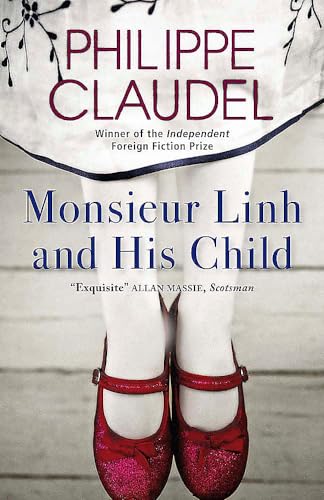

My next choice is also about living in the aftermath of war. Philip Claudel‘s Monsieur Linh and His Child, translated by Euan Cameron. This is a haunting book that will stay with me. Monsieur Linh is in an unnamed country, living in a refugee centre for those who have, like him, fled on an elderly ship from his homeland which has become a war zone – surely Vietnam? His family members have all been killed – except for his baby granddaughter, whom he keeps close and cares for every second of the day and night. One one of his daily wanderings, he meets Monsieur Bark, similarly lonely and isolated since the death of his wife, and the two men, despite having no shared language, develop a deep bond of friendship. Then Monsieur Linh has to be re-homed … This is a restrained and simply told story, which evokes a compelling picture of a gentle man, deeply traumatised by the loss not only of his community and family, but of his homeland, landscapes and daily rhythms. A compassionate, moving book, with an unexpected twist that reveals even more about the losses this elderly man has sustained.

Guadalupe Nettel‘s Stillborn, translated by Rosalind Harvey also has a child at its heart. Two young women, Laura and Alina, know for a fact they don’t want children. So Laura, the narrator, has her tubes tied. While Alina enters a relationship, and changes her mind, even to the extent of having fertility treatment when pregnancy just doesn’t happen. Life gets in the way. Alina becomes pregnant but before the birth, is given the awful information that her grossly disabled daughter will not live. This book is one which looks a the wider definition of parenthood, through the omniscient eye of Laura, who seems to know every intimate detail of Alina’s life with her partner Aurelio and daughter Inés, as well as of their childminder who’s unable to have children of her own, and of Alina, of her own mother, and her neighbour Doris and son. It examines the emotional conflicts and burdens of motherhood: their overwhelming presence in each woman’s life. A startling and forceful story.

My next book also has children at its core. Homesick, by Jennifer Croft is not translated. She wrote the book first in Spanish, then in English … This book is a haunting one, presenting the childhood of Amy and her younger sister Zoe in a series of vignettes, often extremely short. We gradually build a picture of two extremely close siblings: the elder gifted, the younger dogged by frightening ill-health – a rare but benign brain tumour. Tragedy after tragedy strikes -indirect, but significant. Then Amy gets into University aged only 15. A much shorter section details Amy’s post-graduate life until her mid 30s. Like the earlier part of the book, it’s fragmented, yet intimate and sensitive. I was kept at a distance from the two girls: I felt something of a voyeur, though a sympathetic one. I was privy to some of the many disasters that had struck the girls, without really getting to know either of them. Which felt appropriate. Complex lives make for complex characters. How can we really know what goes on in someone else’s head?
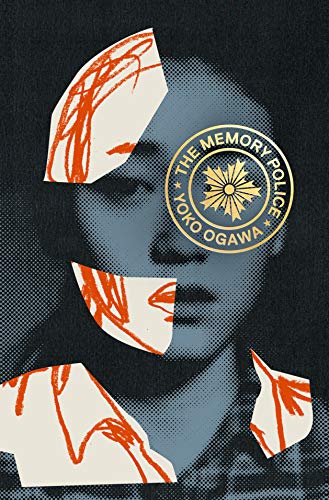
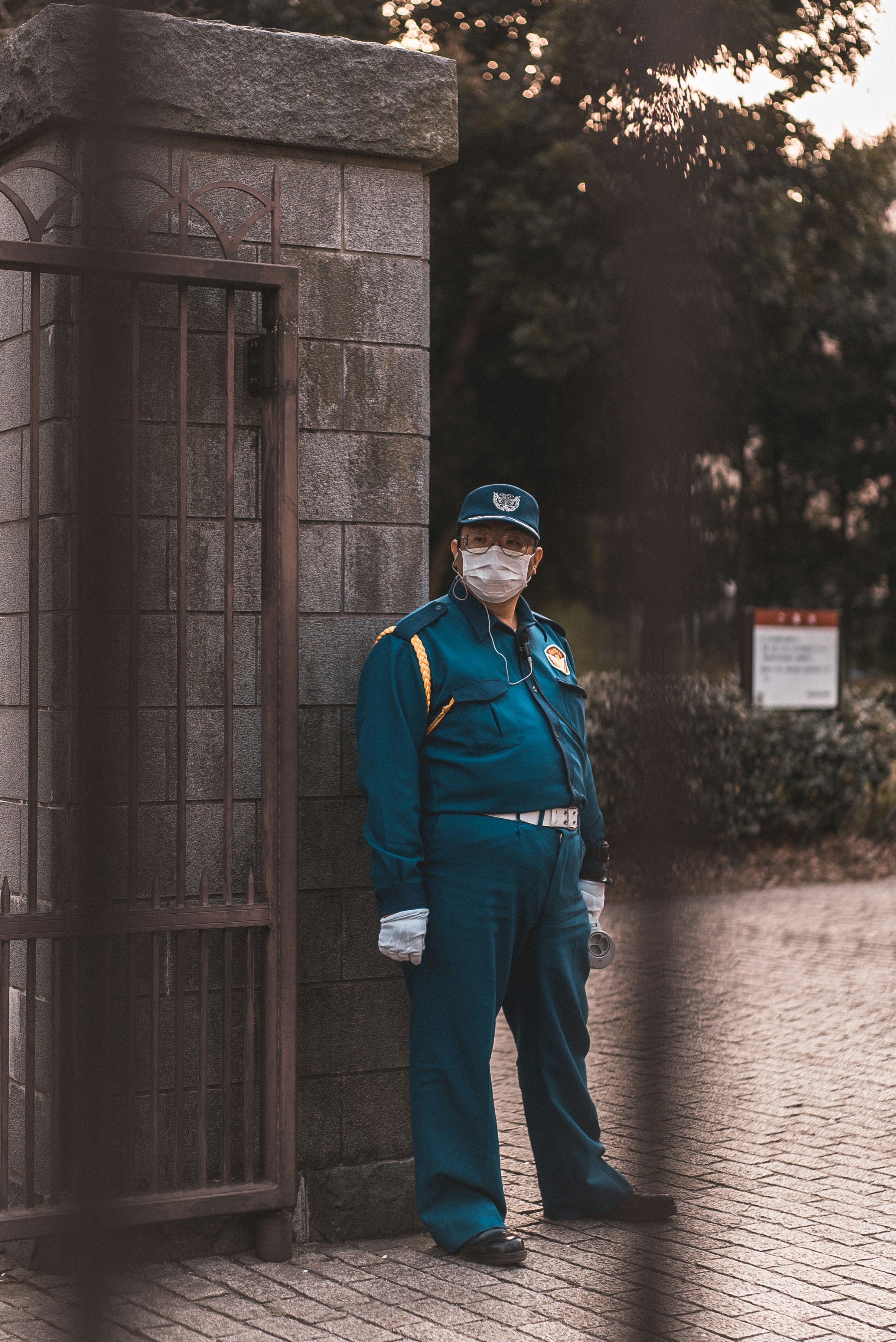
We leave Amy as a young woman, and it’s a young woman who is centre stage in my next choice. I’m not normally a fan of dystopian fiction, but I found Yoko Ogawa‘s The Memory Police, translated by Stephen Snyder to be a powerful and unsettling read. Simply yet lyrically written , the writer – this is told in the first person – lives on an island in thrall to the Memory Police. Things comprehensively disappear: in the early days, simple things like roses, and the inhabitants soon lose any memories of the things that have vanished. Those unfortunate people who find they do not forget – and the writer’s parents seem to have been among them – simply are removed by the Memory Police and never seen again. The ‘writer’ of this book is herself a novelist, and we are privy to her efforts. We never find out more about the Memory Police, or know to whom they are answerable. But we are left with a lot to think about – totalitarian regimes, life, death and the process of letting go and of dying. I’ll go on thinking about this book.
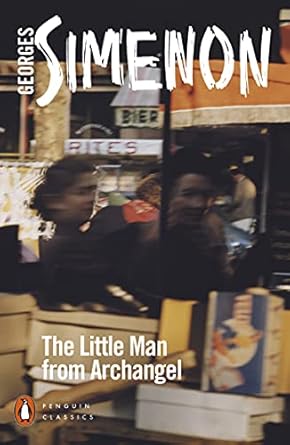
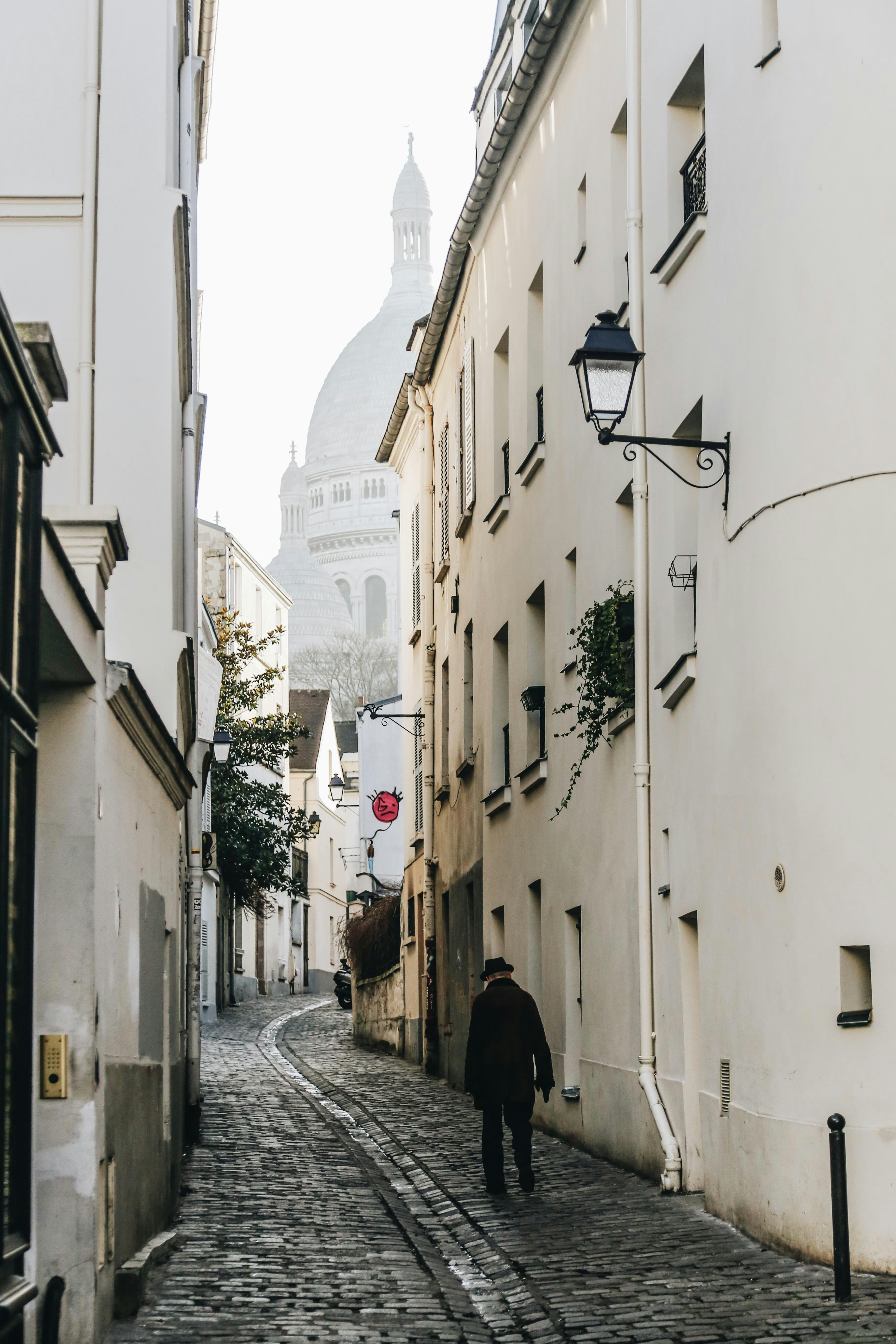
My last book also looks at a life where things are not as they seem: Georges Simenon‘s The Little Man from Archangel, translated by Sian Reynolds. When Gina, the free-loving and much younger wife of Jonas Milk, Russian emigre, small-time bookseller and stamp dealer disappears, Jonas lies, and says she’s away visiting a friend. It’s almost immediately clear that this isn’t true, and Jonas has impotently to realise that his soon-disbelieved untruth has consequences. He’s increasingly made aware that his experience of being both Jewish and a migrant has accounted for his being less integrated into society than he had believed. A powerful evocation of 1950s small-town French life, which though bleak, is also atmospheric and elegantly told.
With my last book, we end where we began: the far-reaching consequences of long-over war. I’m aware that my choices this month have a touch of earnestness about them: they’re not beach-read territory. But they’re well-worth your time.
Next month’s starting point is Heather Rose‘s The Museum of Modern Love.
All illustrations are from Unsplash: Ben White; Jewad Alnabi; Redd F;Omar Lopez; Tom Morbey; Giuseppe Mondi.
Half as Old as Time
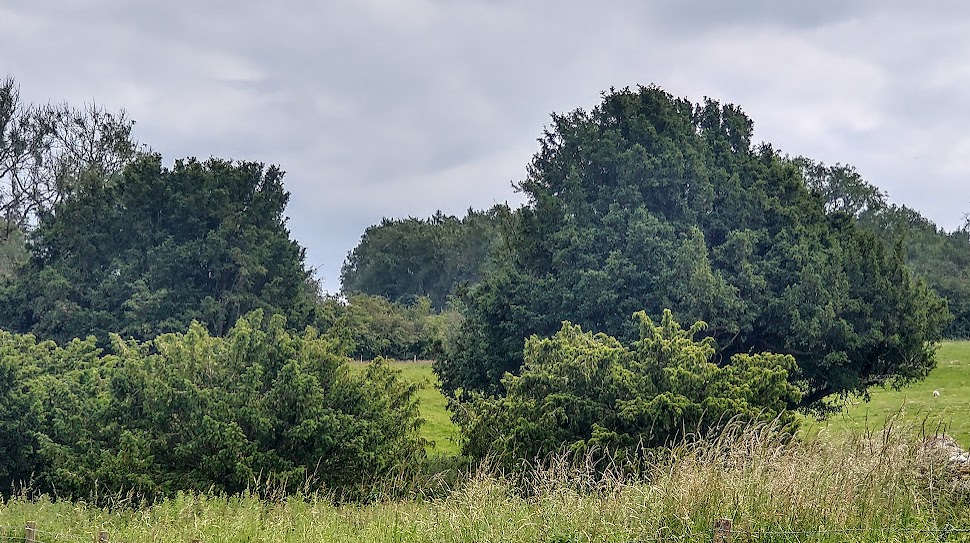
Just beyond the walls surrounding Fountains Abbey estate is a farm rented by a tenant farmer. It includes a small patch of land, untended and fenced off, because several trees got here first. They’re yew trees, and they’re thought to be about 1400 years old.
Think how long ago that was. It was only a couple of hundred years after the Romans had finally left these isles. It was several hundred years before the Norman invasion of 1066. By the time a group of monks from York had come to the site to build a Cistercian community here in 1132, those trees were already some 500 years old. This area would have been wooded, wild and interspersed with occasional farms. There would have been wolves, wild boar, lynx, otters, red and roe deer. But no rabbits. There’s no archaeological evidence for rabbit stew in any of the nation’s cooking pots from those days. They probably came with the Normans.
Those trees – once seven, now only two – would have been witness to the monastic community maturing: to the abbey and all its supporting buildings and industries developing. They would have seen the community grow, then all but collapse during the Black Death in 1248: and slowly prosper again. Until Henry VIII dissolved all the monastries, and Fountains Abbey’s roof was hauled down in 1539, leaving it pretty much the ruin it is today. By then, the trees were working towards being 1000 years old.
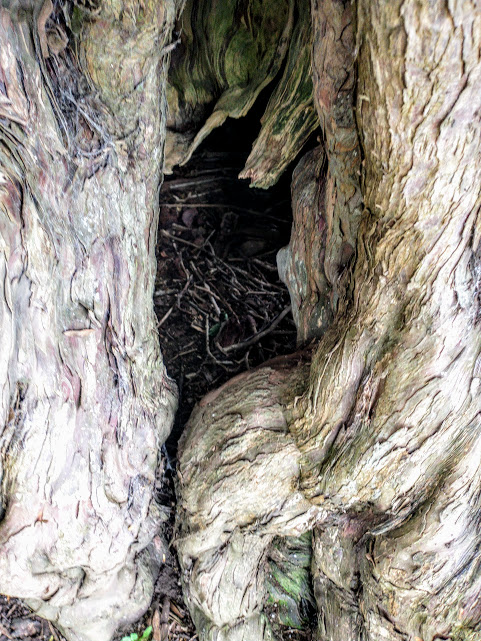
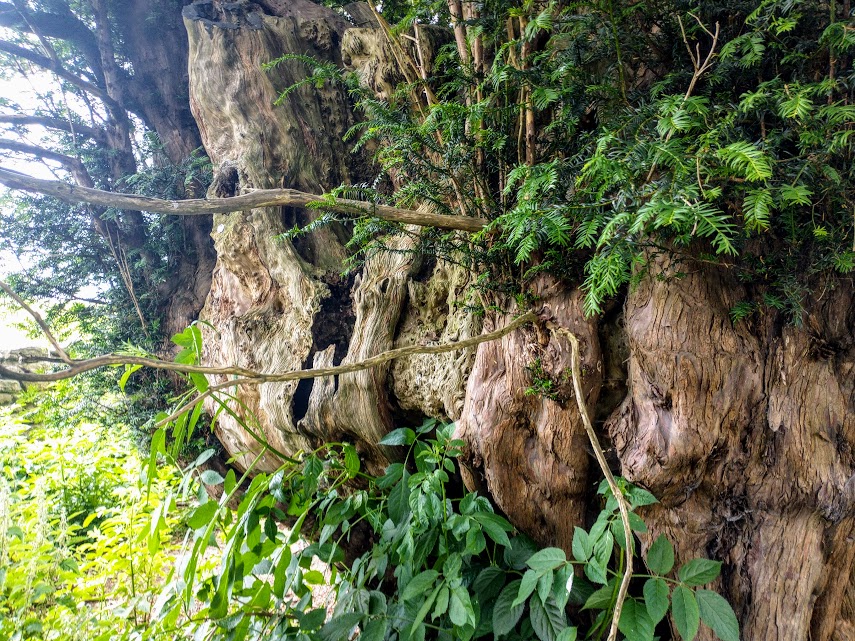
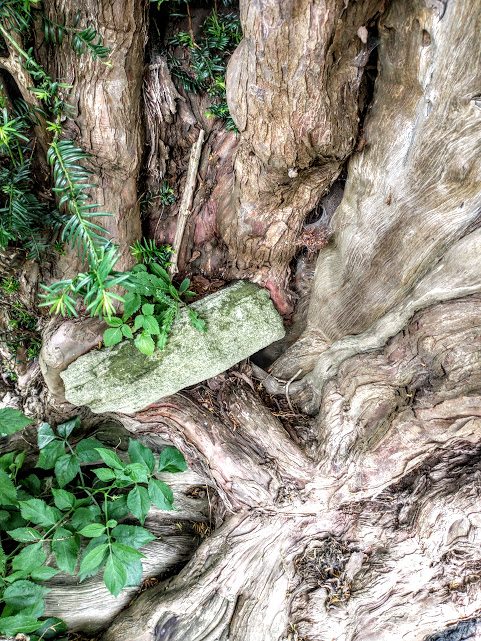
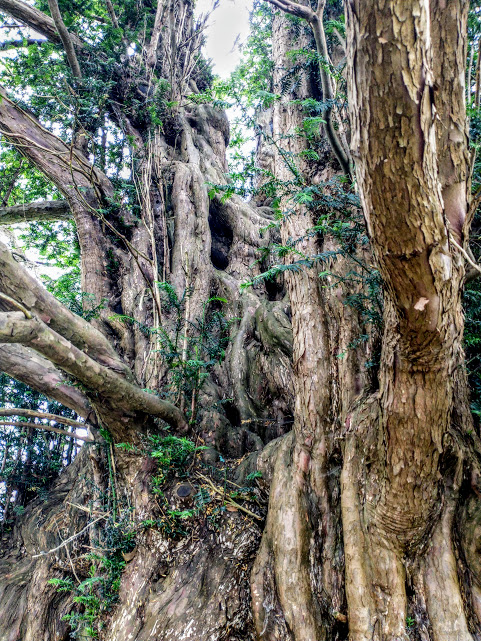
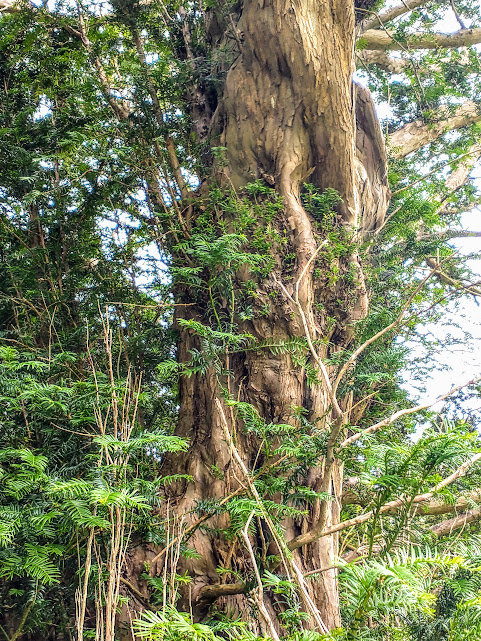
They’ve always been a bit out on a limb, these trees, and that’s what has made them such a rich habitat. They offer protection and nest sites for small birds, who can also eat their berries . Caterpillars feast on the leaves. These days, they’re home to eight species of bat, and a wide variety of owls. Yew trees are famously toxic to most animals – that’s why they’re fenced off – but badgers are able to eat the seeds, and deer the leaves.
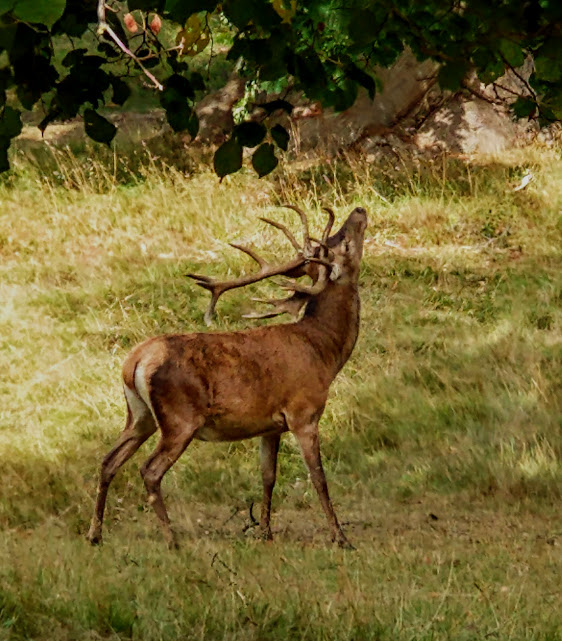
I can’t show you any of the creatures for whom these trees are their neighbourhood – apart from a grazing deer at nearby Studley Royal. Just the ancient trees themselves, the nearby Fountains Hall, built in late Elizabethan times when they were already 1000 years old, and a slightly more distant view of Fountains Abbey itself. My featured photo, the last image I took in June, is of those yew trees, looking as though they’re ready for the next 1000 years.

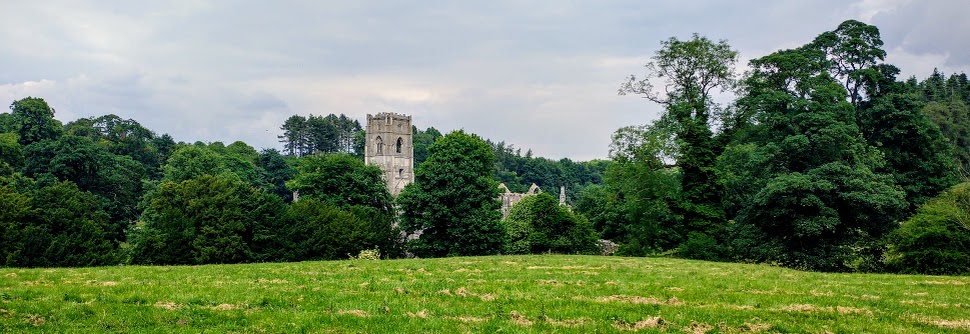
This is for Brian’s Last on the Card, and – somewhat tenuously – for this week’s Lens-Artist Challenge from Tina: Habitat.
The phrase ‘Half as old as time’ was actually coined by John William Burgon in 1845, in his poem ‘Petra’.
Pick a Word – then Pick a Photo
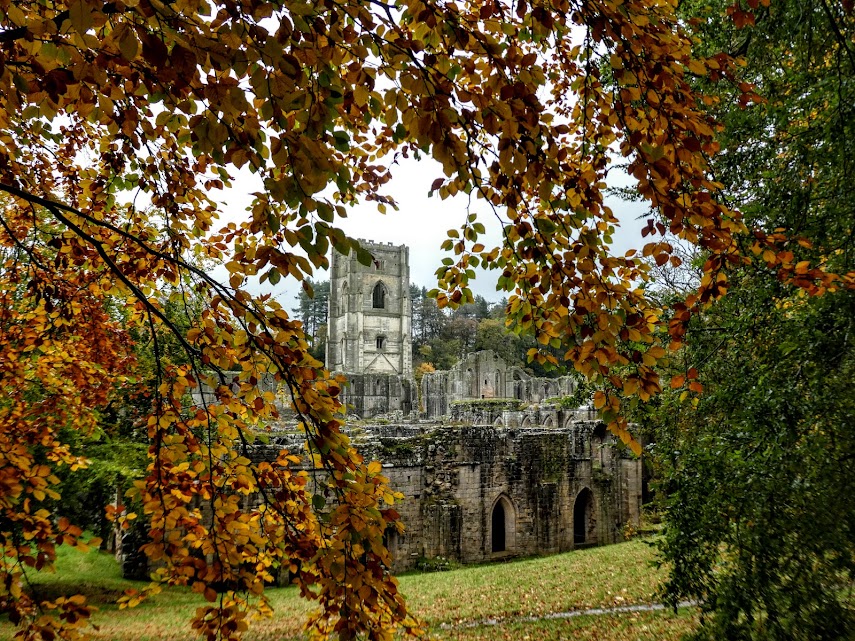
Here’s a challenge and a half. Take five words, chosen monthly by Paula of Lost in Translation, and illustrate them. Here are the words: MONASTIC; ABANDONED; CRYSTAL; ECHOING; AFFABLE.
Monastic was easy. Of course I chose Fountains Abbey, a religious community from 1132 until Henry VIII caused it to be surrendered to the crown in 1539, under the Dissolution of the Monasteries. It’s where I have the privilege of volunteering, so it’s almost become my back yard. Here, in my featured photo, is the Abbey in autumn.
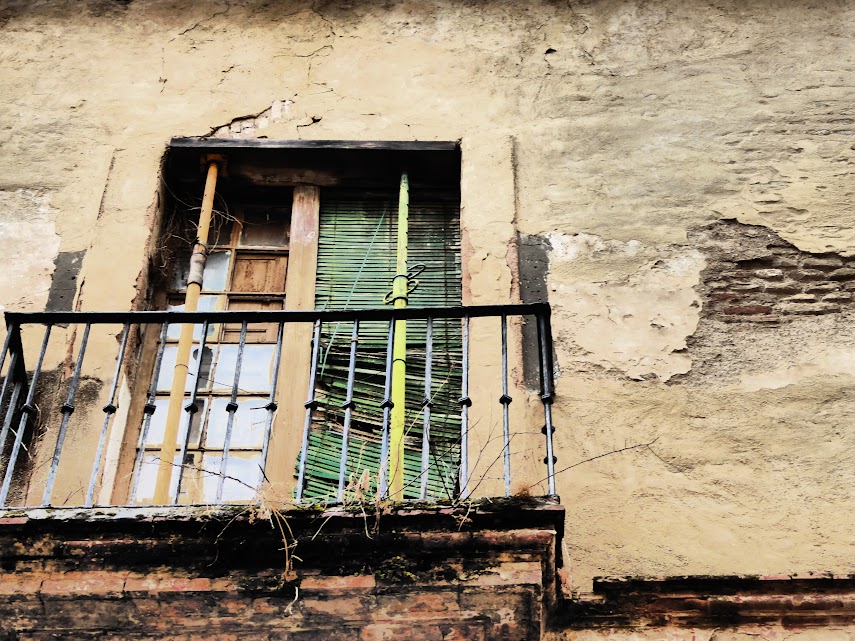
Abandoned? So much choice. I’ve picked a rather wrecked house in Seville.
Crystal was trickier. I don’t move in the right circles. But here is a crazed plate glass window on a ferry bound for Spain which has a slightly crystal-ish look.

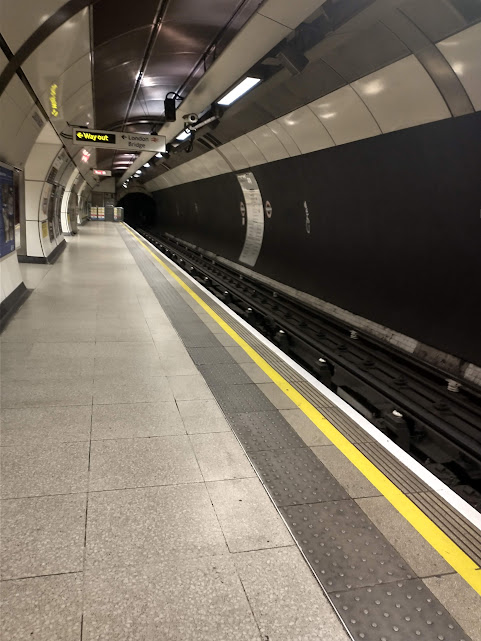
You may not think my next photo illustrates ‘echoing‘. But trust me – it does. I was among the first passengers to arrive at London Bridge Underground Station just after 5.00 a.m one morning recently. There was not another soul on my platform. Only me. It echoed.
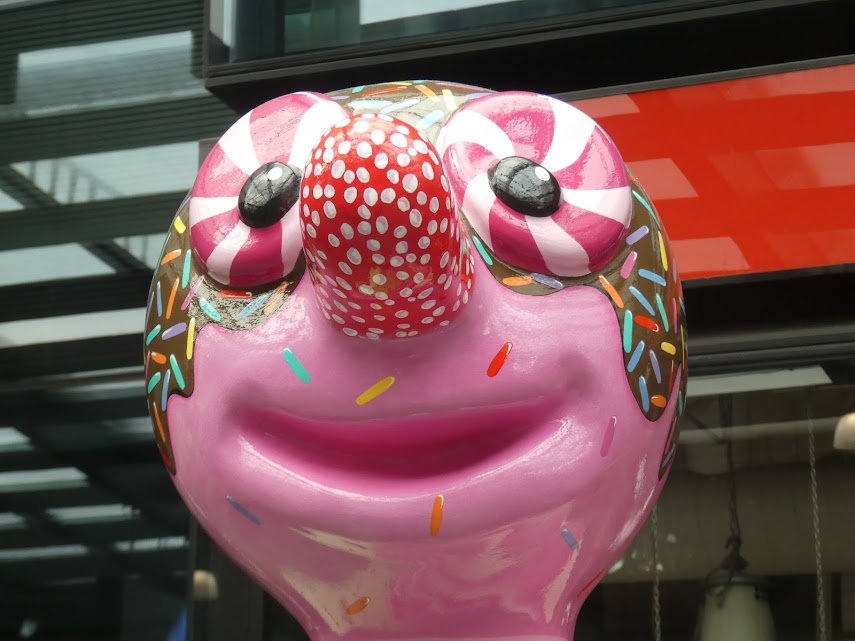
And we’ll stay in London for my last image, a cheery one. This affable chappie was snapped on a day out with Sarah of Travel with Me fame. He was part of a fun sculpture trail for children’s wheelchair charity Whizz Kidz.
So there you have it. Following the links to Paula’s and Sarah’s posts will show you very different interpretations, and perhaps you’ve seen others in blogs you follow too.
A Walk near Rievaulx – in Glorious Technicolor or as Old School Newsreel

The other day, a friend and I took ourselves off to the Ryedale countryside to reconnoitre a route. It turned out to be not only the Longest Day, but the First Day of Summer, in the sense that the weather was wonderful – hot and sunny .
Setting off on a shaded woodland path, we criss-crossed a flowers-edged stream several times.

We forged our way up a steep – unending – hill. Is that even a path?

We exchanged woodland for fields and open views, with clouds above:


We met a ford which lapped along a long stretch of road. Luckily there was a footpath through a field nearby, and edged with iris too.

Sheep looked on, and ancient walls often marked our way.


And at last, below us the ancient ruined Cistercian Abbey of Rievaulx.

Now let’s run this in black and white.
We criss-crossed a stream:

… and later, the woods opened out into farmland. Crazy sky!

Luckily, we were able to dodge fording the ford: or testing our brakes.

As an alternative to sheep-watching, we chose shadow-watching on the narrow road that was part of our route.

And soon after that, Rievaulx Abbey was no longer below us, but alongside.

And as our walk finished, the road sign confirmed that we had indeed seen Rievaulx.

For Jo’s Monday Walk.
And for Leanne and Dawn‘s Monochrome Madness: Roads, Lanes, Paths and Tracks.
Two Rectangles?
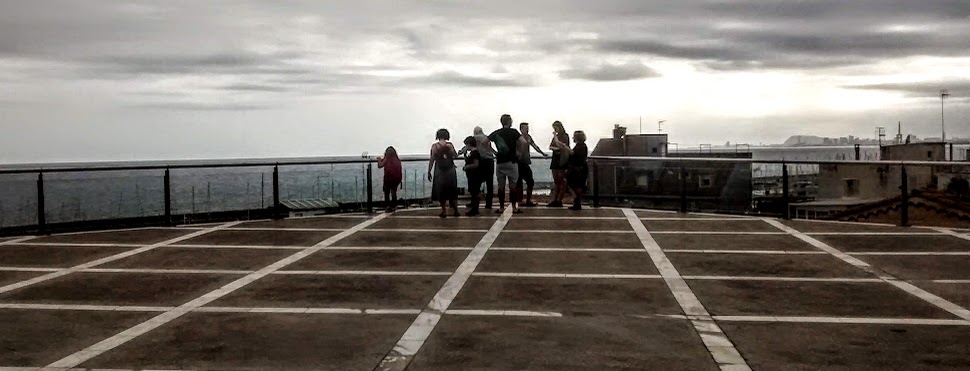
For this week’s Lens-Artists Challenge, Egidio asks us to consider compositions relying on two rectangles for their success. So I thought I’d offer a featured photo with lots of rectangles: the basic two, with sky at the top and earth at the bottom, and then, confusingly, a town square entirely tricked out in … squares. Emily and her Catalan family are looking out to sea.
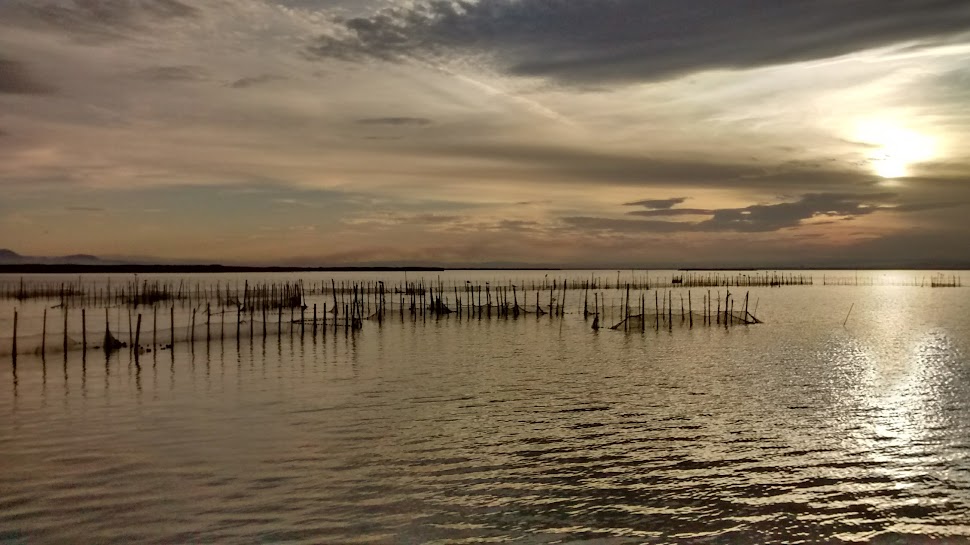
I thought I’d include a couple more using this simplest of devices. The first from my beloved l’Albufera, which I’ve written about before – here (among several others).
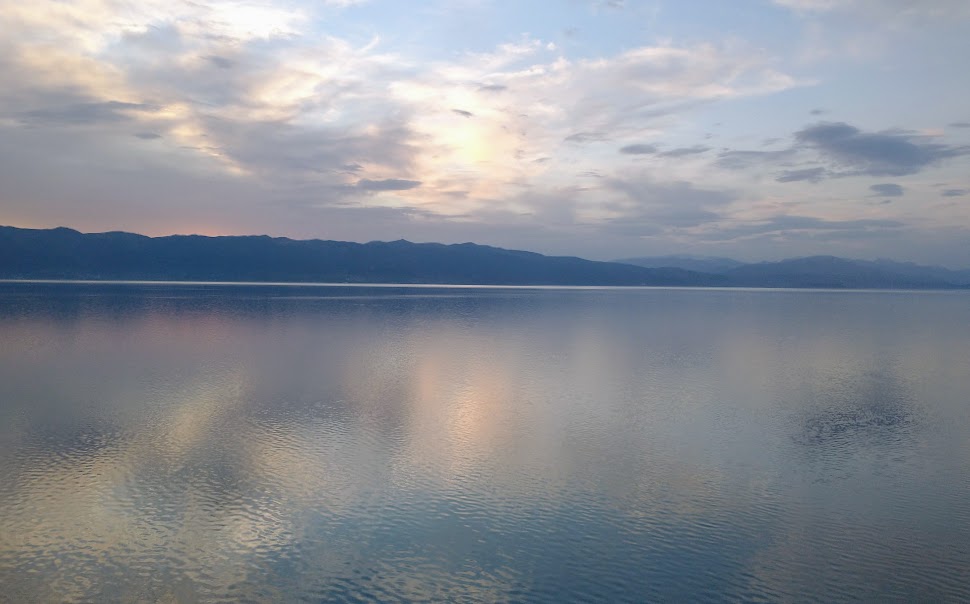
And here’s another, from Lake Prespa in Greece, where the water reflects the sky above: the lower rectangle a pleasing echo of the upper.
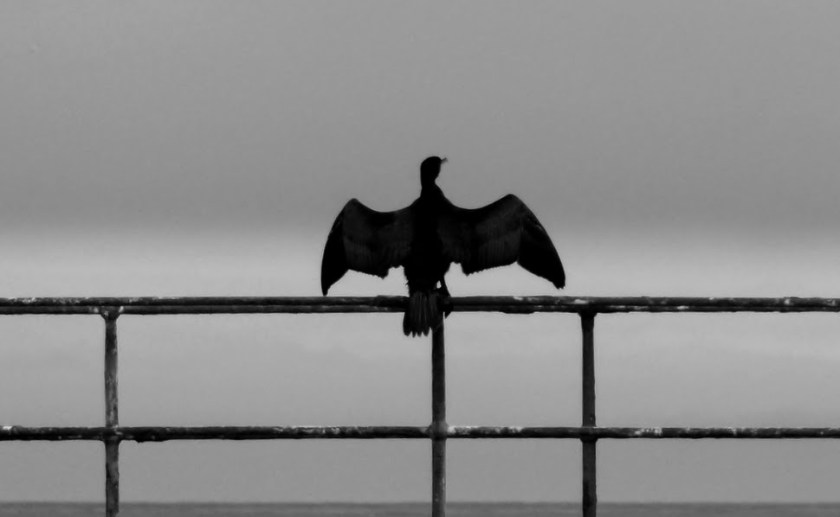
And here’s one closer to home, in Whitby, a cormorant posing at the end of the pier.
Let’s stay beside the water: one a ferry across to Spain, spying on my fellow-passengers. At the Baltic Gateshead, spying on my fellow River Tyne enthusiasts, and in London, over looking the South Bank.
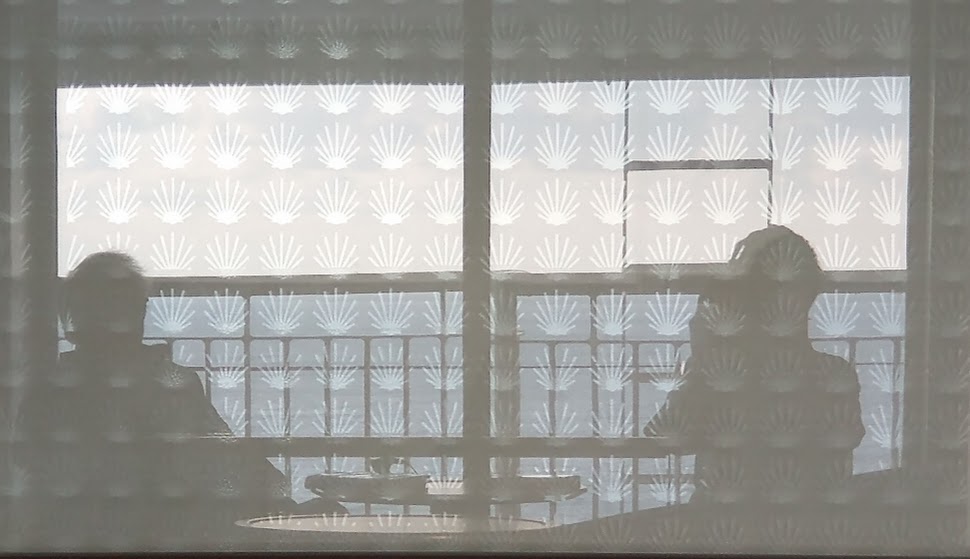
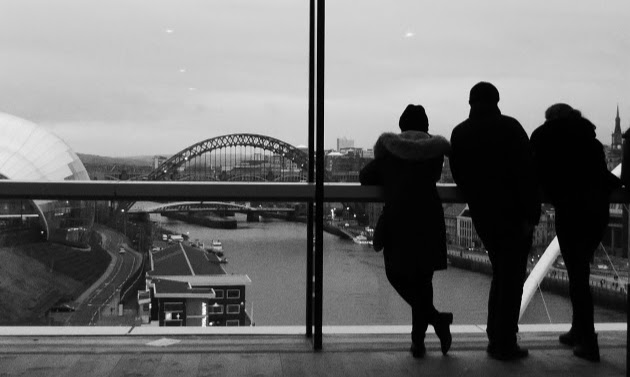

And finally we’ll whizz over to Barcelona, and wander round El Clot, and then Gràcia, where this view has two rectangles and includes any number of smaller ones, and the daily washing line.
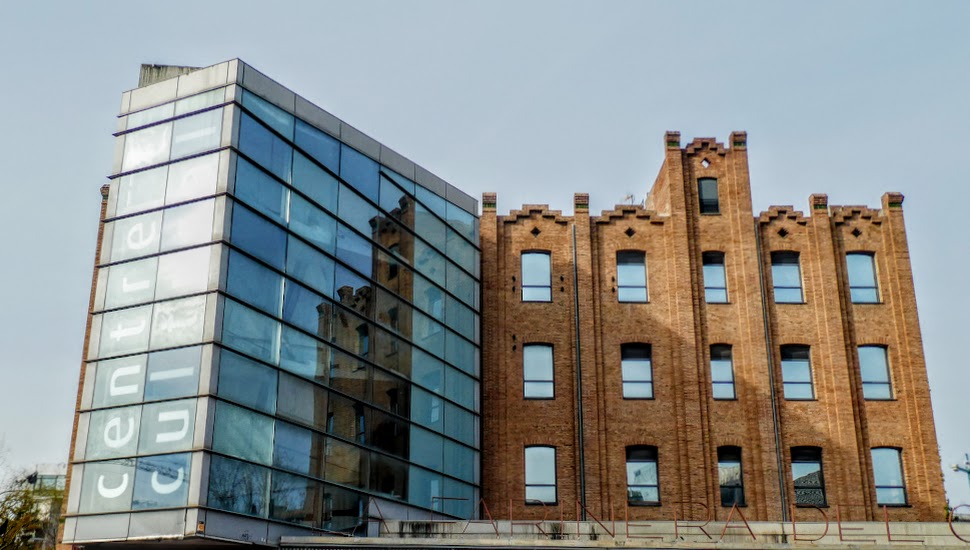
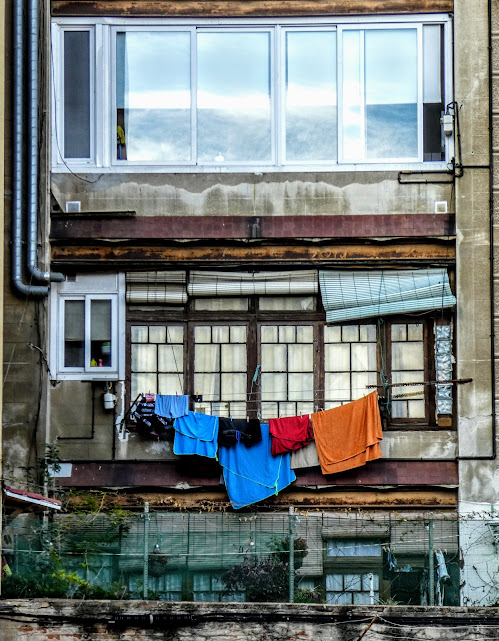
Saint Valery sur Somme Revisited
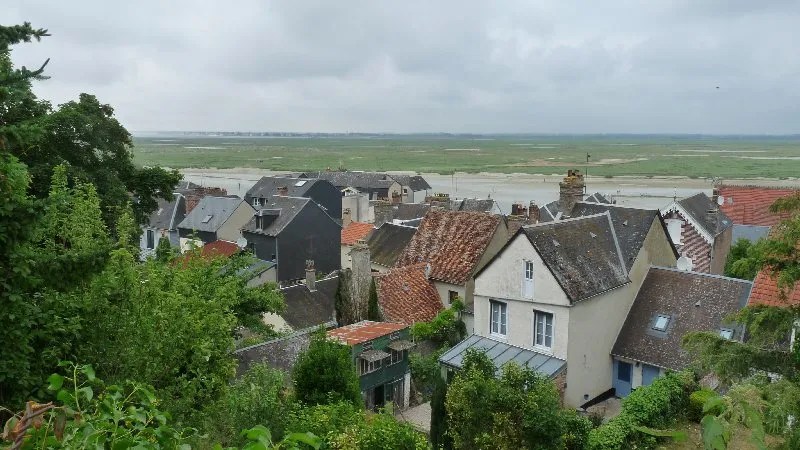
Exactly nine years ago today I wrote a post about a trip we’d only recently returned from. I thought I’d give it another outing.
Saint Valery sur Somme
24th June 2015
Here’s a town we Brits should know. It’s where 1066 And All That really began. William of Normandy and his troops set sail from here, landed on the English south coast and won the Battle of Hastings. William became King of England, introduced a whole new French vocabulary into the English language (‘Pork or beef, madam?’), and his brother Odo commissioned the first strip cartoon, the Bayeux tapestry, to record and commemorate the event. Later though, in 1431, the English held Joan of Arc captive here, before conveying her to Rouen to be burnt at the stake.

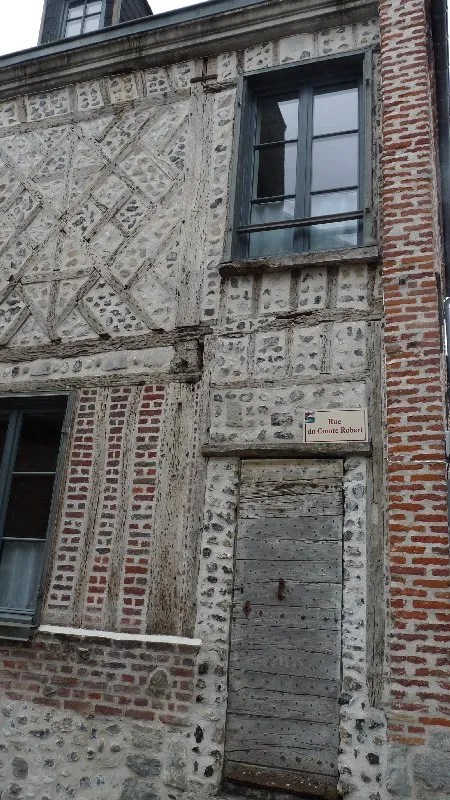
Even without those compelling reasons to make a pilgrimage, Saint Valery is worth a detour. It was and is a harbour and a fishing town with a picturesque mediaeval centre. Like many pretty towns on the coast, it’s popular with writers and artists: Victor Hugo, Jules Verne, Alfred Sisley and Edgar Degas all had homes here, and we spent a pleasant day exploring, poking round the (rather touristy) Sunday market, choosing a restaurant-stop, and generally enjoying the pleasures of a seaside town.



While we were there, something special happened. After lunch (moules, what else?) we wandered down to the beach. There, on the other side of the estuary, were sheep, paddling. Dozens of sheep, scores of sheep, hundreds of sheep. They’re unique. They’re bred from English Suffolk and Hampshire sheep, and they spend their lives grazing the salt marshes., which gives them a highly regarded flavour, rich in mineral salts, and the name ‘Estran salt meadow lamb’. The life of those sheep, and their shepherds, and sheep dogs, is an energetic one. They have to keep moving each and every day to avoid getting stuck in the damp and boggy sand. Their shepherds keep an eye on them, oiling their feet to prevent foot rot, and every night the flock returns to pens with fresh straw via a special tunnel under the road.

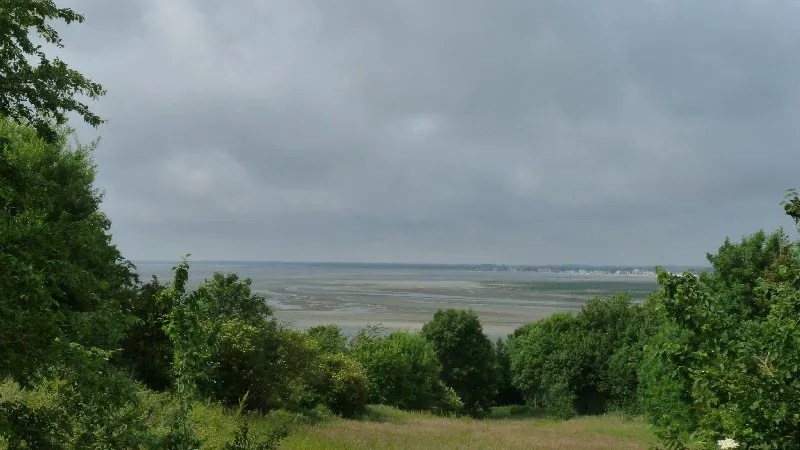
Before we left, we wandered through the harbour, and up to the Chapelle des Marins, a neo-Gothic building, built on the site where the hermit-saint Gualaric, who gave his name to the town, once lived. It’s a good place from which to say ‘Goodbye’ to the town and get some final views of the bay.




You must be logged in to post a comment.