A History of Bridge Building in Ten Bridges

Let’s start with a Roman Bridge, in Córdoba. It’s called the Roman bridge, because it was first built during the Roman colonisation of southern Spain. But it was overhauled in the 10th century. Then in the Middle Ages. Then in the 16th and the 17th centuries, when a statue of St Raphael was added. Lights were added in the 19th century, and it was pedestrianised in 2006. It’s a wonder it can still be called the Roman Bridge. But it can. The 14th and 15 arches are still the original ones.

El Puente Romano de Córdoba.

We’ll leap forward to the Renaissance, but stay in Spain, in Valencia, and visit the Puente del Mar. Flooding in the River Túria swept away an old wooden bridge, so in 1591, it was replaced with this:

Puente del Mar, Valencia.

Stone, brick, wood: all these were the traditional bridge -building materials of choice down the centuries. Until the Industrial Revolution here in England, whose original epicentre was in Coalbrookdale, thanks to its wealth of natural resources all conveniently in the same area. The world’s first iron bridge was built here in 1779.

The Iron Bridge, Coalbrookdale, Shropshire.

This bridge is the grandparent of almost all bridges built – in the UK at least – since then and into the 20th century. Here are three: Vauxhall Bridge, completed in 1906; the Tees Transporter Bridge, completed in 1911, and the Tyne Bridge, completed in 1928.

Let’s leap briefly into the 21st century, and look at one of the bridges in Valencia’s assertively future-facing Ciudad de las Artes y las Ciencias, created between 1998 and 2009.

Ciudad de las Artes y las Ciencias, Valencia.

And finally, the Millau Viaduct, sweeping more than 300 metres above the Tarn in southern France, designed by Norman Foster and completed in 2004. Like Valencia’s Science Park, it’s a destination in its own right.

Millau Viaduct, Occitanie, France.

But we can’t leave without mentioning the featured photo: London’s iconic Tower Bridge, open to traffic since 1894: both road traffic, and when regularly lifted, to river traffic beneath. The photo demonstrates why the extra height is necessary: that’s HMS Belfast in the foreground.

And to finish off, let’s stop at something that’s even older than bridges as a way of allowing travellers to cross water. Stepping stones. These are at Redmire Force, and are still a popular way of crossing the River Ure.

For Leannne’s Monochrome Madness#17: Bridges

Seven Years Ago, in Krakow

Exactly seven years ago today we were in Poland, the country of my father’s birth. And we’d fetched up in Krakow, where were were staying in the former Jewish quarter. The feature photo shows the view from our window. Yes, advertising the Jewish Museum was an image of the menorah, the seven headed candelabrum which has become the symbol of Judaism. Here’s the post I wrote on 16th September, 2017.

Jewish Krakow

Here we are in Krakow. And here we are, staying in the former Jewish quarter, Kazimierz, once a completely separate town.

How come there were so many Jews in Poland by the early 20th century? They formed, for instance, 20% of the population of Krakow by the beginning of WWII.

Blame the crusades. The Polish kings at the time declined to get involved. Jerusalem was so far away after all. So there were no crusaders from Poland in the routine persecution of Jews that took place in those so-called Holy Wars.  And Poland became a place of sanctuary.

Along came the Black Death. Citizens from all over Europe looked for someone to blame. Jews, obviously. Jews needed somewhere to flee. Poland, obviously. Poland somehow escaped the Black Death, so didn’t need to persecute Jews at that time.

Over the centuries, Jews did well in Poland. Well educated by their rabbis at a time when education was far from universal, they prospered. They tended to live together, in harmony with their Christian neighbours.

Then Hitler came to power.  As he occupied Poland, he began his all-too familiar persecution, then extermination of the Jews. But in Krakow, the factories were short-handed. and Jews were required as slave labour. 3000 Poles were forced to leave their homes in the Podgorze area, and 16,000 Jews moved in to the ghetto it became. 

This street forms one of the boundaries of the ghetto.

One of those factories was Otto Schindler’s. 1000 Jews who might otherwise have died lived because of his protection – he could have managed with 100 workers. This dark period is remembered in Plac Bohaterow Getta – Ghetto Heroes Square, where 70 chairs symbolise absence, departure. This Square was the place where Jews were executed, or sent to almost certain death in the local Concentration Camps. Another sobering day.

Plac Bohaterow Getta – Ghetto Heroes Square

Other posts I wrote during our holiday mentioning the Jews in Poland include:

For Becky’s Seven for September.

Everyday Objects Enjoy Five Minutes of Fame

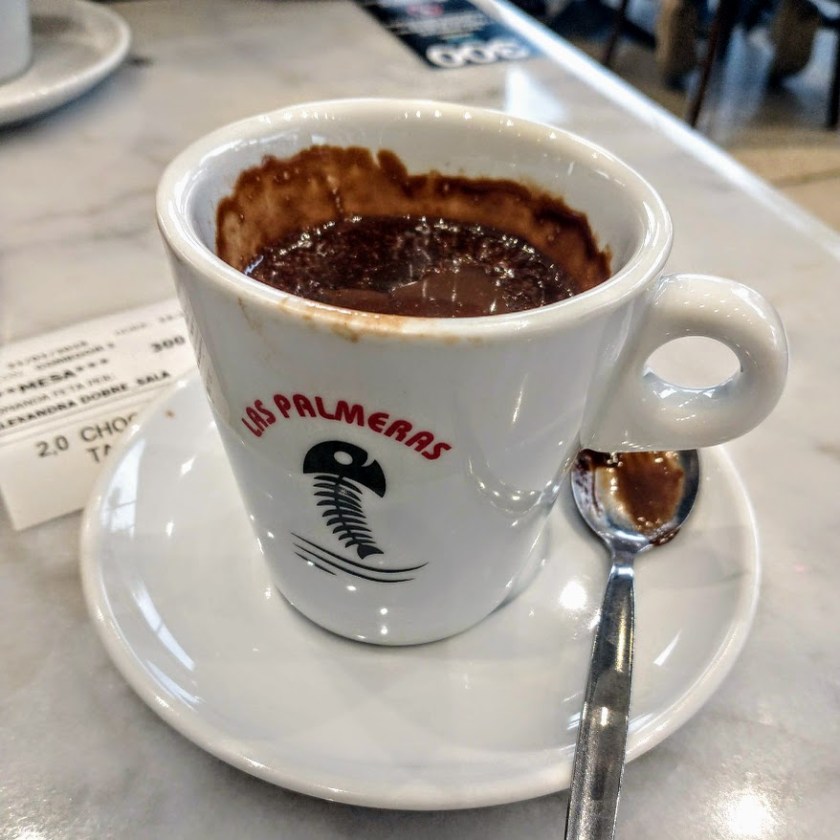
This week, Ritva has proposed Common Objects for this week’s Lens-Artists Challenge. I’m offering a few, such as these coffee shop cups and saucers in the feature photo, served to us by a barista who clearly thought we were Baby Bear, Mummy Bear and Daddy Bear out to enjoy a morning coffee.

Back home, here’s our washing line: featuring the underwear of a colourful guest. And then the washing line itself – or rather its shadow- on the ground below.

Here are common objects put to less common uses. Like these cutlery items re-purposed as decorative works of art in a restaurant in Premia de Mar.

Then there are pillar boxes. I do like the first one, transformed into a slightly surprised face. And the second, from Ripon, reminding us of the D Day commemorations earlier in the summer.

Then there are the everyday things that have become display items. The garden tools in a display of Edwardian gardening implements at RHS Harlow Carr; the padlocks re-purposed as love tokens in Liverpool; and the toilet bowl that’s become a planter in Saltburn.

Let’s finish off with a clutch of jolly handbags parked by the dance troupe 400 Roses as they entertained us all in Masham during the last Sheep Fair.

I am joining Becky and Brian on a mission to get rid of that subscription pop-up box that appears every time someone leaves a comment on your posts. Can you go to ‘Newsletter Settings’? You will find it listed in the main Settings menu on the Dashboard. Then unclick the one that says ‘enable subscription pop-up for commenters’.  You may not even be aware that you have this feature enabled – I didn’t. But it’s an irritation we could all do with getting rid of.

7 x Ducks & Ducklings, Geese & Goslings

For Becky’s Seven for September, and because I often post for Monday Portrait, I’m down at the local duckponds. Dedicated duck-and-geese-counters may notice the odd beak or rear-end tail feathers that don’t quite belong. Please ignore them. Unless they need after all to be included. Then please do not ignore.

Shorelines

This week, Anne of Slow Shutter Speed is encouraging us to look at shorelines for Lens-Artists Challenge #314. And so many of you have. You’ve shown us glorious holiday-brochure sandy shores with perfect blue skies; dramatic rocks and craggy cliffs; urban shores with a dizzying backdrop of skyscrapers; lakesides in gloriously wild surroundings .

I’ve decided to lower expectations, and go for mudflats; rippled sand; eroded rock and stone. And we’ll stay here in the UK.

Alnmouth
Mossyard, Dumfries and Galloway
Heysham, Lancashire.
Filey, North Yorkshire.

There’s no chance you’ll do any sunbathing on any of these beaches. Best go beachcombing. See what you can find.

All found at Mossyard, Dumfries and Galloway.

Six Degrees of Separation: from After Story to Beastings

On the first Saturday of every month, a book is chosen as a starting point and linked to six other books to form a chain. Readers and bloggers are invited to join in by creating their own ‘chain’ leading from the selected book.

Kate: Books are my Favourite and Best

I haven’t read this month’s starting book, After Story, by Larissa Behrendt. I understand it’s about a mother and daughter struggling to come to terms with the death of a sibling. They embark on a journey, visiting the sites important to their literary idols. Idols who include the Brontës. So …

Robert Edric‘s Sanctuary. You can’t be familiar with the brooding moorlands near Howarth and not feel as though you understand something of the Brontë family and their lives. Most of us think we know about them: the mother and sisters who died; the sisters who remained hewing their path towards immortality in slow, painful steps. And then there’s the brother, Bramwell, the black sheep, fighting his failures, his addictions, his inability to find a way to make something of his life. He is the subject, in fact the ‘author’ of this book. He paints a sorry picture of his stumbling path, in the final year of his young life, towards illness, addiction and death. I found the picture he painted of himself – hopelessly depressed, fault-finding, increasingly estranged from his family, increasingly self-deluded a fascinating one. In this book, Bramwell does not dig deep in his moments of introspection, but then you wouldn’t expect him to. He doesn’t favour us with pen portraits of his father, his sisters. Just tantalising glimpses of what they’re like. But nobody is more self-centred, less self-aware than Bramwell Brontë. Edric has carefully constructed this book in a series of vignettes that barely constitute a narrative, but which leave us feeling bewildered sympathy for an intelligent young man who has utterly lost his way. A beautifully imagined reconstruction of a life ill-lived.

Here’s another book re-imagining history. Carys DaviesClear. This is a story about a vanished way of life. One which vanished during the devastating Highland Clearances in Scotland during the 19th century. A man Ivar, the sole inhabitant – with his few animals – of a remote island, is alive to the natural rhythms of the island – the many seasons, winds, mists, rains and tides that govern it. And when John Ferguson turns up to evict him, but instead falls into a concussioned coma from which Ivar nurses him back to health, he too falls under the island’s spell. Haltingly Ferguson begins to learn the vocabulary, then the language itself which Ivar speaks. The books celebrates that language and the fragity of life in such a spot, as well as asking questions about the future of Ivar, John, and John’s wife Mary, all of whom are in different ways implicated in the consequences of the Highland Clearance.

A forbidding terrain and climate are central too to Daniel Mason‘s The Winter Soldier. We’re in Eastern Europe at the beginning of the First World War early on in this book – well, Vienna rather than Easter Europe. Privileged Lucius Krzelewski, medical student, finds himself put in the role of fully-fledged doctor, with only a nurse who’s also a nun, and a few other men – a cook and general hand, in a woefully underequipped and isolated field hospital on the Eastern Front. He does his best to learn his craft, largely from nun Margarete, and has to make decisions about the onward fate of soldiers who leave his care. One such decision has lasting consequences for the soldier concerned, for Margarete and for him. And he falls in love, just before the war sweeps him up once more and makes decisions for him…. A heartfelt and involving story, bringing to life the appalling conditions which so many had to contend with on the Eastern Front.

Another book, another unforgiving landscape in Michael Crummey‘s The Innocents. Set in 19th century Newfoundland, this is the story of a brother and sister, aged about 12 and 10 at the beginning of the book, whose baby sister, then their mother, then their father die after a long period of illness. They are isolated. The nearest town is not near at all, and they get supplies only twice a year, when the ship Hope arrives to buy what they have produced and sell them what they need for the coming year. Evered and Ada cope. They have no choice. The landscape is harsh and unforgiving. Fish and seals are their natural resources. There are occasional adventures – to a shipwerecked vessel, where what they find at first delights, then horrifies them. There are occasional visitors from distant ships: well-drawn characters who add leaven to their lives. It’s the depiction of the landscape, then the story of the maturing of these two lonely, isolated yet self-sufficient children as they become adolescents that gives this book its unusual power. A gripping tale.

We’ll stick with contending with demanding circumstances and landscapes, and with not-so-recent history too by looking at The Lost Wife by Susanna Moore. In 1855, Sarah leaves her abusive husband and her child, to flee from Rhode Island to the American West, Minnesota: Sioux country. Resourceful, she quickly finds a husband, a doctor, who decides his calling is in a community where Native Americans live too. This is the story of a woman who becomes friendly with the indigenous population, and who finds her husband, herself and her children in danger when this population rises in revolt at the unfair treatment routinely meted out to them. In the ensuing uprising, she’s not entirely trusted by some native Americans, but thoroughly despised by her fellow whites. What should have been a gripping rendering of a rather terrifying and unedifying history based on known facts is rather prosaically yet choppily told. A slightly disappointing read, from which I nevertheless learnt a lot about this piece of pre-Civil War American history.

Uncompromising stories set in testing landscapes seem to be this months’s choices. Why change the formula? Beastings is by my current pin-up author, Benjamin Myers. A priest who’s no better than he ought to be enlists the aid of a poacher to pursue a mute young girl, the product of a brutal orphanage, who has made off with a baby whose parents – specifically the father – she mistrusted. Their pursuit takes them across an unyielding and elemental Cumbrian countryside which is itself a character in this austere, bleak novel. It’s not entirely clear when this novel was set, but it doesn’t matter. The Girl (no character is named) meets one or two helpful souls: a woodsman, a farmer, but on the whole she and the baby are alone, trusting to the landscape and the elements as they undertake their increasingly desperate escape from a life with few prospects into an equally bleak and impossible future. A shocking, absorbing, involving story.

My chain this month seems to consist of books which relate more to each other than to the starter book. Ah well. Next month, our book to begin the chain is Colm Tóibín’s Long Island, which has been on my Must Read list since the day it was published.

Photo credits: Me; Ed Philips; National Library of Scotland; Erin Minuskin; Jen Theodore.

Birds of Britain x 7

Bird photography isn’t something I excel at. No long lenses, no patience. But today, just so I can join in three whole challenges listed below, I offer you seven images. Not seven birds, please note. Just seven images.
My feature photo is of an egret and a heron studiously ignoring one another at our local nature reserve.

And my next is of a herring gull. Doubtless it’s a mug shot of him taken at the police station, as he helps police with their enquiries over the matter of the fish and chips snatched from a blameless pensioner eating his take-away fish dinner on the seafront.
The next two are familiar local residents: a robin posing for a Christmas card: and a house sparrow in reflective mood.
Back to the seaside. To the Farne Islands. Here is a puffin stretching his wings: and an irritated Arctic tern objecting to my possibly disturbing his young.

We’ll end where we (nearly) began: with two birds – cormorants in this case, ignoring one another at another local nature reserve.

For Becky’s Seven for September.

And Leanne and Elke‘s Monochrome Madness #16.

And IJ Khanewala’s Bird of the Week.

Seven Oddments from Shropshire

Our time in Shropshire resulted in a few finds that didn’t make it onto the postcards I sent. Now – thanks to Becky’s Seven in September – I have my chance.

Now you can sort out t’other from which.

  • An owl in a Church Stretton garden.
  • An elderly marionette in an elderly pushchair spotted in an antique shop in Ludlow.
  • A pugilistic fairy figure in Bishp’s Castle.
  • More owls – little ones spotted in Shrewsbury.
  • A peacock mincing – very carefully – down steps at Powis Castle.
  • A decorated drainpipe reminiscent of those in Valencia – in Ludlow.
  • A fish van in Shrewsbury.

Seven for September starts with Seven Cows

Seven? Did Becky say that this month’s Squares Challenge was all about the number seven? Well, I’ve only got only three here in my featured photo.

Erm. That’s still only five. Try again …

Not good enough yet … What else can I find?

Seven! Done it! Welcome to SevenforSeptember. I aim to post Seven Times.