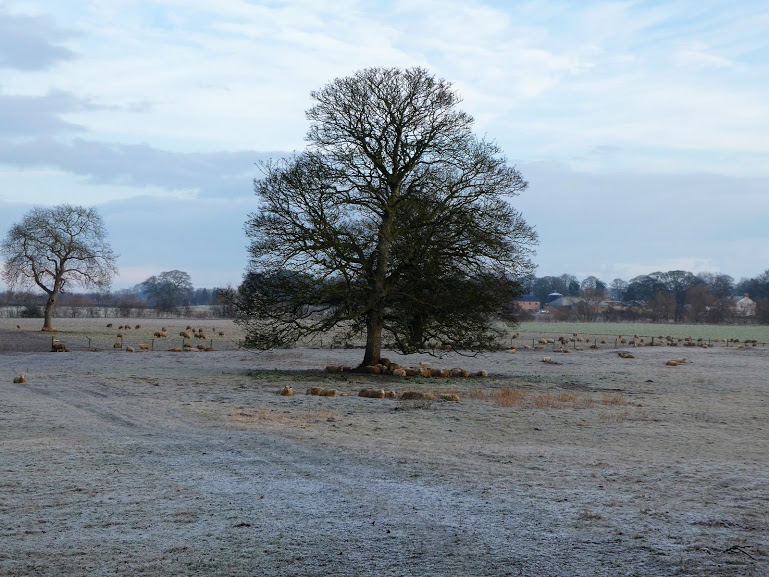
Regular readers know I’m a member of a walking group. Regular readers don’t know that one of the features of our summer programme is a series of evening pub walks: walks of only three or four miles, finishing up at a pub for a convivial meal or drink together. Usually about eight to twelve people come along. This time, it was my turn to lead the walk, which had been publicised round the area in a low-key kind of way.
I’d already been messaged by a Chinese woman who asked if, though they weren’t members of ‘rumbles’, a group of nine of them could come along. Three other new-to-us people got in touch, and on the night, two other ‘newbies’ were there. Then there were Emily and Miquel, over from Spain.
The group of nine proved after all to be eleven, and included two small children. They were an extended family, living in various places all over the north of England, who’d snatched a few precious days staying together at a local campsite.
The usual regulars turned up. I did a quick head count. Twenty nine people….
The walk begins……
Have you ever tried getting twenty nine people over several stiles, down narrow paths, along the lakeside, through the woods, across the fields, down the road and back through the Nature Reserve without losing anyone en route? Actually, because of the small children, the Chinese team left us at half time, but we had fun making new friends and promising to try out the restaurant that one branch of the family runs, many miles north from here.
Sunset over the lake at the Nature Reserve.
The pub coped admirably. In fact only twelve of us chose to eat there, though most of the others stayed for a drink. Here’s free publicity for The Freemason’s Arms, Nosterfield. Great home-cooked food (try the fish and chips if you dare. Massive), provided by a friendly, unflappable team.
Photo courtesy of Miquel, who was almost, but not quite, defeated by this plateful.
‘Yarn bombing is a type of graffiti or street art that employs colourful displays of knitted or crocheted yarn or fibre rather than paint or chalk. It is also called yarn storming, guerrilla knitting, kniffiti, urban knitting, or graffiti knitting.’Wikipedia
Thirsk has adopted yarn bombing in a big way. It’s the town where I first came across it, at Remembrance tide two years ago. St. Mary’s church was festooned – drowned almost – in a sea of poppies knitted by keen volunteers from miles around. It was a arresting, beautiful, and had the effect they were seeking. As we paused to look and admire, we did indeed remember the fallen of the two World Wars.
A display of knitted poppies by Thirsk Yarn Bombers at St Mary’s Church, Thirsk (Photo: Northern Echo)
This year, Thirsk asks us to remember the NHS (National Health Service), now 70 years old. Various knitted offerings are clustered in the Market Square. It’s witty, charming, and reminds us all how much almost every one of us is grateful for the NHS and all who work in it.
The early 1950s were in many ways the fag-end of the war. I lived in Sandhutton, a little village outside Thirsk, where my mother was head of a two-teacher school. I was with the under eights, while she taught the nine to fifteen year olds. Few pupils aimed to pass for Grammar when life as a farm labourer awaited. The school photo confirms my memory. Everything was beige and grey.
Sandhutton School, c.1952, just before I started there as a pupil. My mother is the teacher on the left, and my teacher, Miss Burnett, is on the right.
Sweets were almost unknown, and we were happy to supplement our adequate-but-dull diets by marauding the hedgerows for blackberries and rosehips, or by getting up at four in the morning to go mushrooming on the now-abandoned airfield.
Perhaps that dinginess is why my memory of that meadow is so vivid. Not far from our house, it was where we’d go sometimes when, during the long school summer break, my mother put together a picnic . I enjoyed running wild in the fields, while she managed a rare daytime doze in the sunshine. What I remember is flinging myself down in the grasses which then rasped and tickled my bare legs. I was searching, among the vetch, the buttercups and the poppies for daisies or other small flowers that I could make into a daisy chain. I wasn’t very good at it. The stems would split and mash, and my chain would tumble apart before it had even reached bracelet proportions.
I remember the fuzzing and the droning of the bees and flying things that murmured and hummed about my head; the brief sting of one of the single-minded ants out to seize any of our stray crumbs. I think back to the vivid colours of the meadow flowers – yellow buttercups and vetch, blue cornflowers, white meadowsweet blushing faintly pink or yellow, and the delicate papery petals of scarlet poppies. It smelt – well, green – and wafting from the next field was the sappy smell of recently cut hay. In the early afternoon there were no birds singing. Instead, the whirring of insect wings, the rumble of a distant tractor.
Directly above, as I lay in the grass, were no threatening clouds at all – of course there weren’t – just puffs of white cumulus, or ethereal streaks of cirrus in the perfectly blue sky.
Distance lends enchantment to the view. But it really was like that.
This miscellany of photos doesn’t come from Sandhutton at all, but from bits of North Yorkshire, from Shopshire, from Franconia …. anywhere that has a meadow. Click on any image to see it full size.
If you saw my post at the weekend, you’ll know my head and my heart are just in one place: thinking of little Zoë, one week old today and doing well: her mum has been allowed home, so that’s one milestone. Luckily the hospital is a walkable distance from the family home, so that’s all good.
The Ragtag Challenge word today is ‘blue’. So this gives me a chance to show you William visiting his new little sister as she experiences life under an UV lamp: all good for clearing up the jaundice that many little babies seem to experience shortly after birth.
William watches Zoë.
And here’s the blue knitted octopus that the nurses gave her to clutch at, as she waves those little arms about.
She’s doing well, so far. 29 weeks in the making, and she even has some hair.
William’s parents were expecting a baby. We were all looking forward to meeting her sometime in late October. But things suddenly got dramatic, Sarah got whipped into hospital, and the focus changed to keeping Sarah and the baby stable for – please – just a few more weeks. Or failing that, a few more days.
But the baby was born on 7th August, at only 28 weeks old. She weighed 1.19 kg. (that’s 2 lb. 10 oz. in old money). And so far, all is well, with both mother and baby. I went to meet Zoë (for such is the baby’s name) today.
I was a little wary to tell you the truth. What would I feel about this little scrap, wired up and screened from us in her little plastic incubator, surrounded by a phalanx of monitors, recording graphs and banks of numbers?
It was easy. I fell for her, instantly. Those delicate attenuated toes with their tiny nails! Those gently waving arms! Those slowly blinking, unfocussed blue eyes! She’s a proper little person. We can’t wait to get to know her.
And hooray for the NHS. Between Ellie and this little baby, our family has had its money’s worth.
Best not go and see the Handlebards. Not if you’re hungry, anyway. Here is a theatre troupe who will drink your beer and steal your strawberries all in the name of art.
But our date with the Handlebards has been in the diary since February. Ever since I saw this witty and inventive lot at Bolton Castle last year I’ve been on their mailing list. Last year I saw the female troupe. This year we went to see the men at work. William Shakespeare’s Twelfth Night. Sixteen characters. Four actors. No problem. Men can multi-task too.
The four Handlebards just before it all began.
And multi-task they did. The Queen’s English, broad Scots, Northern accents all had their places. Hats, jackets and gilets all stood in for the characters who wore them, but who were temporarily detained in another role. Balloons barely concealed behind an voluminous white pinny lent girth and a (sort of) female form to Maria, while sporting a little number in prettily sprigged voile enabled us to understand that the (bearded) Olivia was now on stage.
Olivia.
Maria.
Occasionally audience members were pressed into service. The cast took any opportunity to help themselves to crisps, wine and cake, legitimising the thefts by working them into the action on stage. Nobody thus deprived of their picnic minded at all. Picnic? Yes, it was a lovely summer’s evening. We’d all spread ourselves over the lawn of the Ripon Workhouse Museum, armed with blankets, garden chairs and baskets of treats. Gruel was not on the menu.
See what I mean? Who stole the crisps?
It was all a bit exhausting, even for the delighted audience. How the troupe summon up the energy to cycle off to a new venue day after day is beyond me. But that’s what they do, up and down the length of the kingdom throughout the summer season. ‘Have bike, will perform’ must be their motto. Here’s what they say:
Since 2013, the HandleBards have clocked-up over 7000 miles by cycling around the world to perform Shakespeare. Described by none other than Sir Ian McKellen as ‘uproariously funny’, we set the world on wheels with our unique brand of extremely energetic, charmingly chaotic, environmentally friendly cycle-powered theatre.
We love an adventure.
You really should go and see them after all. And take a picnic. A picnic big enough to share.
We don’t live near the sea: 61 miles, to be exact. But sometimes, on a hot day, only a wide expanse of water will fit the bill. And that’s what Nosterfield, fewer than four miles away can provide. It was – and still is – a gravel quarry. On any day of the week, you’ll see great yellow trucks lumbering down the road, laden with gravel. Back before the 1980s, this area was a lunar landscape: sand and gravel pits, gargantuan earthmovers,spoilheaps. Some of it still is.
Mid afternoon’s not a busy time for birds: the water level’s low too.
But in the 1990s, a professional landscape architect, Simon Warwick, spotted its potential. He’d noticed how even as an industrial site, the area attracted thousands of migrating ducks and geese each autumn. Parts of the site were no longer economically viable and no longer being worked. Not without considerable difficulty, he established the Lower Ure Conservation Trust, and focused on creating an area of wet grassland, with water attached – sometimes extensive lakes, and at other times drying out into muddy scrapes. Native flora were allowed to regenerate naturally.
The lakes can be full …..….. or empty.
Wildfowl are delighted. Wading birds are enchanted. 200 species of bird make use of this service station for birds, halfway between the important migratory staging posts of the Dee Estuary and Teesmouth. Birdspotters and nature lovers generally love this place, and the well-appointed hides that are a feature of the site are rarely out of use.
I wonder who’s on that scrape over there?
Greylag geese.
If, like us, you’re strictly amateur in your knowledge of birds, you might love it too. It’s a tranquil place, except when the birds are having spirited and raucous exchanges, and a perfect place to spend an hour or two at any time of year. But especially on a hot day in summer, with a cooling breeze drifting from the waterside. With wild cherries, apples, plums and blackberries on offer, you’ll even have a snack provided.
I’ve got lots of readers with Yorkshire connections. With addresses in Australia, southern France, London, Northumbria, Spain and East Sussex, among other places, I bet not one of them has celebrated Yorkshire Day.
Who knew? Not me. Not anyone I know. We all bumbled through life in the 1970s, 80s, 90s, and though the early years of the twenty first century, blissfully unaware until about five years ago that we were supposed to be partying for Yorkshire.
Two Ripon shops take Yorkshire Day seriously.
Now Yorkshire cities take it in turn to host Yorkshire Day, and this year it is Ripon’s turn. This meant a fairground in the Market Square, a procession with a band and civic dignitaries, a service in the cathedral, picnicking in the Park, and all manner of stalls in the town centre, mainly celebrating Yorkshire charities and institutions.
It’s early yet. It’s still quiet round the Town Hall.
If you can’t see the procession, catch it om your phone ….
A fine marching band.
Good old Punch and Judy: ‘That’s the way to do it!’
This bank of flowere was a great place for photo opportunities.
Such as The National Trust’s stall celebrating Fountains Abbey & Studley Royal. I was there. I was one of a small team encouraging mainly families to have fun. A few punters dressed up as monks from the Abbey, or as fine Georgian ladies who might have enjoyed the Studley Royal Water Gardens. Most children – boys and girls – got enthusiastic about using the kind of wool which was produced in abundance at Fountains Abbey to get stuck into simple weaving. They chose their colours with care, threaded their shuttles, and wove, wove, wove. They ended up with nothing more elaborate than a bookmark, but goodness, they treasured them, and handed them carefully to mums, grandads – anyone who would put them safely away till they arrived home.
All that hand-dyed wool! Best get stuck into weaving.
And we all ate Wilfra Cakes. That’s a sort of apple pie cooked with Wensleydale cheese, and a long-forgotten Ripon delicacy, produced thanks to the Workhouse Museum.
If we go back this evening, there are bands playing, and a big firework display. Well, any excuse for a party in God’s Own Country. Why not?
Diaphanous sugar-pink wraiths trailing long floating tendrils pulsated gently round their royal blue tank: hypnotic: mesmerising. They neither paused nor hurried. They simply oscillated, surged, ebbed, flowed. These ethereal creatures didn’t merit their prosaic name of Black Star Northern Sea Nettle. Who dreamed that one up?
When we finally left them to it, we discovered we hadn’t finished with pulsing creatures. Here was a Blue Spotted Ribbon-Tail Ray. He gently wove round the tank, his flat body slowly rippling to the rhythm of his inner pulse.
William helpfully points out the Blue-spotted Ribbon Tail Ray.
Then there were the frogs. Look at these two Amazon Milk Frogs. They had nothing to do but regard us without interest, as their chests swelled and deflated – pulse, pulse.
Two Amazon Milk Frogs, so called from the sticky white substance they secrete through their skin when threatened.
Haworth: a charming village on the top of a high and steep hill, in an area of high, bleak and steep hills; home to the Brontë sisters and the surrounding moorland countryside of Wuthering Heights.
Cottages near Haworth. Cosy now: possibly less picturesque back in the Brontë’s time.
Everyone knows that you can expect ‘weather’ when you come here, whatever time of year you arrive. As you stumble along the church path to leave the village, slashing rain tumbling from sullen hostile skies needles your skin, slicks your hair to your face and saturates your clothes. As you set your face against the wild wind, your boots sink into the sodden peaty turf as you trudge onto the moor. If you dare to glance up, you see unending moorland before you: bleak, barren and bare, with sheep huddled against the dry stone walls which march across the landscape. This is Nature-in-the-Raw, and we expect no different.
I went there earlier this week. None of the above applied.
We are in Week Five of a heatwave. I doubt if either the Brontës or even Heathcliff himself had ever seen the like. Brittle coir matting now carpets the brooding moorland fells: and several weeks early, the heather is almost in flower, rich and purple. Yellowing grasses replace the dense green turf the sheep prefer, whispering and rustling in the light breeze.
Beyond Haworth, coir matting stands in for moorland turf.
There’s a little brook in the valley here. Angry peaty water jostling officiously along its path has been replaced by still, clear shallow pools.
The brook by Brontë bridge.
The Brontë sisters would cheerfully have paused here to rest, reflect and write a little. Then, like me, they would have slogged on, up the peat-and-stone pathway that leads upwards, ever upwards, towards Top Withens.
There’s Top Withens, up there. Beside that solitary tree.
Top Withens may have been the isolated upland farmhouse that Emily Brontë pictured Cathy Earnshaw and family living in when she wrote Wuthering Heights. It’s a ruin now, the roof torn off in a violent thunderstorm in the 1890s. Just as you’d expect.
It was the perfect picnic spot for me. The moorland stretched before me, its hillsides rhythmically rising and falling. The world was silent: not that silence in which there is no sound, but that of the living countryside: the low susuration of the swaying grasses; the humming of the wind in my ears; the occasional complaint of a bird sweeping overhead. Beyond the moorland, greener fields lay, chopped centuries ago into rough rectangles by drystone walls. Some held sheep, some cattle, others recently cut hay. The sun warmed my rocky seat, and I was perfectly content.
Except for the sky. The day was sultry, sweaty, but freshened by a soft breeze. I knew the sun might be chased away by gusty rain. Ash-grey clouds swelled and receded, revealing granite tones behind: and beyond that, cornflower blue once more. It was a signal. Haworth takes weather seriously. Never be tempted to climb these uplands without a very capable waterproof in your kit.
The moorland I saw this week was not the Brontë’s moorland. It’s been a little sanitised. There are helpful finger posts pointing the way at every junction, in English and … Japanese.
Top Withens or Top Withins? Take your pick. I don’t know which the Japanese choose.
The pathways the sisters trod are no longer springy peat tracks, or sticky muddy gullies. Instead, heavy slabs line the way, to prevent footfall damage to this fragile area from the hundreds of people who tramp these paths looking for the Real Brontë Experience.
My day was far too comfortable for that. I was not returning to a draughty parsonage with self-destructive brother Branwell to worry about. If you want to see the Brontë’s life through his eyes, read Robert Edric’s ‘Sanctuary’. You’ll be glad to get back to bustling tourist-destination Haworth for a nice cup of tea.
This post fits nicely into one of the Ragtag Daily Challenges this week: Travel. There’s no need to cross the ocean or even take your passport to discover sights worth experiencing.
You must be logged in to post a comment.