Most of us living in Britain know something about the model villages built by philanthropic industrialists in the 19th century. With the advent of the Industrial Revolution, workers poured in from the countryside to a filthy urban environment. They found, alongside work for long hours in the newly-established factories, hastily built, crowded, poor quality housing with no facilities.
Some philanthropic factory owners decided to do things differently. Robert Owen built New Lanark for his miners. Titus Salt built Saltaire near Bradford for his textile workers. William Lever, 1st Viscount Leverhulme built Port Sunlight for his soap workers. And so on. All these communities offered decent, usually terraced housing with a small amount of outside space. There was a shop, a school, an institute for adult learners, a health-care facility of some kind, certainly a church. There was not however, a pub, or anywhere where alcohol was sold. Workers at the time often drowned out the reality of their miserable lives by drinking, and those philanthropists wanted a different life for their workers, whether they liked it or not.
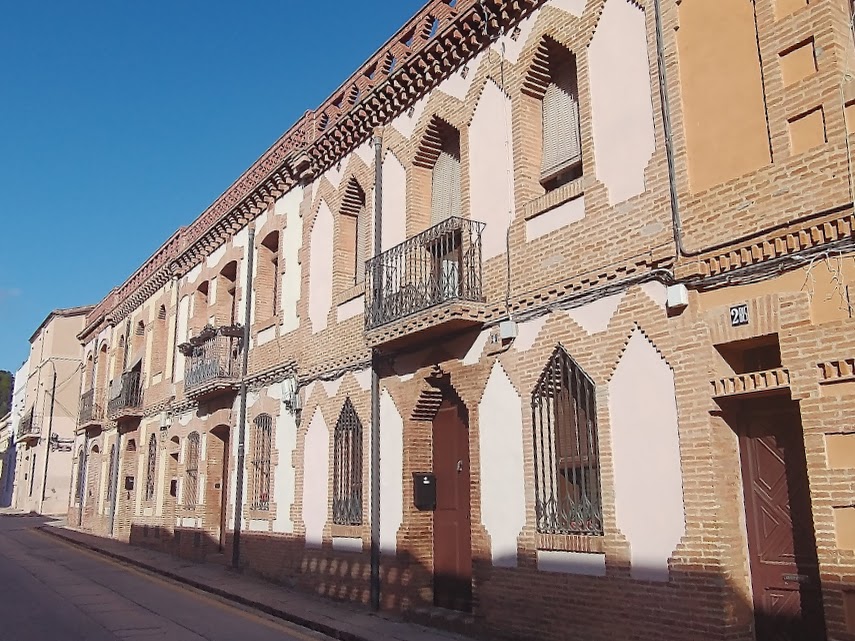
So we were interested to visit Colonia Güell when we found out about it. It’s a similar set up in a manufacturing area, Santa Coloma de Cervelló, just outside Barcelona. Spain’s industrial revolution came later than ours: but in 1890, industrialist Eusebio Güell realised that if he wanted to attract workers from Barcelona to the factory he was building on his country estate – an essentially rural area – he would have to provide housing. And like his British counterparts, he wanted to do The Right Thing.
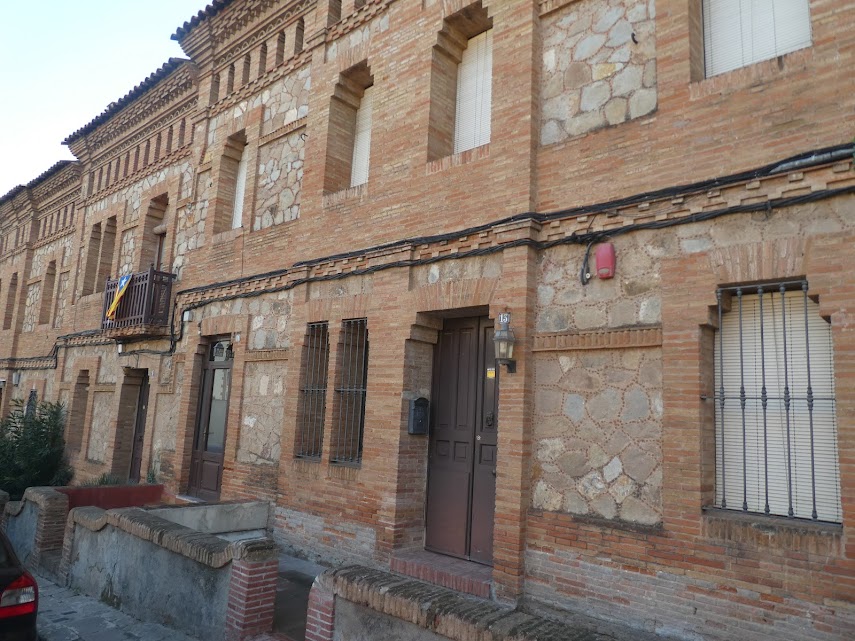
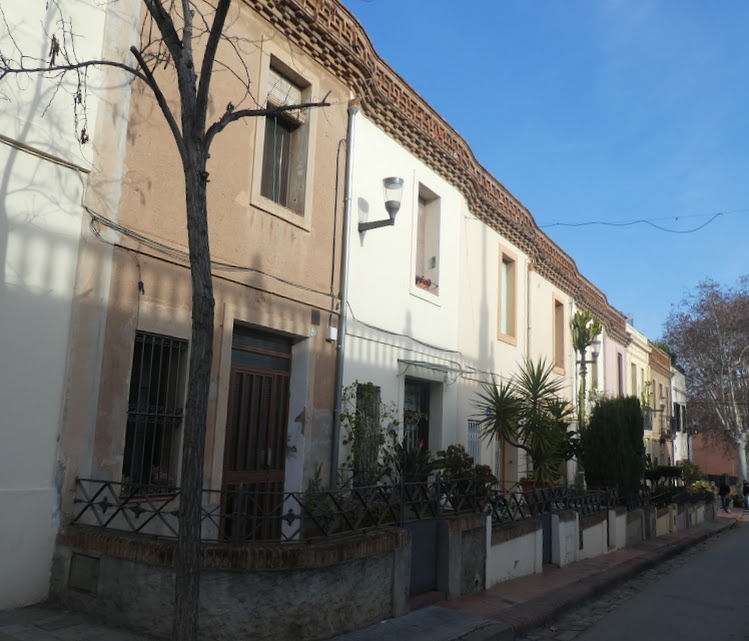
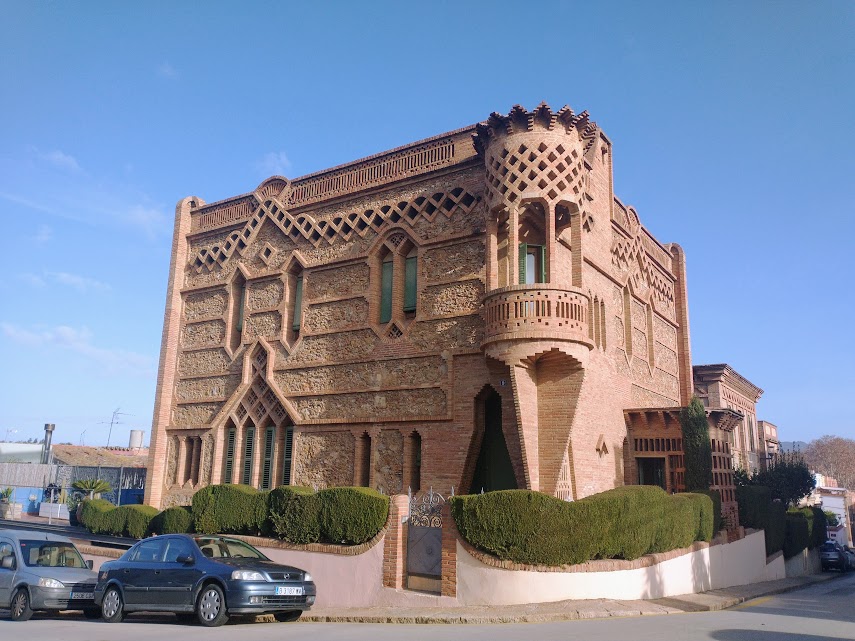
Eusebio Güell didn’t just want to have any old housing. He sought out the best architects of the day, disciples of the Modernista movement: the ideas behind Art Nouveau found particularly vibrant expression in Catalonia. More details here.
He provided decent housing for both workers and professionals in spacious streets, the factory itself of course, a theatre, a doctor’s surgery, a school. The school however was for boys only. In many ways it was progressive, teaching foreign languages as well as the three Rs. But girls had to make do with being taught embroidery and other manual skills that would make them dextrous with machinery when they went to work later on. Nuns at the convent taught them, and also provided a nursery so that mothers could return to work soon after they had given birth.
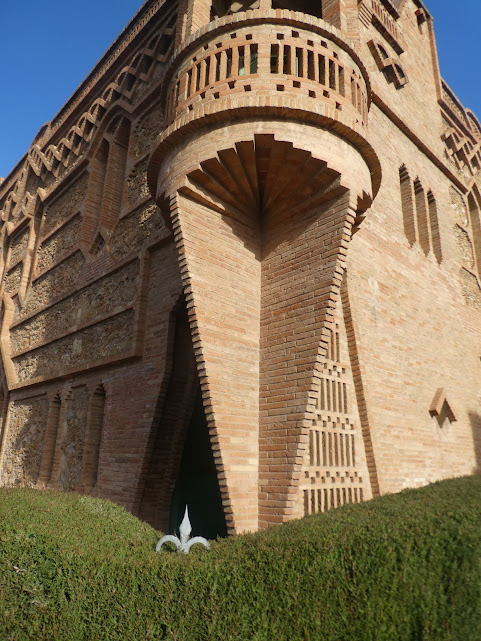


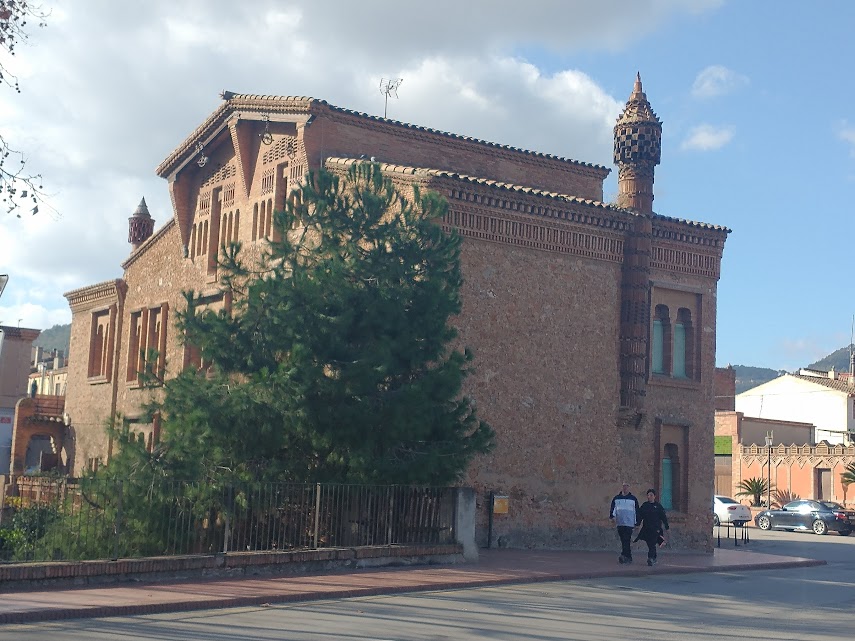
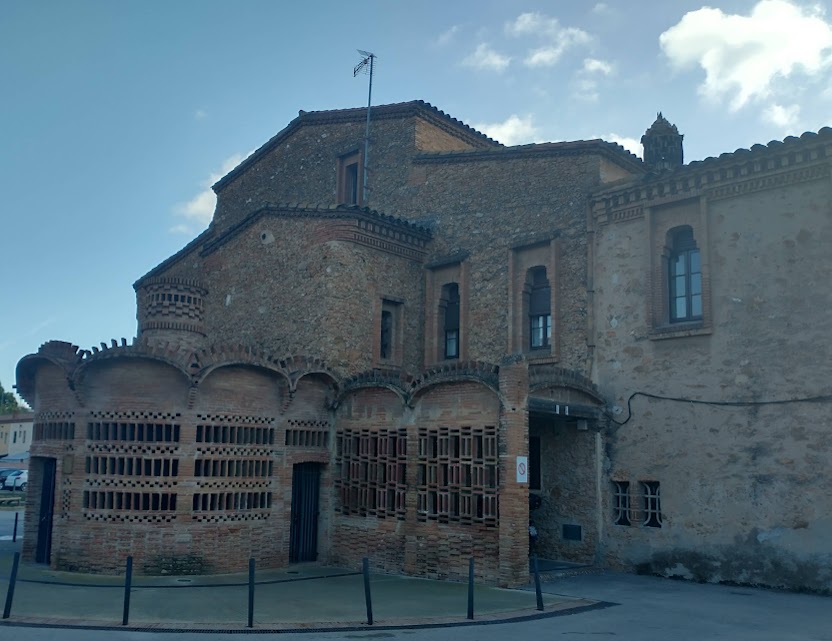
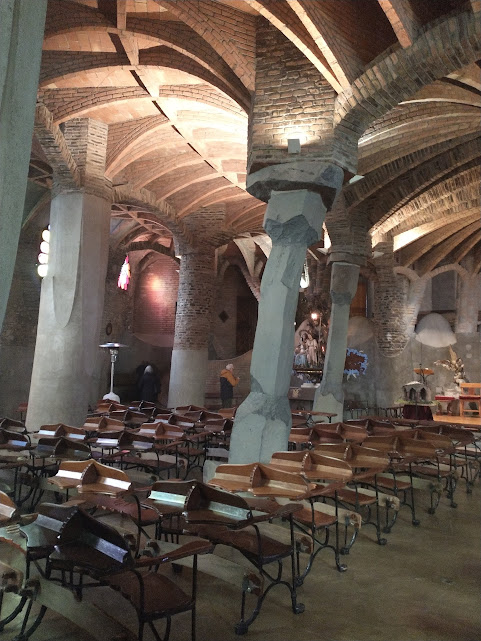
Of course there was a church. And in 1898 Eusebio Güell commissioned the young Antonio Gaudí to design and build it. Had it been finished, this church would have been as ambitious a project as Gaudí ‘s still not quite finished Sagrada Familia. Two naves, lower and upper! Towers! A central 40 foot dome!
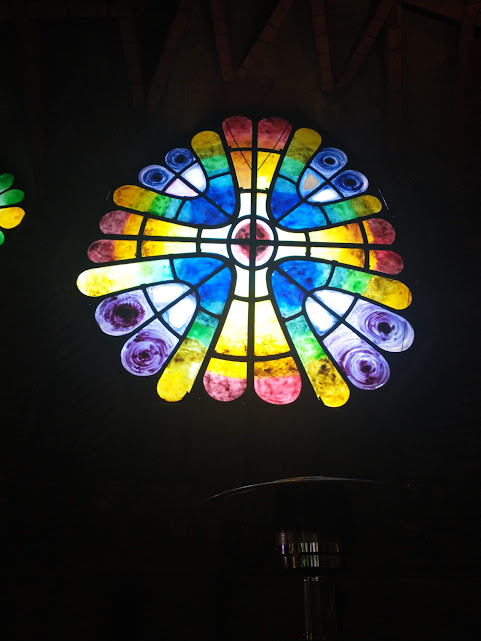
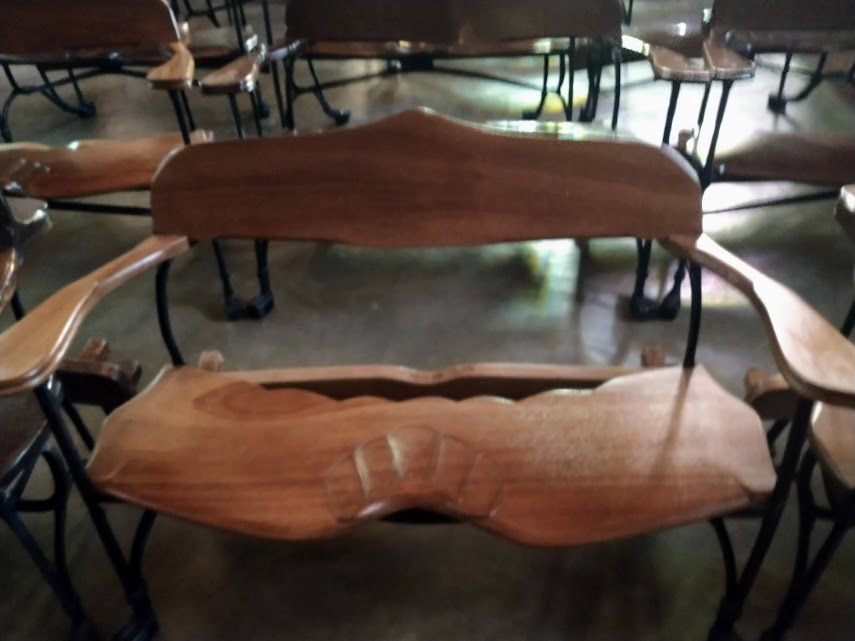
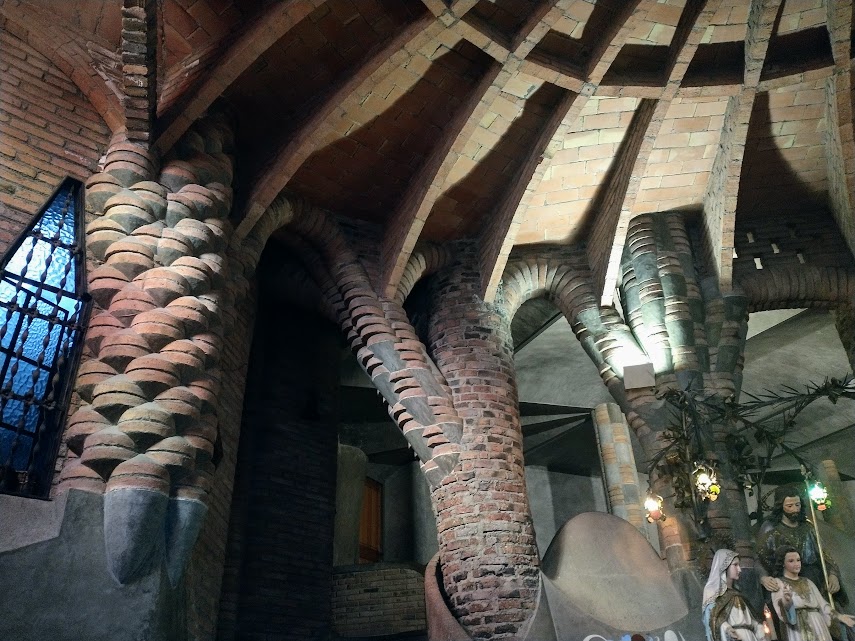
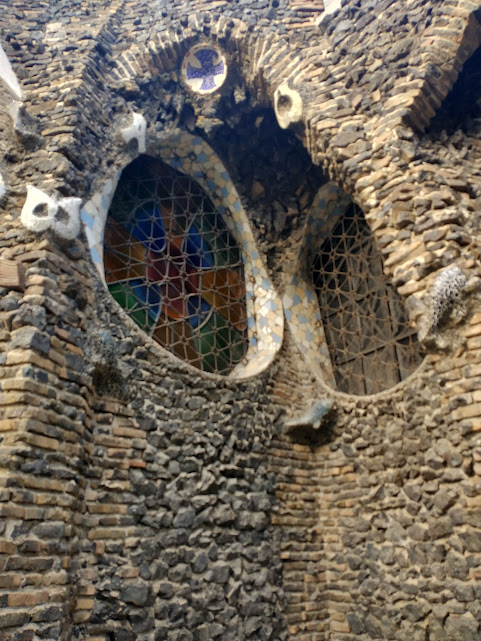
The building was begun, but in 1914 the Güell family decided to stop funding the project and Gaudí turned his back on it with only the lower nave completed, now known as the crypt. It was consecrated in 1915. I found it difficult to photograph, but here is a miscellany of shots from the inside and outside of an astonishing building.

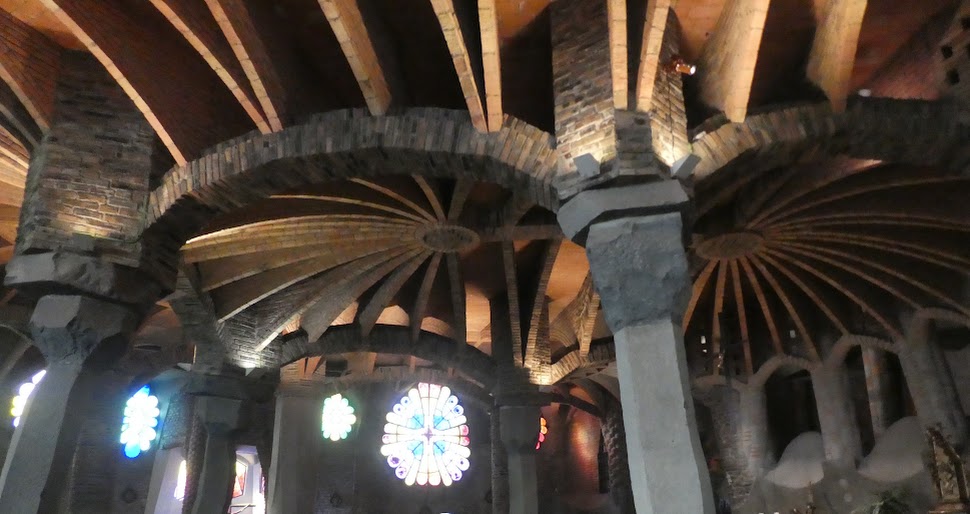

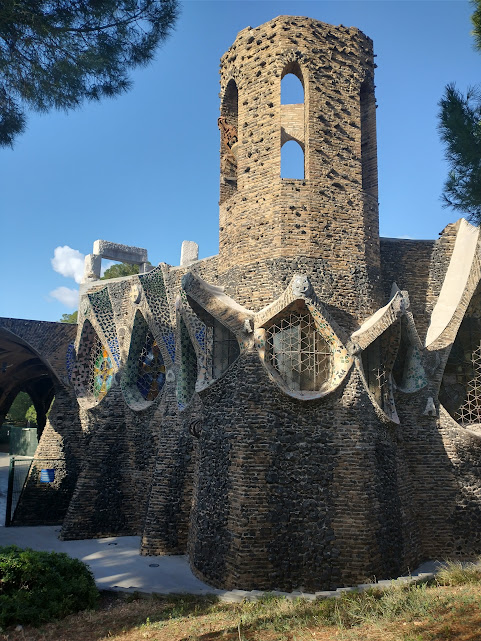
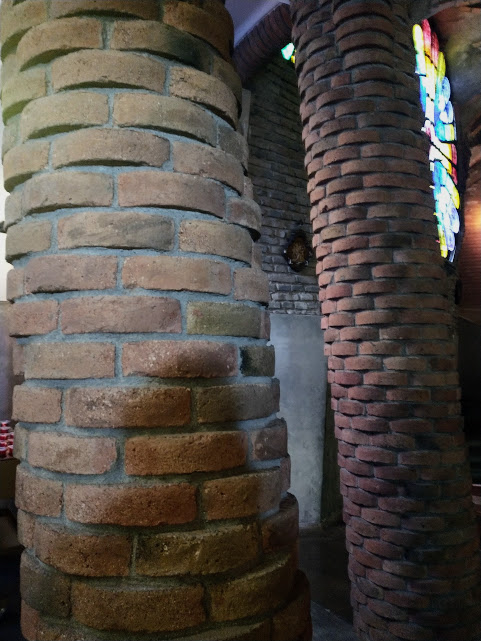
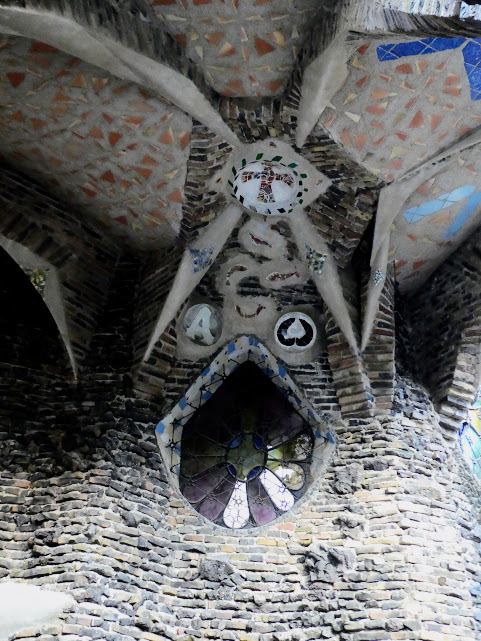
During the Spanish Civil War, the mill was collectivised and run by its workers. After the war it was sold back to the Güell family, who sold it on again. Its days were numbered. The textile industry in Europe was collapsing and the factory ceased production in 1973. The factory itself was sold off piecemeal, and the houses to their residents. The settlement was in danger of losing its identity. But in 1990 the Colonia Güell was declared a ‘Heritage of Cultural Interest’ by the Spanish government and the protection of some of its most relevant buildings was established. Nowadays it’s an ordinary working community with an extraordinary history.
We enjoyed walking round and exploring. Sadly, we couldn’t see the factory. On Sunday its current many and various component businesses are shut, the gate to the site barred.
It’s not the easiest place to reach from Barcelona without a car, and as these things are apt to change, I won’t include public transport options. But we’re so glad to have visited, and will go again.

 From Pyrenees to Pennines
My brother lived in Barcelona in the early ’90s so I visited often but knew nothing about this. Looking at the dates, it was probably still being restored then. Great to hear it’s back to being lived in by ordinary people.
LikeLiked by 1 person
It’s taken us ten years to get there! And yes, it might well not really have been visitable at that point. It’s still hard to reach without a car,
LikeLiked by 1 person
Fabulous Margaret, has to be one of the most interesting architects
LikeLiked by 1 person
He has the most extraordinary mind, hasn’t he?
LikeLiked by 1 person
Very
LikeLiked by 1 person
Very interesting. I have been to Barcelona a number of times bit did nit know about this. Perhaps next time I’ll visit. I have been to Park Guell which also was never completely finished.
LikeLiked by 1 person
It’s a tricky place to get to, which is why it’s relatively under-visited. Even Park Guell is a bit of a schlep.
LikeLiked by 1 person
It’s up a steep hill. We had to take a taxi but it was worth it. xo
LikeLiked by 1 person
Definitely. Taxis aren’t expensive in Spain in any case.
LikeLiked by 1 person
This is fascinating history, so well told in pics and words. Thank you Margaret for this interesting lesson and powerful presentation. You are an excellent photographer/reporter, amongst many other qualities you have! I would love to visit but chances are slim we ever return to Barcelona and this treasure. I bet the Guell family regretted in hindsight the stopping of this extraordinary architectural masterpiece .
LikeLiked by 1 person
I bet they did. I hope they did. And thank you for your kind words. We too though are beginning to realise how many travelling dreams will probably remain unrealised.
LikeLiked by 1 person
How interesting, and what a fascinating uncompleted church
LikeLiked by 1 person
It really is a stunner. 3.00 tomorrow by the way? Still OK?
LikeLiked by 1 person
Still OK, and on for 3pm tomorrow, look forward to your invite!
LikeLiked by 1 person
👍
LikeLiked by 1 person
Fascinating piece of history. I enjoyed reading about it.
LikeLiked by 1 person
Thanks. It’s definitely worth exploring.
LikeLike
I will put it on my list.
LikeLiked by 1 person
This is the best of blogging, when you read of things you would never know about other wise.
Happy Valentine’s Day!
LikeLiked by 2 people
You too Marian – and thank you.
LikeLike
I see a bunny rabbit in your final picture. Is it just me?
LikeLiked by 1 person
Just you, Peter, though I see what you mean. Think – dragon.
LikeLiked by 2 people
Dragon who missed his dental appointment!
LikeLiked by 1 person
Such a shame that the church was never finished, but nice to know that the community is being preserved and that it is a place where people still live. Thanks for taking us there.
LikeLiked by 1 person
It’s a bit in the back of beyond, despite being able to see nearby Barcelona from there. I wonder what day to day life there is really like.
LikeLiked by 1 person
That all looks really fabulous. What a lovely environment to live in (though I expect life was still extremely hard for the original occupants).
LikeLiked by 1 person
I’m sure it was. Though an improvement on city-living for the workers. As in the UK.
LikeLiked by 1 person
What an interesting excursion with you. Thar Chapel is spectacular with all those twists in brick. I feel I was there. Thank you.
LikeLiked by 2 people
And thank you. Yes, those organic columns are quite something.
LikeLiked by 1 person
Gorgeous details, thanks for sharing
LikeLiked by 1 person
And thanks for reading!
LikeLike
Thanks for the tip! Interesting to see early Gaudí. Great photos despite challenging lighting.
LikeLiked by 1 person
Thank you! Another thing for your Barcelona check list.
LikeLiked by 1 person
That’s so interesting. I didn’t know Guell was such a philanthropist.
LikeLiked by 1 person
Nor me. I hardly knew him in fact!
LikeLiked by 1 person
Such an enlightening post with beautiful photos! The manager’s house is beautiful. What an interesting idea to build a city for someone’s employees. Thanks for sharing this great post.
LikeLiked by 1 person
It’s a to some extent forgotten about piece of Barcelona’s history. So glad we went.
LikeLiked by 1 person
Beautiful photos and fascinating historical information, Margaret! Such a revolutionary idea and great effort to build these decent houses, facilities… for workers. Thank you for sharing with us!
LikeLiked by 1 person
It’s a fascinating village that ‘hangs together’ well.
LikeLiked by 1 person
So this is the chapel you ‘teased’ us with some time ago. What an amazing building, even if unfinished! And the story behind the factory, housing etc is interesting in the way it echoes our model villages, as you say
LikeLiked by 1 person
If finished, I think it would have been his magnum opus, and La Sagrada Familia might have been a much less indulgent creation. He had high hopes at the time, anyway.
LikeLiked by 1 person
It’s extraordinary, and has Gaudi’s signature for sure. I’m not surprised you found it difficult to photograph. In some ways I found it difficult to look at. But I can only applaud the concept.
LikeLiked by 1 person
It’s probably my favourite Gaudí so far. So fluidly organic. I’ll definitely go again.
LikeLiked by 1 person
The houses look lovely – much more decorative than the utilitarian houses often built for workers here. I love the round turret on the factory manager’s house.
LikeLiked by 1 person
It’s a handsome place indeed.
LikeLiked by 1 person
awww I should’ve known of this place when I went there the last time. Oh well, thanks for taking me here to see it.
LikeLiked by 1 person
Without a car, it’s actually quite difficult, hence its not being on the Tourist Trail.
LikeLiked by 1 person
Oh that is why. We just walked everywhere in Barcelona.
LikeLiked by 1 person
That’s definitely the way to get to know the city.
LikeLiked by 1 person