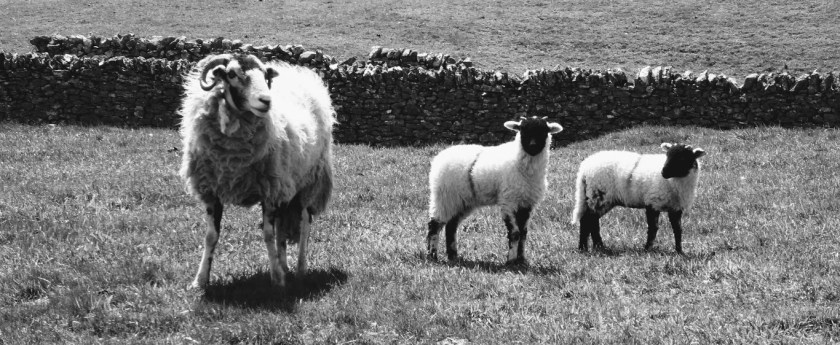
Yorkshire has over 8000 km. of drystone walls.
Constructing these walls is an ancient art which seems in no danger of dying out: younger generations continue to learn the skills needed. Large stones are carefully jigsawed together into 5′ to 7′ high walls. Here are some instructions:
‘Gather and sort the stone by size in a type that complements and harmonises with the landscape such as limestone, grit stone or sandstone. Make foundations level and about a yard wide. Large stones go at the bottom butting against each other. All other stones must make contact with others and have the weight back into the wall and the face facing. With each layer of stone fill in void spaces with smaller stones to ‘bind’ the wall. The wall should taper like a flat topped ‘ A’, this slope is called the batter. ‘Throughs’ are the large heavy stones laid across the wall at intervals for extra strength. Topping stones as the name suggests are the icing on the cake also called coping, cap or comb stones. Cheeks or Heads are the end stones. A Cripple hole is a rectangular opening at the base of a wall built to permit the passage of sheep. Also known as a hogg hole, lonky or lunky hole, sheep run, sheep smoose, smout hole, thawl or thirl hole. Smoot hole is to allow Rabbits and Hare to move through or even small streams.’
(From Yorkshire: God’s Own County)


I love these ancient technical terms. I love the order these walls impose upon the landscape, as they perform their traditional task of dividing fields, and keeping sheep in their place.
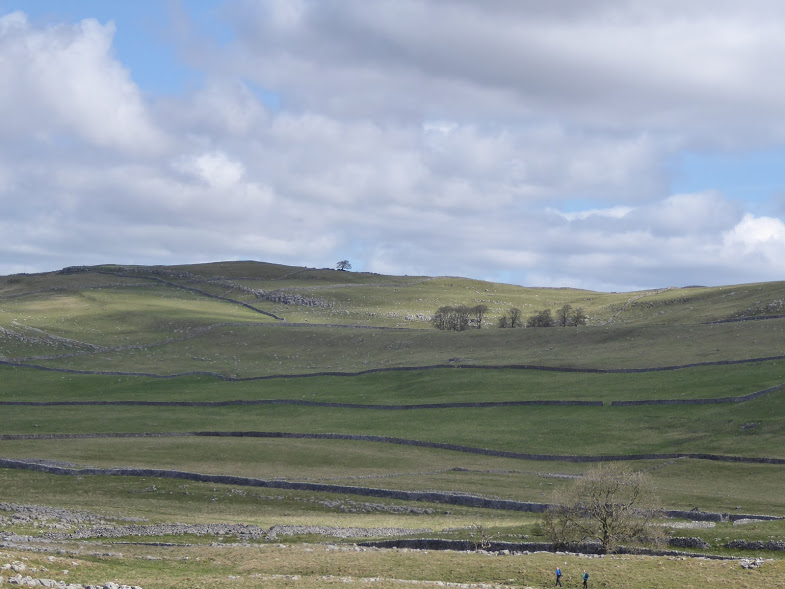
This week’s WordPress photo challenge is ‘Order’.

 From Pyrenees to Pennines
I, too, love the look of drystone walls.
LikeLiked by 2 people
They seem to be such a part of the landscape I can’t imagine it without them.
LikeLike
I love dry stone walls…and the term ‘smoot hole’. At least now I have an excuse when my efforts at fencing go awry…’They’re smoot holes of course’….
LikeLiked by 2 people
Great words, aren’t they? Not sure you’re entitled to use them though. Not from God’s Own Country, see?
LikeLike
We used to have a corner shop in Marton Road, Middlesbrough…doesn’t that give me dual citizenship??
LikeLiked by 1 person
Hmm. Just maybe 😉
LikeLike
Beautiful post❣️The last photo is a gem, deserves a frame.
LikeLiked by 1 person
Oh, thank you. That’s a real compliment coming from you.
LikeLiked by 1 person
Margaret; this post is AWESOME!
Giggling (indecently loud) reading all those names to Hero Husband over late espressos
Sighing (deeply) over those magnificent walls
Smiling (dopey smiles) over the brilliant sheep pics
I LOVE ALL OF THESE,
– the sheep – Oh how I miss them after 8.5yrs in South Devon!!! – We still have one sheep – not to be taken too literally! – swinging from the back-mirror in the car, bought in Lynmouth North Devon – along with honey & other stuff on a visit, now 18yrs ago!!!
– the drystone walls – we had one around our Victorian house in Torquay and have one around our land here in France too, pretty hard leaning over steeply and in some danger to fall down on the road at some point (hopefully long after we’ll have left here…..). Am so glad to read that this art is being preserved and passed on.
– those landscapes with rolling hills
– those names!!!! THOSE NAMES!!! I start laughing out loud again – just went over them once more. And I remember fondly how we sometimes had no idea what villages our Devonian were talking about because the swallowed 9/10th of the names 🙂 But with times we caught up nicely and we don’t say Glochester any more but Glostə like the ‘vrai Gloucesterians’…. LOL, so many memories and so much nostalgia for our time – and even though we visit every year (Devon) and see how much it all changes and sadly not often for the better – we still have our heartstrings tugged ….
How’s Ellie? And the boys? I won’t have to ask after the dog, I know HE is well… 🙂
LikeLiked by 1 person
Yes, those names are pretty good aren’t they? And I’m impressed by your actually having had your own drystone walls. Ellie and the boys on the home stretch now. Thank you. Fingers crossed.
LikeLike
Such a great post, Margaret–both the excellent photos and the fun background on the technical terms. I remember my father and grandfather picking stubborn stone from the rocky soil on the farm. They made walls but I think it was more just something to do with all those stones than any real craft. Hard work!
LikeLiked by 1 person
Even a wall made without the rule book is quite an achievement in my eyes. And I knew you would like the technical terms!
LikeLike
Beautiful, homesick now 😊
LikeLiked by 1 person
I don’t think I knew you were from this part of the world.
LikeLiked by 1 person
Well, technically I’m not, as in I wasn’t born there, but I think I have explained previously that I was born on the other sode of the Pennines and my hb in Yorkshire. We lived in and around Leeds for many years, often taking the kids on Sunday drives in the Morris Minor. Burnsall was a favourite, it had a little stream and small patch of sand in the middle of a field. We would go to Harrogate with a horde of neighbourhood kids to buy American ice-cream. We took them on Ilkley Moor so my hb could teach them how to sing what may as well be his national anthem 😄
LikeLiked by 1 person
Of course! Sorry, you have – I’m getting senile. Excellent place, Burnsall. I’m not sure I know what American ice cream is though.
LikeLiked by 1 person
There used to be an American Ice-Cream Parlour in Harrogate that had lots of excitng flavours unknown to us Brits at the time. We were used to vanilla, strawberry and chocolate but they had wonderful combinations like pistachio and almond, tutti-frutti, mint choc chip, rum and raisin etc.
LikeLiked by 1 person
…. and not a calorie or an e-number in sight ….. 😉
LikeLiked by 1 person
😄😋
LikeLiked by 1 person
I love the Yorkshire dry stone walls, so different from those in the Cotswolds.
LikeLiked by 1 person
Indeed. And connoisseurs can even tell which area of Yorkshire they’re in by glancing at the walls.
LikeLike
You trying to make me homesick? Think I am ready to come home!! 😐
LikeLike
Well, today’s Mediaeval event at Fountains was rained off, and I’m currently wearing a cosy fleece and cosier socks. Are you sure you want to come home?
LikeLike
Fascinating, and great take on the theme.
LikeLiked by 1 person
It is interesting how dry stone walls have become a feature in some modern garden landscaping, even ‘down under’. I also love your sheep photos.
LikeLiked by 1 person
Sheep are always rewarding subjects. Dry stone walling as garden feature? Well, that’s different!
LikeLike
One thing I missed seeing (well, one of many things), while in England was you wonderful stone walls. I have said many times that those walls would be enough to bring me back one day!
LikeLiked by 1 person
Whenever you can come, those walls will be waiting for you!
LikeLike
Oh thanks so much for that post. I’m fascinated by dry stone walls. Let’s hope that this craft never dies out.
LikeLiked by 1 person
I think there’s life in it yet. Lots of people know the skills and are handing them on.
LikeLiked by 1 person
Great post, Margaret. I am so pleased that this art is still being practised; I see evidence of this in my travels round the country. There has been a recent resurgence here in hedge-laying for which I am truly glad. More of the local farmers are starting to keep sheep again, which may have something to do with it.
LikeLiked by 1 person
Good to know that the traditional way of ‘fencing’ is doing well in your part of the world too. I’m just reading Stephen Moss’s book ‘Wild Kingdom’ though, which demonstrates there is a lot of work and re-education still to do.
LikeLiked by 1 person
That book looks interesting! Another one to add to my lengthening list!
LikeLiked by 1 person
Hopeless, getting through the book pile, isn’t it? Perhaps we should give up sleeping?
LikeLiked by 1 person
Now that’s an idea!
LikeLiked by 1 person
I meant to add that Dina is quite right about your last photo (in my humble opinion) – it is a beauty!
LikeLiked by 1 person
Thank you!
LikeLiked by 1 person
Oh, I know. Too many books, too little time.
LikeLike