This post is really just a chance to post a few photos from a couple of recent walks, one in the Ariège, and one in the Aude. Each walk brought out some of the contrasts and similarities between the two Départements.
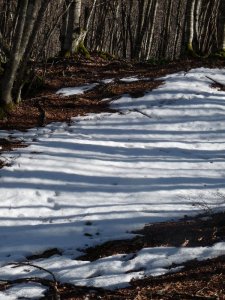
The more local walk, near Ventenac last Sunday, was near meadows where cattle grazed, through fields being prepared for sowing feed crops such as maize, and through oak and beech forest. Though there are villages dotted about, the area is still thinly populated, densely forested. During the Second World War it provided cover for the Spanish Maquis , scourge of the German army. With the support of many, but not all locals, the Maquis came to regard the area as a centre of gravity, from which they emerged to pass soldiers and refugees across the mountains, and to organise acts of resistance to German occupation . You’ll find monuments to their activities, their battles, their acts of martyrdom all over the area. It’s easy to see how, in this large territory, with under-developed links of communication, the Germans had such difficulties keeping tabs on the Maquis’ whereabouts.


Over in the Aude on Thursday, near Esperaza, we saw no farm animals, but our path took us past vineyards where the vines were being hard-pruned ready for 6 months of vigorous growth and grape production. Martine, from a wine-producing family, explained some of the different methods of pruning – and there are dozens. Older varieties of vine, unsupported by wires, may be pruned with an open centre, so the core looks almost like a bowl. Other kinds of grape usually require training along wires: all sorts of schools of thought here. These days, much harvesting is mechanical. Martine’s family send their grapes to a wine co-operative for processing. This co-operative sends an oenologist every year to analyse their grapes and those of all the other members of the cooperative. Then he will book everybody a two-day spot with the mechanical harvester at what he believes to be the optimum moment for their particular harvest. Few grapes cannot be harvested in this way, but the local Blanquette de Limoux is one. Its low-growing grapes are unsuited to mechanical methods. With wine-production the main agricultural industry, the villages here have a properous air to them.


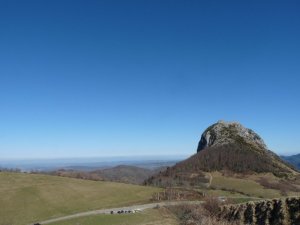
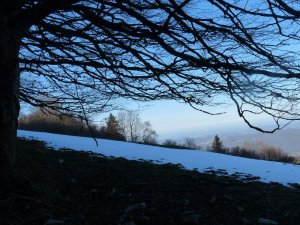
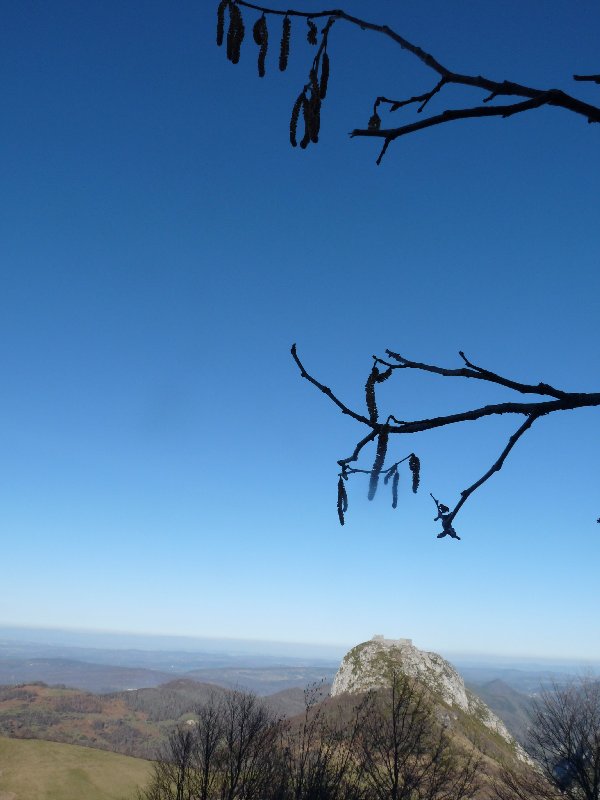
Both walks shared a fair bit up uphill (and therefore downhill) marching. And in both cases, the rewards were in the views of the distant Pyrenees, still covered in snow. In the Ariège, you’ll be looking to recognise the peaks of Saint Barthélemy and Soularac, whereas in the Aude, you’ll have no difficulty in recognising Bugarach looming above the surrounding peaks.
These last walks are bitter-sweet. We’re enjoying them, but not enjoying the fact that, for the time being, there are (almost) no more to come.











 From Pyrenees to Pennines
You must be logged in to post a comment.