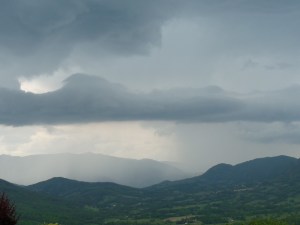
We’ve all had it. Months and months of horrible weather. Especially rain. Even now, when things are slowly picking up here, we expect to have all kinds of weather within a single day. Beautifully hot skin-warming sun may be followed by lashing winds, summer showers, or deluging heavy downpours. Glance up at the sky, and it will be in turn a cloudless azure, or bright blue patched with blowsy puffs of white cumulus. Or it may be grey, or even black. If the clouds aren’t coursing lazily across the heavens, they may be tearing across the sky so swiftly that they’ll have disappeared from view if you glance away only for a few moments. The rivers are still full to overflowing.
Farmers are in a mess. They’ve only just begun to cut their hay, when normally they’d be onto their second harvest. Seeds have failed to germinate in the cold and wet. Often they haven’t been planted at all in the sodden and waterlogged fields. Preparations to take cattle and sheep up into the highland summer pastures have had to be postponed, with snow still on the ground at higher levels.
At last though, we walkers are once more getting out and about. We choose our routes with care, because thick sticky mud has made some of our favourite walks unuseable. Where we can walk though, spring has at last sprung. Familiar paths have become narrow passages edged by massed armies of knee-high grasses, shocking in their vibrant greenness. And our favourite spring flowers that by now should be sun-shrivelled and long past their best romp across meadows and pastureland, and spread across their favourite sun-warmed stones. Here are a few that we’ve enjoyed finding in the last days and weeks.


UPDATE: After she’d read this post, a kind friend, AnnA, wrote to a botanist friend of hers enlisting help in identifying the flowers I’ve shown. Here’s some of what she said. Reading from the top, left to right:
2. Globulaire rampante – Globularia repens (Creeping Globularia)
3. Hélianthème – Helianthemum Alpestre (Alpine rock rose)
5. Perhaps from the Linacée family. She needs a photo of the leaves. Watch this space
6. Céphalanthère à longues feuilles – Cephalanthera longifolia (Sword-leaved Helleborine)
8. Oeillet – Dianthus – (Dianthus). She needs more info. to help her be more precise.
She’s asked to see more of the leaves, and to be told as well where the flowers were found and at what altitude. There’s such a lot to it. I had no idea and am so grateful for all this help.
 From Pyrenees to Pennines
You must be logged in to post a comment.