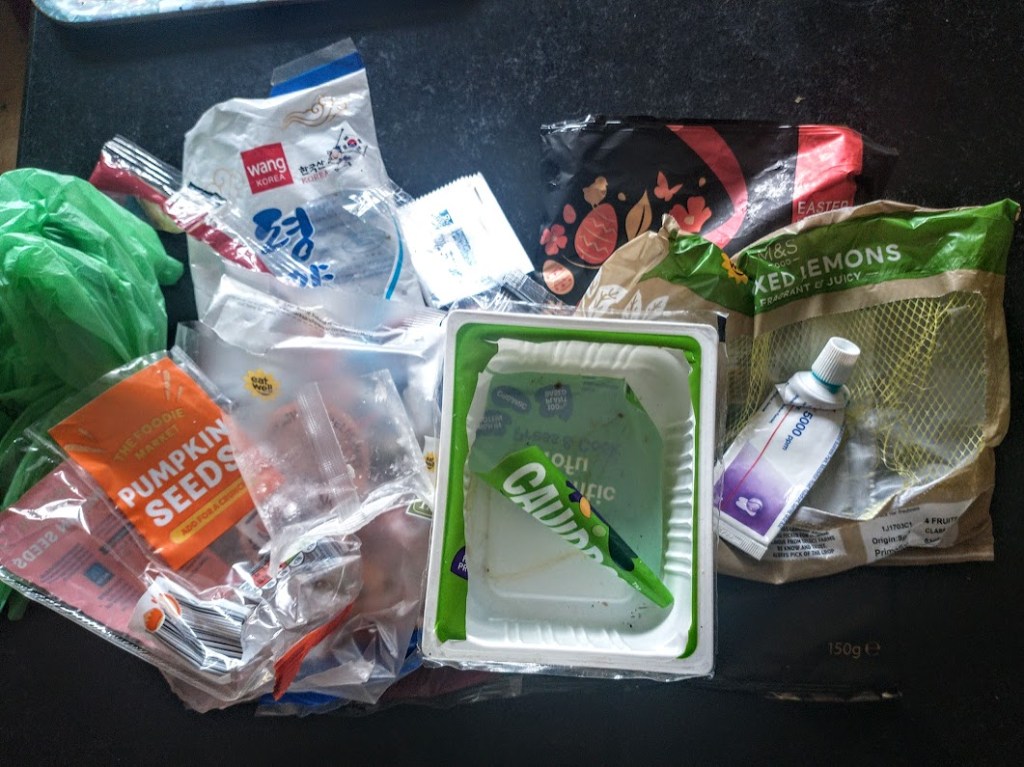
British readers! Did you take part in The Big Plastic Count last week? We did. It involved tallying together every single bit of single-use plastic that we bought that week. The yoghourt pot. And the plastic film that covered it beneath the lid if it was a a big pot. The plastic net bag that the satsumas were in. The cellophaney-plastic that the package of pasta/rice/dried fruit/coffee/tea/you name it was packaged in. The plastic disc wedged into the lid of the (plastic) pot of kimchi. The cling film parcelling up the cheese, bought loose from the cheese counter. And so on.
So why did we do it? Well. The Big Plastic Count is a Citizen Science project aimed at collecting evidence on household plastic waste to pressure government and supermarkets to take action. It challenges the idea that solving the crisis is purely a personal responsibility, arguing for systemic change to reduce plastic production.
So we and hundreds of like-minded individuals, school students, cubs, brownies, scouts, guides, U3A groups and so on tracked our plastic waste for one week to build a realistic picture of how much plastic is thrown away and what happens to it, highlighting that much less is recycled than widely believed.
Past results showed that only 12% of UK plastic waste is recycled, while 45% is incinerated, 25% is landfilled, and 17% is exported.
Honestly, we try to be plastic free. We buy unpackaged goods where we can, use our local refill shop, never use products like clingfilm. But still we assembled 18 pieces of plastic last week.
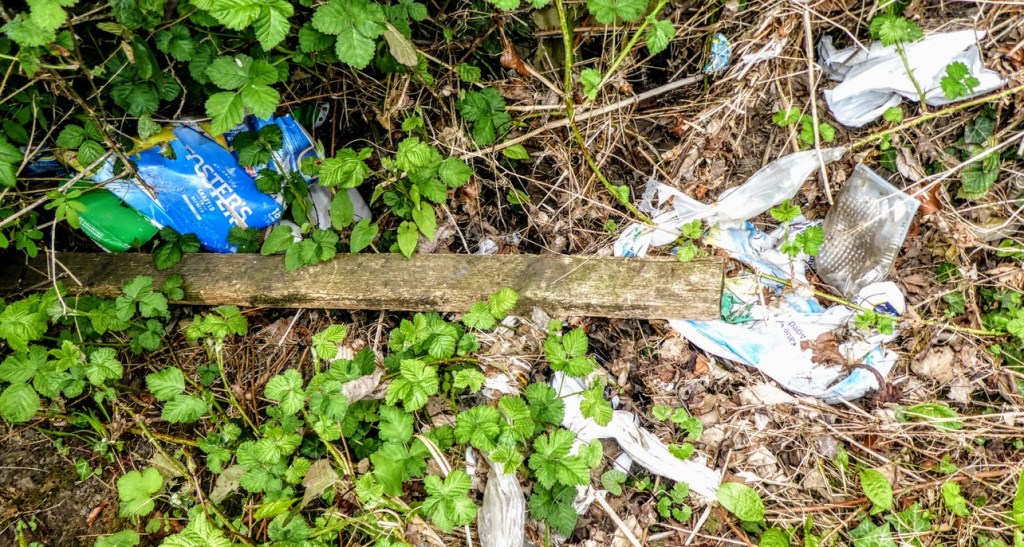
Litter is a whole other issue. Living in the country, as we do, albeit along a main road, the quantity of plastic bottles, crisp packets and other packaging that we see on any roadside stroll is truly shocking. The same applies to a beachside walk.
On a personal level, this audit encouraged me to redouble our efforts to cut out single-use plastic. Whether our results, gathered countrywide, have any effect on either government or supermarkets remains to be seen. And whether the world will eventually be knee-deep in plastic waste, as we ingest a daily diet of micro-plastics also remains to be seen.

 From Pyrenees to Pennines
I didn’t know about the big plastic count, but a quick look at the accumulation waiting to go in the recycling this week, about twenty pieces here too. There would be only one or two pieces if I was doing the shopping by myself.
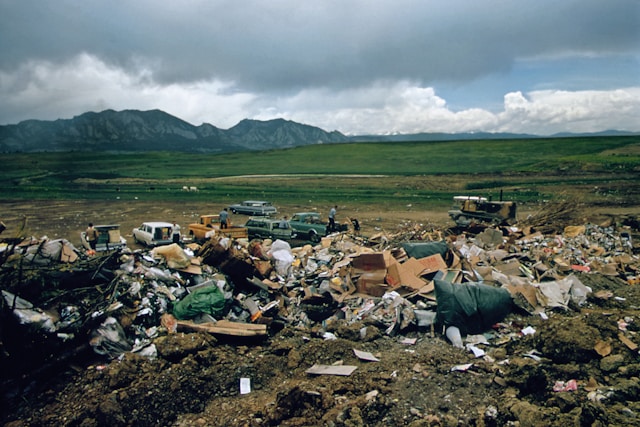
And while we complain about litter on the roadsides locally, it’s nothing compared with what we saw on the motorways while driving across the Midlands to Norfolk last week. So, depressing.
LikeLiked by 2 people
It’s always shoving to compare our own motorway verges with those on the continent. And I’m gald to say that the roadside photo I took, though fairly local, is not typical of round here. Which is however, not great.
LikeLiked by 2 people
Good for you! I try to use less plastic but I’m not as diligent as you. And then I meet my neighbour in the elevator and I catch a glance at his bags (canvas) and his contents (plastic) and I dismay.
LikeLiked by 1 person
Oh well. He’s taken the first step. I have got The Bug a bit, but of course I’m not infallible. I should, for example, be making my own yoghourt to avoid those plastic cartons.
LikeLike
Well the first step is mandated in Germany. Plastic bags are available but they cost (and are not cheap). I used to make yoghurt but I hardly eat them anymore and my husband likes the flavoured kind and my flavouring is not up to par.
LikeLiked by 1 person
Yeah, I must get round to making yoghourt. We eat plain anyway, so that’s OK. Carrier bags cost here too now, but not bags round individual products. We have a long way to go.
LikeLiked by 1 person
It’s not easy, is it? Even if you use a local butcher rather than the supermarket, the meat goes into a plastic bag. Butter is more readily available in plastic tubs, though I go for foil wrapped wherever I can. I reuse plastic bags in place of clingfilm, but things like detergents and bleach are always in solid plastic containers. I’m sad to say we make quite a few trips to the recycling. And yes- we get very cross about roadside litter too. Just why? xx
LikeLiked by 1 person
As I replied to Anabel, we are lucky to have refill shops for things like detergents. And we don’t have mains drainage here, so bleach is forbidden to us. I’m always impressed by how – on the whole – we don’t see roadside liter in Spain so I assumed it was the same in Portugal? But it’s all so depressing ….
LikeLike
The towns are constantly being swept, Margaret, so they are ok but you do find that people have abandoned plastic bottles and packaging in some of the access roads. I hate it! We have a clean-up group on Sunday mornings but it shouldn’t be necessary.
We had a refill shop in Hartlepool but I think it closed down xx
LikeLike
Well done you for cleaning up! Poor Hartlepool. We went there recently, and it really seemed down on its uppers. The main street was just plain sad. Such a shame.
LikeLiked by 1 person
We did take part – for the third time and I’m pleased to say our count has gone down each time but it’s not nearly as good as yours. Slightly unfortunate when things like the big bottles of olive oil, detergent and washing up liquid all decided to run out last week! 3 bottles in the recycling right there.
LikeLiked by 1 person
We’re lucky in having a good refill shop, so household detergents, washing up liquid, shampoo and anything like that come from there. Olive oil I buy in glass bottles aynway. I always worry about oils kept in plastic leaching micro-plastics and phthalates into the oil. I was born to worry!
LikeLiked by 2 people
Great work. Agree this is not just about personal action there needs to be a real game changer from the food industry plus others too. I am surprised the big yoghurt pots are not recyclable. And those plastic nets around fruit too are so insidious. Not sure here in Spain how much of the recycling bins do get recycled.
LikeLiked by 2 people
Well, in Emily’s town in Catalonia, every group of homes gets access-by-key to particular street bins, and all has to be sorted and placed in the correct compartments, or there are Consequences! So now quite a lot gets dumped outside said bins! Oh, the big yoghourt pot ARE recyclable. I’d just sooner they were returnable glass. Or something. And grrr to all pre-packed fruit and veg. Spain seems much better at avoiding that. (OK. Maybe just Ametller Origen and the neighbourhood grengroceries run by immigrant families)
LikeLiked by 1 person
Lidl here has a better mix but agree local greengrocers and there amazing displays sin plastico are the best.
Oh thank goodness no keys for bins yet in our part of Andalucia and this works really quite well except for some shopkeepers and the cardboard packaging… but bins sorted at least twice a week. Always consequences if rubbish is made too difficult. West London was good until the dumps became privatised and book your slot online, only once a week too, add in high turnover of let properties and terrible increase in flytipping. Hope all brightening up in UK.
LikeLike
Te weather is brightening. Other than that, not a bright world just now.
LikeLiked by 1 person
I didn’t know about it, but a quick look in my plastic recycling bag is pretty terrible. Milk, yogurt, juice, smoothie, berry cartons, cream, olives the list goes on. Around 20 items for the fortnight.
LikeLiked by 1 person
That’s not too bad. I had 18 in a week remember!
LikeLiked by 1 person
We have for years recycled all plastic for several years, but we also recycle, organic waste, paper, cardboard, glass and metal and it is sad the amount of plastic, it requires the biggest bin and fills up quickly. But all of this is collected from our complex . Plastic bottles are taken to local food stores
LikeLiked by 2 people
We do all of the above here – except return bottles to the store. Som of us have been campaigning for this for years, but it doesn’t happen.
LikeLiked by 1 person
it works great, I hope you get it some day.
LikeLiked by 1 person
It’s great to see the efforts to recycle and reduce plastic waste. We’ve been doing that, and more recently, composting was also added as an option for us. We can save compostable items in a bucket. Every two weeks, the service comes by to exchange the bucket for a clean one.
LikeLiked by 1 person
Yes, we have that here too. But then, there’s the plastic that inadvertently gets into compost. There are still teabags which are partly – and invisibly – made of plastic. It’s all pretty pernicious, even for the well-intentioned.
LikeLike
I think it is a great idea. I will modify this and analyze our single plastic use. And check whether and how we can personally reduce it in our household. And yes, littering is also a big problem here in Germany. Ok, I cannot throw away what I do not get. So the supermarkets and producers might be a part of the problem. But the main problem are the people who don’t care and do not carry their stuff home to put them at least in the recycling bin.
LikeLike
Maybe the problem really lies with the manufacturers who over-package in the first place. A plastic box AND a plastic sleeve for a humble packet of biscuits? Really? My personal bugbear is firms who seem to be using paper, but when you open the pack, it’s … plastic lined. On balance, you’re all much better in Germany than we are.
LikeLiked by 1 person
Sure, the manufacturers bear a big part of the situation. But we as consumers have a lot of possibilities to reduce plastic, too. So, for me it says, not to wait but to act. And in the supermarket, if there is a product wrapped in plastic and it can be carried without it, I put the plastic in their trash bins. Not the best solution, but may be a signal.
LikeLiked by 1 person
Indeed. It may be those small personal choices that in the end swing the balance.
LikeLiked by 1 person
Wish I’d known about this count – I would have happily taken part. Earlier today I was complaining to my parents that recycling initiatives are really targeting the wrong issue. Real progress in plastic waste reduction isn’t going to happen until you reduce the production of products involving plastic. I remember hearing from one of the environmental managers where I worked that waste reduction (doesn’t matter what the waste is) should always follow the sequence of reduce – reuse – recycle. In other words, recycling should only happen when you’ve tackled the other steps.
LikeLiked by 1 person
Exactly. So much of the stuff that is plastic-packaged could easily be sold in other ways – even not packaged at all. And I was brought up in that post-war generation of Make Do and Mend. But even though I tried to bring my children up the same way, they’re much more prone to chuck stuff than I am. It’s going toi be a slow process. You can join in the count next year!
LikeLike
I don’t know how things work in your neck of the woods, but here in Melbourne our council provides four bins. One for glass, one for green waste, garden clippings and kitchen organic waste. A third for paper, cardboard and plastic containers. If there’s anything left it goes in the ‘rubbish’ bin. What happens after that I don’t know, I just hope that those of the next stage do the right thing.
LikeLike
That’s the case here too. But too many people either don’t bother at all, or don’t do it right. To be fair, sorting out ‘good’ plastic from ‘bad’ plastic is degree-level stuff half the time. And as to the next stage? Hmmmm….
LikeLike
Quite possibly shipped off shore, at great expense both eco and $, to a poorer country for recycling or disposal. Sorry for getting a tad negative. Have a great day!
LikeLiked by 1 person
But you’re right. And I wish you weren’t. Yes, you have a good day too.
LikeLiked by 1 person
That sounds like an interesting initiative, though I bet the worst offenders wouldn’t take part.
When I was young and in my Earth Mother phase, making *everything* from scratch, even Worcester Sauce, there was a campaign to force change by unwrapping stuff and leaving it at the counter. Men’s shirts used to come in plastic boxes with cardboard and all sorts of plastic bits holding the collars stiff, and we would take it all off the shirt, and put it into our carry bags. Shop assistants bore the brunt of that (and we always apologised) but it did work, men’s shirts are now sold on hangers, or neatly folded on tables.
The rot set in when Japanese stuff became fashionable. I remember so vividly going into a shop in Docklands to buy some of those little cups for Japanese tea, with matching plates for sushi and whatnot, and the assistant used up more tissue and wrapping paper than I did for all my gift giving in a year, and then put it into their own branded carry bag. I was astonished, but it became the norm, and now you see people getting endless stuff (especially clothing) in carry bags stuffed with tissue. But *grumpy frown* I don’t suppose those buyers of fast fashion care anyway… No one can convince me that young people care about the environment and climate change when I see them in shopping centres with armfuls of those carry bags stuffed with t-shirts that they wear once, five in each hand. And it’s not people my age who are littering the roadsides with takeaway food packaging.
Change has to come from consumers and the manufacturers. When Cussons stopped packaging their soap in simple cardboard wrappers, and replaced them with three layers (cardboard, plastic, cardboard) I wrote and complained and the reply was that consumers wouldn’t buy the soap if it was chipped. Sure, we can make our own yoghurt and ice-cream to avoid the plastic, and I do, but it’s not a solution when so many claim to be ‘time-poor’. They’re just not going to do it.
LikeLike
You’re a really great example to us Lisa. I don’t write as often as I should to ‘offending’ manufacturers. And perhaps you have given me the push I need to make my own yoghourt. Ice cream I can live without. Usually.
LikeLike
I can’t live without ice-cream and making my own has turned me into an ice-cream snob. Plus, I’ve experimented with all kinds of weird and wonderful flavours including avocado, brown bread (truly!) and my dinner guests’ favourite, orange and cardamom. But you do need a proper ice-cream maker that chills and churns or else it’s way too much hassle. Somebody gave us for a wedding present, one of the ones that you have to chill the tub in the freezer first and it was such a pain I only used it twice.
The same is true with yoghurt. The right equipment makes it easy. I have a David and Waddell which is super simple to use, but if I were buying one now I’d buy the Wolstead one that sets it in (reusable) little tubs like the ones you can buy in supermarkets but without the plastic. That would stop me from giving myself too-greedy serves…
LikeLiked by 1 person
That’s why I don’t make ice cream – no room in my freezer for a freezer tub. It probably isn’t worth our while to buy a stand-alone fpr the amount we eat. We have an excellent ice cream farm nearby. But brown bread ice cream, and damson ice cream are the two best flavours in the entire world! Your suggestions re yoghourt makers noted – thanks!
LikeLiked by 1 person
I didn’t hear about this and I suspect if I had done and taken part I would have found rather more than I would like to admit to! We are super-careful about recycling (and Ealing as a council take it seriously) but I know it builds up. I do look for non-plastic alternatives where I can but it’s not always feasible – and I don’t see me taking up yoghurt making I’m afraid.
LikeLiked by 1 person
Yoghurt making is my next challenge!
LikeLiked by 1 person
This is a great idea to raise awareness, Margaret. Wonderful that you took part.
LikeLiked by 1 person
But will it change anything????
LikeLiked by 1 person
I believe it is up to us as consumers to demand the companies do better using recyclable materials.
LikeLiked by 1 person
There’s a big movement supporting change. But it’s mighty slow, and often token.
LikeLiked by 1 person
That sounds like a good idea.
LikeLiked by 1 person
It is … if it brings change. Don’t hold your breath!
LikeLike
We have such a long way to go…. What depresses me most is the litter in this country- what is it about people rhat they think it’s okay to chuck their litter anywhere on the street on verges but not in the bin Aaaargh
LikeLiked by 1 person
I know. There aas a crisp packet half way up our drive this morning. You can bet it wasn’t one of us. 😒
LikeLike
Grrrr
LikeLike
How sobering that only 12% of plastic waste is actually recycled. I am aware that a lot of what is put into recycling bins actually can’t practically be recycled. In any case recycling plastic is not a ‘clean’ process. So reducing packaging is the way to go, so I hope this interesting campaign does lead to changes in the packaging system.
LikeLiked by 1 person
They’ve been banging away for some years. It’s a long struggle.
LikeLiked by 1 person
I’m not sure how The Big Plastic Count has escaped my attention. It’s the Great British Spring Clean these two weeks, though, and I’m organising a neighbourhood litter pick on Saturday morning with borrowed equipment from the Council. I’m disappointed that (out of a community Facebook group of 500+ people) I’ve only gotten 3 people to commit to join me so far. Nonetheless, even just a few of us working for an hour or two will make a big difference.
LikeLike
Good for you. I love a good litter-pick. Not so much when, only a week later, we seem to be back to Square One.
LikeLike