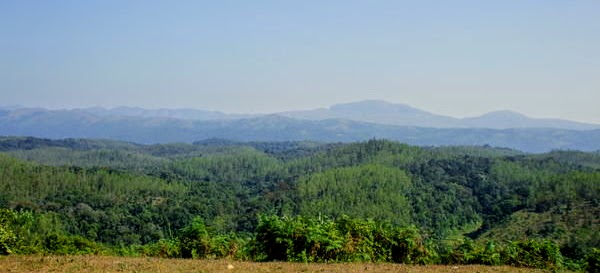
I rather enjoyed re-visiting India via my blog the other week. So I went and dug out the diary I faithfully kept. The events it describes have never yet seen the light of day. For the first ten days I was with the group of people my ex-brother-in-law had put together, to explore aspects of rural Indian life, focussing on small producers working in traditional and organic ways. We had no internet access during that period.
I’ve decided to share my diary with you. This will take several Fridays. I’m pleased that I kept such a detailed record of a piece of personal history, and of a country I’d never visited. I wonder how dated this account would seem to the current traveller?
Tea Plantation Day
18th November 2007
Tea Plantation day! We set off later than we should have – who knows why? Led by Ravi, who pointed out vine snakes, trees, all sorts. We were VERY late at Ludwig’s and he had to go out soon. I was pretty annoyed, and I suspect L was too. He’s German, but has lived and worked here for many years.

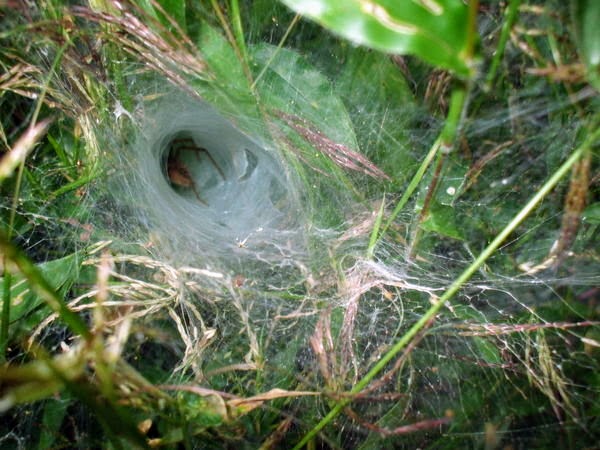
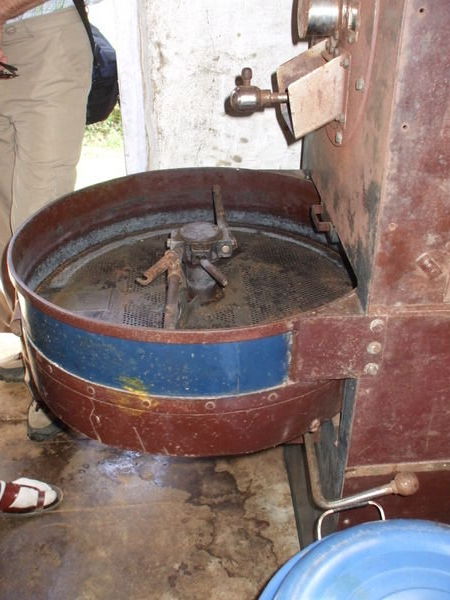
Still, he showed us the coffee production process: collect beans, dry them, rub off ‘cherry’ coating (big producers wash this off – superior, but expensive), winnow, size-grade by riddling and store till roasting. His roasting machine, powered by gas, is the sort you still see from time to time.
We were shown the tea sheds, but that, it seemed, was that, apart from seeing the tea-picking, then seeing a Hindu temple. Ludwig offered that we could see tea processing in the afternoon and I accepted straight away, and so did C and M. L offered a simple lunch.
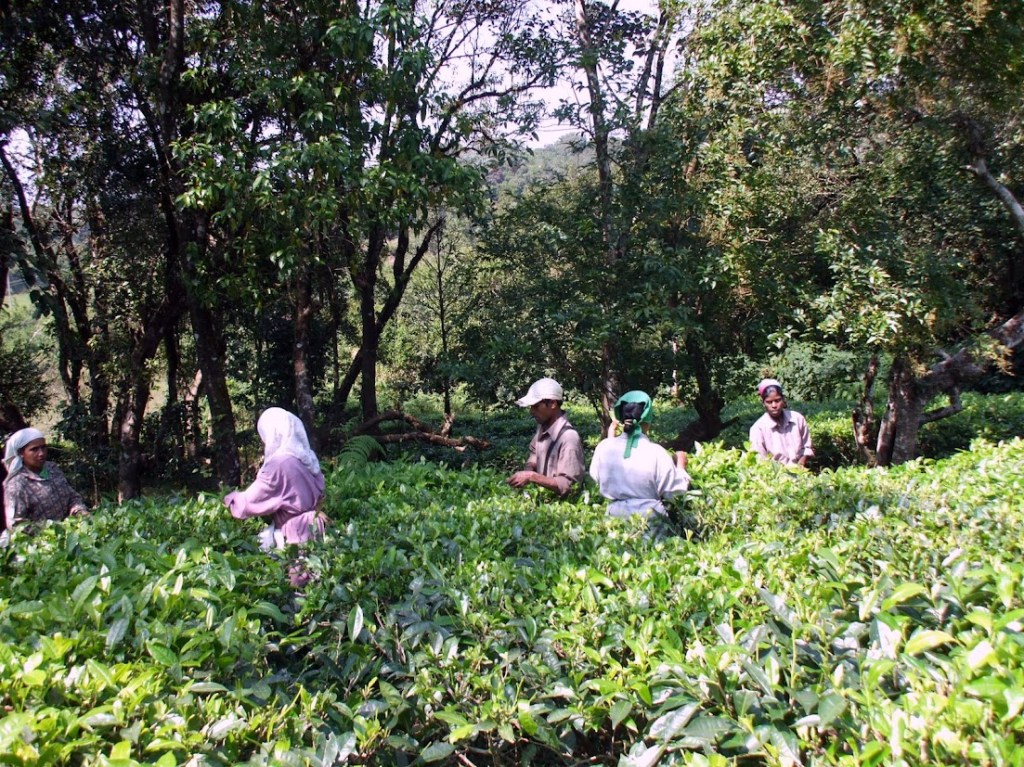
Tea production is not well-established here, so the pickers don’t have the experience of those in other areas. When we saw the workers, we were surprised to see them take more than the first couple of leaves, and it proved we were right – this batch will only be fit for lower-grade tea.
Then along another long walk to see the Sacred Grove and Temple. It’s been long neglected, but its bright colours are still evident. We had to approach, shoeless, via a long green passageway which was apparently the established home of a crew of leeches (which we found out about the hard way).


On the way back, Ci felt ill, so we stopped at a village shop for refreshments, and to phone for a taxi for her. After that, our paths divided. The others went home, and M, C and I returned to Ludwig’s. He was out, but had arranged a simple lunch which we ate at one of his guest lodges (he’s currently building another, out of mud bricks).
After that, the women began work on the tea leaves. For green tea, you steam the leaves briefly. This arrests the fermentation process. Then the leaves are pounded – this doesn’t take long – till they become shredded.

For conventional tea, the leaves are first dried – only for an hour or two, before the pounding process. This is long and hard, and involves a huge three and a half foot long pestle, and the woman at the mortar beneath constantly moving the material from the edges to the centre. Then the mixture is dried.
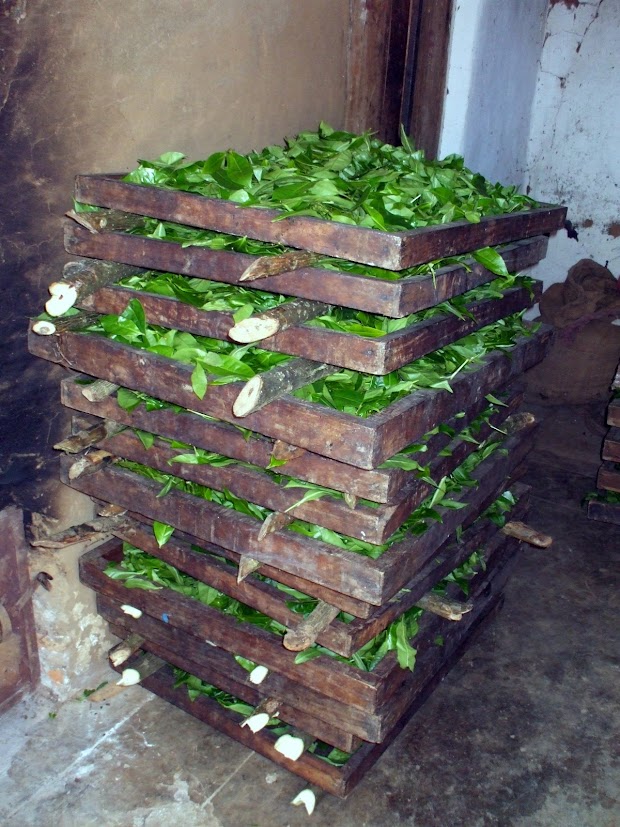
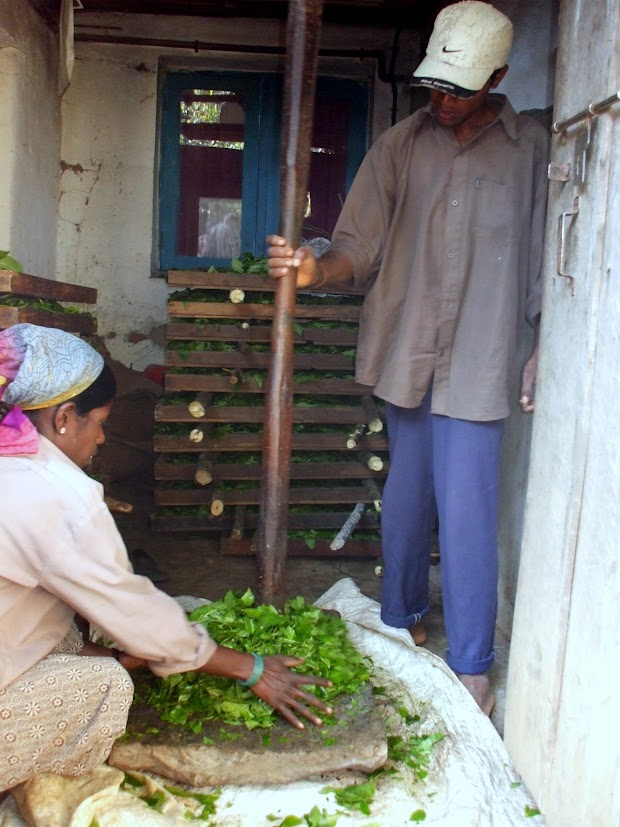
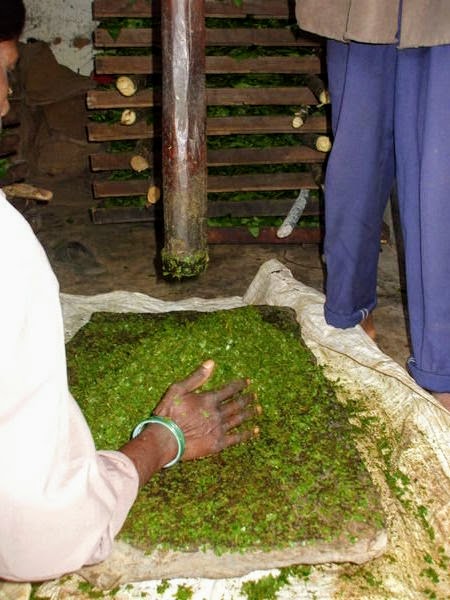
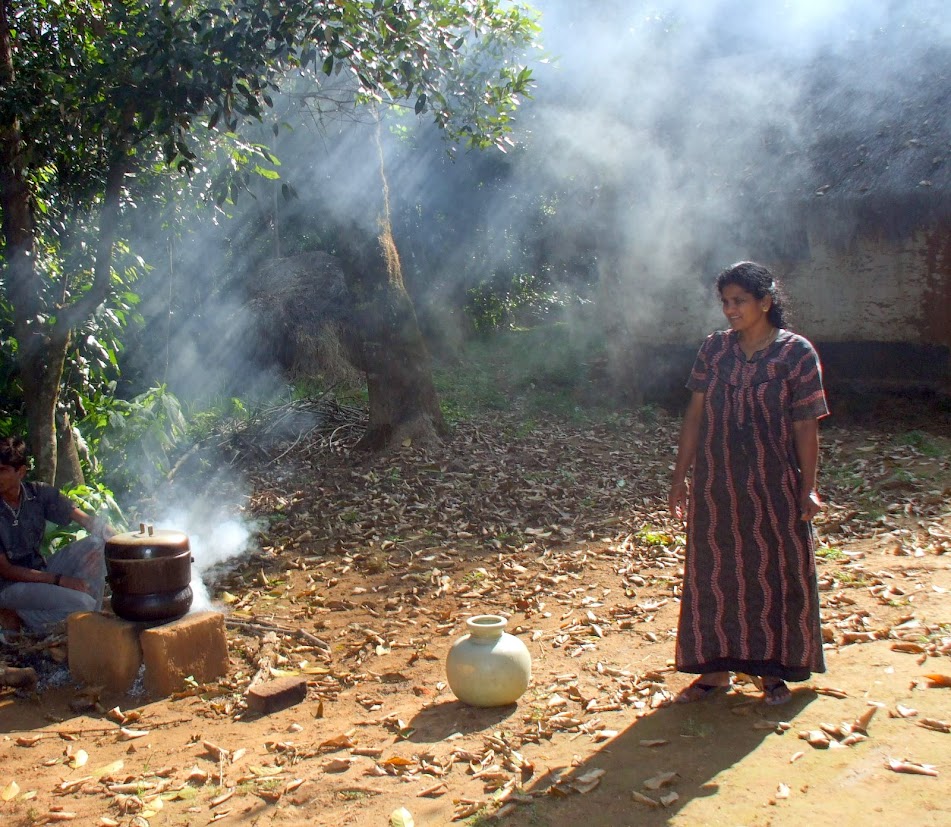
There is enough of a local market for this organic tea to make it viable for Ludwig to employ ten people all the year round. They also work in his paddy field and care for his cattle. Typically, workers in larger plantations are only employed seasonally. Ludwig doesn’t own his farm: as a non-Indian, he can’t, but he has an Indian sponsor from whom he rents it.

On our way home we saw egrets, parakeets and various birds we couldn’t identify, as well as lots of frogs. Hornbills too.
Oh yes! In the afternoon, while talking to L, we suddenly heard the cicadas in the trees. The noise grew and grew, reaching a crescendo so loud we had to raise our voices: then as suddenly died down. Extraordinary. This YouTube video gives some idea of it.

 From Pyrenees to Pennines
Who knew tea picking could be so picky.
LikeLiked by 1 person
I know! Very fiddly and time consuming.
LikeLike
I’ve never seen a coffee roaster like that, Margaret, even in museums. Once again, I’m grateful for being born where and when- leeches, back breaking work. To think I grumbled about being a Civil Servant…
LikeLiked by 2 people
😊 A coffee roaster like that is one of my early childhood memoroes – walking down a shopping street near where we lived in London was a shop with a coffee roaster. The smells it gave out probably made me into the coffee junkie I am today.
LikeLike
I don’t have any such excuse. Happy Friday xx
LikeLike
They look like slow leaf pickers. I have seen the women with baskets on their backs go along like machines.
It is an interesting process. I had guests from Taiwan whose parents owned a tea farm that was family owned for over a hundred years. They were interesting to chat to about all things tea
LikeLiked by 2 people
Oh yes, that would have been good. This lot were very measured pickers. No payment by results I guess?
LikeLiked by 1 person
Like all picker job, paid by quantity or weight
LikeLiked by 1 person
I thnk this team were on a regular wage. With so few of them, they really did work as a team nd each pulled their weight as well as they were able to.
LikeLiked by 1 person
Another fascinating glimpse into rural Indian life and indeed society. I’m so pleased you decided to share your diary with us.
LikeLiked by 1 person
Thanks for reading it Sandra. I thought it deserved an outing.
LikeLiked by 1 person
I’m about to drink my coffee having already had a breakfast cup of tea and am feeling grateful to those who made both possible. Sorry about the leeches!
LikeLiked by 1 person
There are worse things than leeches. Midges are far worse. Yes, tracing our morning drink of choice to its source was interesting.
LikeLiked by 2 people
Fascinating and informative
LikeLiked by 1 person
A differet world!
LikeLiked by 1 person
Over most of this range of hills the quality of tea is not much to speak of. Farmers that I talked to pick leaves several times a year, being more interested in quantity rather than quality.
As for the leeches, I refuse to go anywhere in these hills which requires me to take off my shoes. I guess you’ll do the same if there is a next time around.
LikeLiked by 1 person
Leeches didn’t bother me too much, and I’m no fan of tea, so wasn’t a judge of quality.
LikeLiked by 1 person
So what happened with the leeches?
LikeLiked by 1 person
They did what leeches do best – bloodsucking. But honestly, it doesn’t hurt.
LikeLike
That is a low-key adventure – (no swagger and all that) – but an adventure. Thanks for sharing, story and photos!
LikeLiked by 1 person
It was a great day – especially the cicadas.
LikeLiked by 1 person
That was interesting! I wonder why they were picking more than the 2 leaves?
LikeLiked by 1 person
I guess to get more done in less time?
LikeLike
There used to be a coffee roaster like that (although I suspect not powered by gas) in a shop in Ealing, with a vent in the window that allowed the most fantastic smells to drift out into the street!
LikeLiked by 1 person
That’s my memory too. I was only eight or so then, far too young for coffee. But I was hooked.
LikeLiked by 1 person
Oh, this was as recent as the 1980s when we first moved to Ealing!
LikeLiked by 1 person
Good to see some of the process in photos, Margaret! Thank you for the link, that noise is interesting.
LikeLiked by 1 person
…. and deafening. Thank you.
LikeLiked by 1 person
😄
LikeLike
We have cicadas here in Spain and I hear them when I sit on my terrace in the summer months. I rather like the sound. I found your description of the tea plantation very interesting. Thanks so much for sharing it with us.
LikeLiked by 1 person
I LOVED the cicadas, But goodness they were noisy! Thank you too, for reading this!
LikeLiked by 1 person
Thanks for your photos and descriptions of a tea plantation visit.
LikeLiked by 1 person
Thanks for coming along, Rebecca!
LikeLiked by 1 person
Great experiences and beautiful photos!
LikeLiked by 1 person
I was very much a newbie in those days, but the subjects were so interesting I could hardly fail.
LikeLiked by 1 person
Fascinating. I enjoyed the tour.
LikeLiked by 1 person
Thank you. So did we.
LikeLike
What a fascinating experience even the leeches add that twist on what seems a pleasant green path to a temple of God.
LikeLike
It was an excellent day and we learnt a lot.
LikeLiked by 1 person
what a fascinating tour.. Those tea workers really do have a hard life, Back breaking work. Love that old coffee roaster!
LikeLiked by 1 person
That coffee roaster was a real Memory Lane moment. The tea workers were hard working but laughing and chatting the while, so I hope they were happy enough.
LikeLiked by 1 person
let’s hope so
LikeLiked by 1 person
Very interesting 🤔
LikeLiked by 1 person
It was an excellent day – thank you.
LikeLiked by 1 person
What a day – fascinating in every aspect. With those very loud cicadas to cap it!
LikeLike
They were totally amazing. Yes, a good day.
LikeLiked by 1 person
beautifull
LikeLike